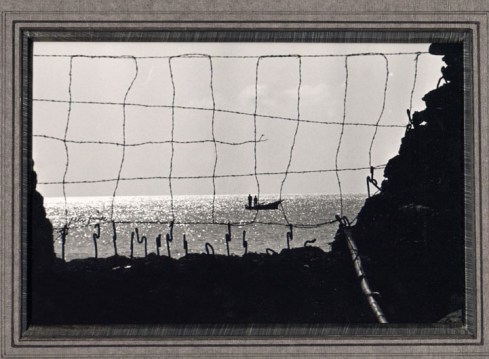
Peter Fink. Barbed Wire Fence, date unknown. Gelatin silver print. Courtesy of Monique Fink.
“Sometimes I felt a debt to the KGB. Thanks to them, I’d met some of Russia’s finest people―the persecuted and the resisting. I had had time away from my little world of the rehearsal studio to sort out what mattered in life, to form my own views about good and bad. They had given me an abundance of risk that pushing oneself to the edge of safety on a motorcycle could never provide. People might plan for a decade but not really know what they would be like in crises. I had seen myself paralyzed with fear―and also standing up to pressure that crushed fighters who were better prepared, both politically and morally.
The best of me had been a ballet boy who wanted to express himself and take curtain calls. They had made me a husband who felt responsibility to his wife. Their persecution had taught me that I was Jewish; I would always be grateful for this. They had forced me to look at mankind and its history, to sympathize with sufferers, to think about how and where I wanted to fit in if I ever got out of Russia.
Something deep in me now warned I might never dance again. Something else was grateful for the compensations.”
―Valery Panov, from Panov with George Feifer, To Dance (New York: Alfred A. Knopf, 1978, page 359).
The American photographer Peter Fink (1907-1984) started his career as a designer with the Chicago firm V’Soske. He joined the firm of Lucien Lelong, as a package designer and a decorator for their French and American salons. He later became the art director for Lanvin Parfums. During his travels to Paris with Lelong, Fink was introduced to the camera by his friend, the American interior designer Elsie De Wolfe. From that moment on, the camera was his constant companion. During his years as a designer, Fink quietly worked on photographic commissions of interior settings and portraits. His frequent travels allowed him to shoot images of street life in various parts of the world. His first one-person show was held in Portland, Oregon in 1950. Fink was in New York City by the time of the publication of his photographs, The New York I Love, in 1964. Two more books of Fink’s photography were later published: The San Francisco I Love and New York Nocturnes ― 85 After Dark Photographs. Most significantly, Peter Fink was fortunate to see his photography shown in over fifty one-person exhibitions hosted by more than sixty institutions in cities across the United States, in Jerusalem, Havana, Paris, and London. A resurgence of interest in the photographer appeared only recently since his passing in 1984. Besides the first scholarly monograph on the artist, a dissertation in 2001, two major exhibitions of his work were shown: an exhibition that traveled between three German institutions in 1999 and an exhibition that appeared in Mannheim in 2005.
Valery Panov (born Shulman, 1938) was a principal dancer for the Maly and Kirov Theaters, both in Leningrad. In 1972 Panov applied for emigration to Israel and was persecuted for the next two years. Only international pressure finally allowed Panov and his wife, ballet dancer Galina Ragozina, to leave the Soviet Union.
Tags: ballet, galina ragozina, leningrad, peter fink, soviet union, valery panov






 dpduckworth