



Always Dance!
5 Sep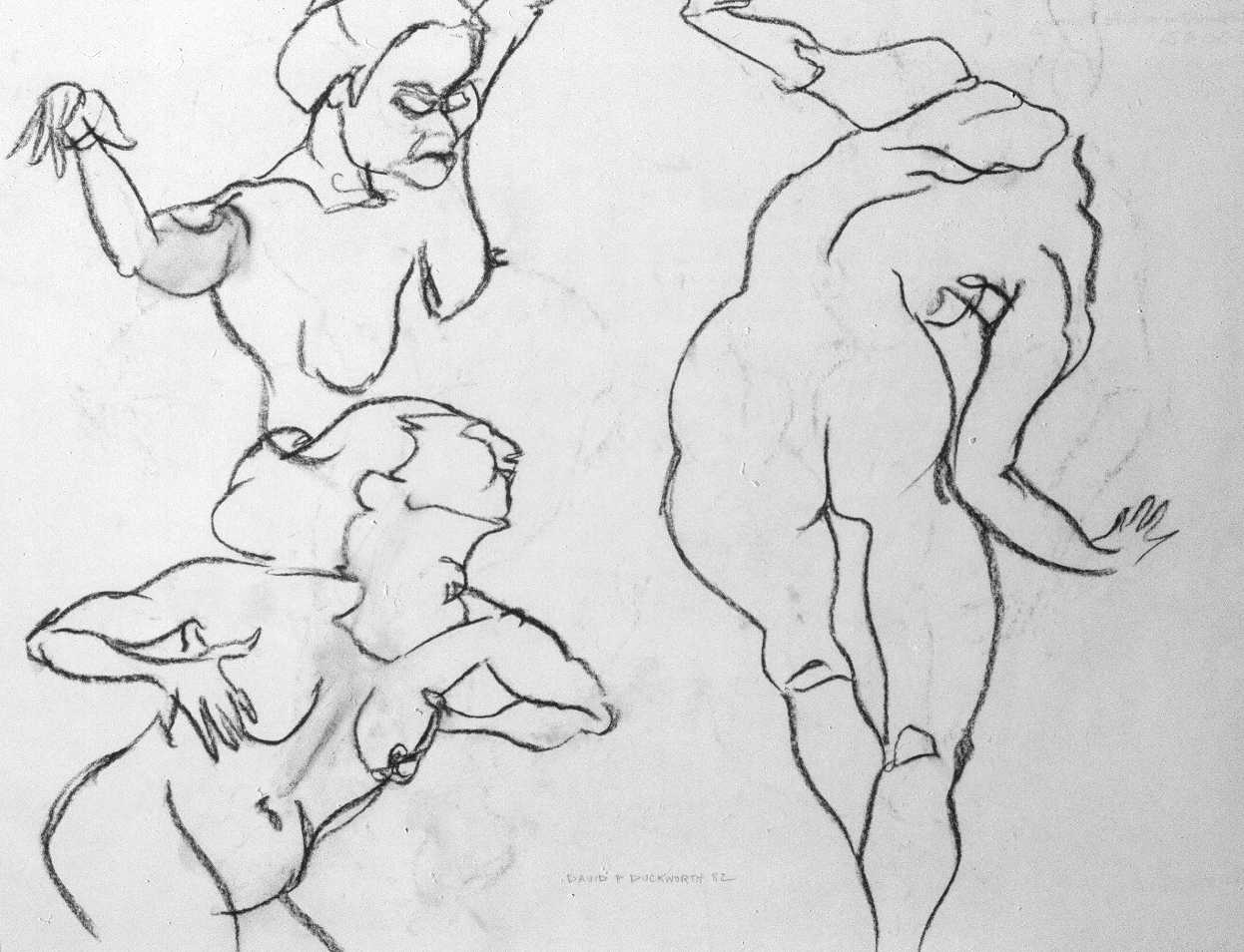 David Duckworth, Untitled, 1982. Charcoal on bond paper, 19 x 24 in.
It’s always a pleasure meeting a lifelong dancer. That is how I felt meeting Julia Montrond, dancer, painter, poet, through my work at Expressions Gallery, Berkeley, where Julia is an exhibitor. Julia will be reading a poem this coming Saturday, September 8th, at the 18th Annual Dancing Poetry Festival, where she among other prize honorees will present between noon and 4:00 p.m. (http://www.dancingpoetry.com/). The venue is the Florence Gould Theater in the California Palace of the Legion of Honor, Lincoln Park, San Francisco.
Dance is my first love. I studied ballet and modern dance at a school in Los Angeles under the direction of Sally Whalen. I quit after almost three years of training, not knowing as a young adult how I could build a career as a ballet dancer. I was in need of mentoring but only understood the isolation I felt at the time. For years afterward I quietly dwelled on the regret of an unfulfilled ending. I did not realize until much later in life that I had always danced and that this dance was not only my constant return to the joy of physical movement, but the uplifting of my soul. This is how we stay young, by forever dancing. Julia’s poem appears below.
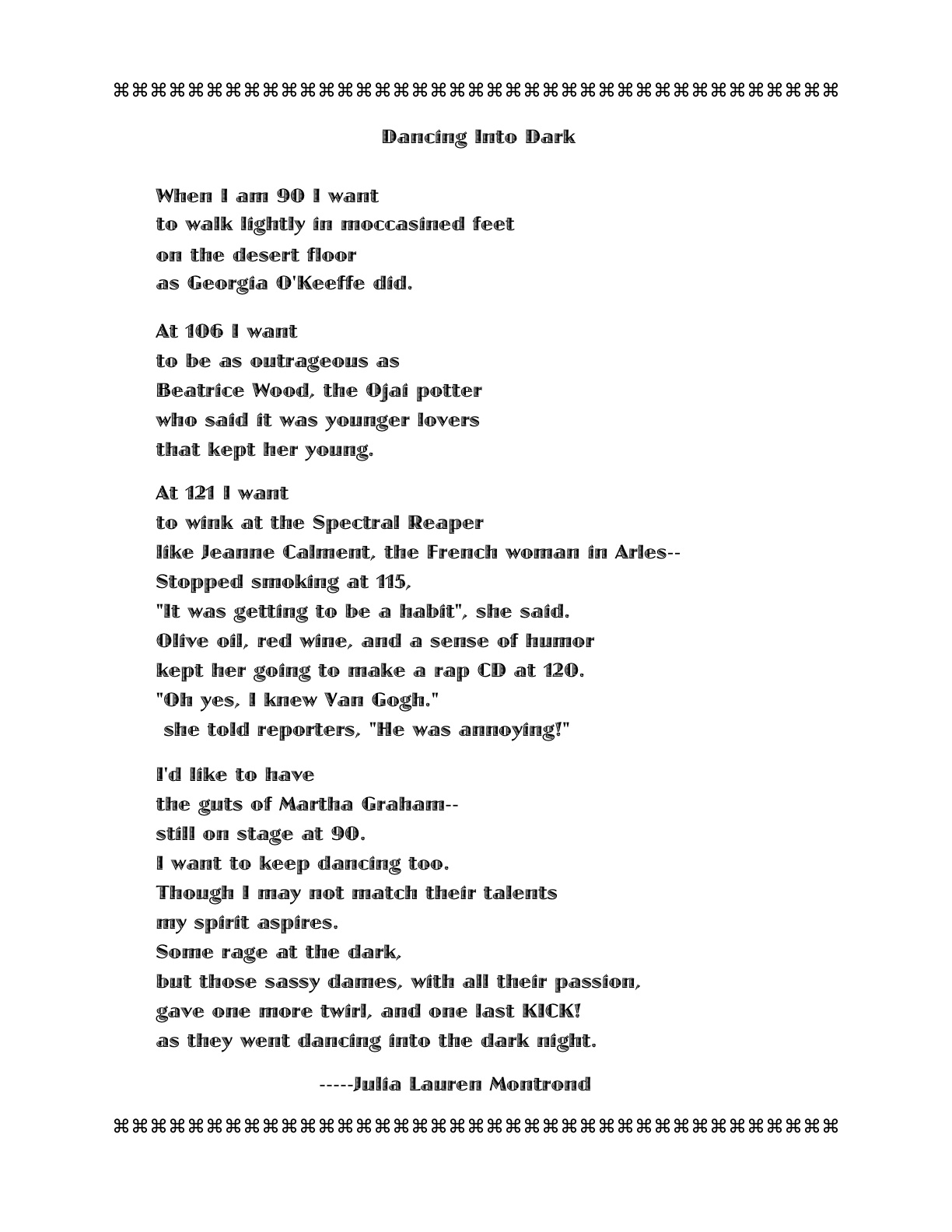
Julia Montrond’s poetry has appeared in Blue Unicorn, Poetalk, Farewell to Armaments, and her chapbook: Steaming Radiators and Red Poppies. Her poems have won prizes in the International Dancing Poetry Festival, the Ina Coolbrith Contest, and the Alameda Haiku Contest. A BAPC prizewinning poem, the judged remarked, was so sensuous it made him reach for a cigarette and a pen! A teacher for 45 years, she spent her last ten years teaching drama in Berkeley. Her poems cover a variety of themes and moods, including identity, New York childhood, journeys, and aging.
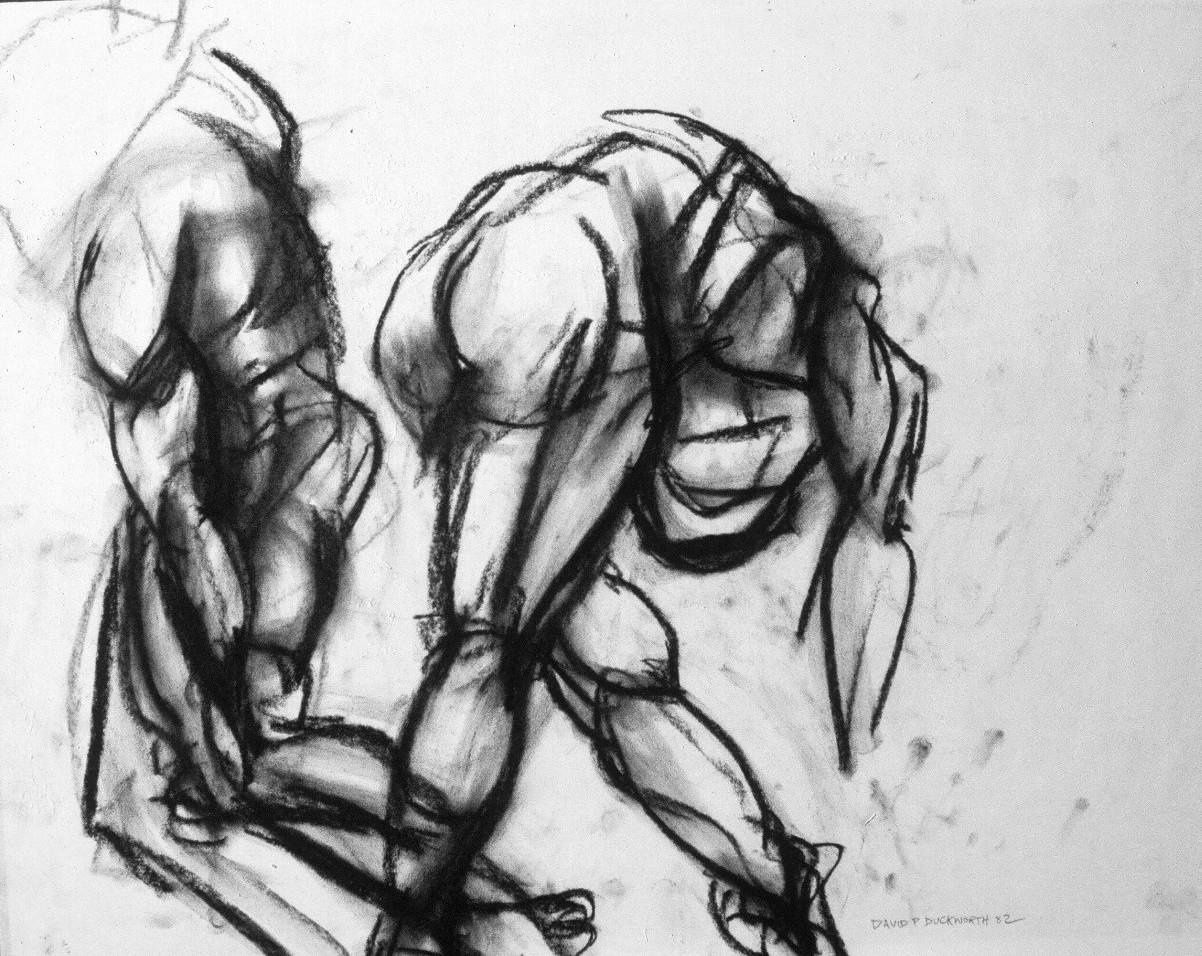 David Duckworth, Untitled, 1982. Charcoal on bond paper, 19 x 24 in.

Lars Mars
30 Aug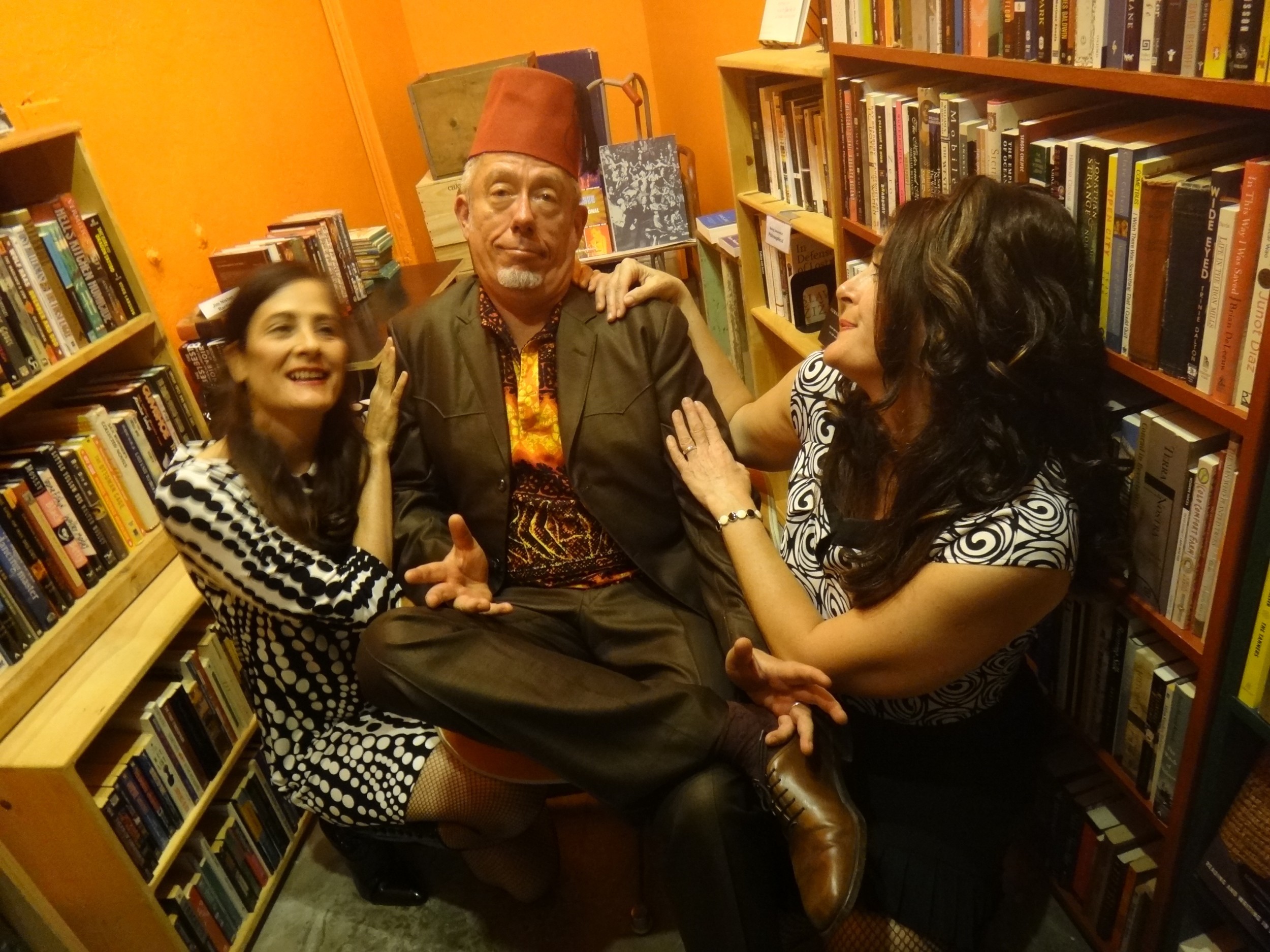 Lars Mars with the Fitzgerald Sisters. Photograph by Jean Lemanski.
Who is this comic genius of music? Classically trained in Europe, Mars has been a San Francisco fixture for many years. While his humorous style and delivery, and the wacky riffs and puns of his fellow musicians, can keep a smile on your face throughout an evening of lounge ballads, Mars reaches a level of pathos with select numbers that is quite moving. On Saturday evening, a small, rapt audience was treated to the fabulous Mars revue at The Green Arcade, which included longtime accompanist Durand Begault on the piano. The first set sent me to heaven with a group of Burt Bacharach tunes.
Four in a Room
24 Aug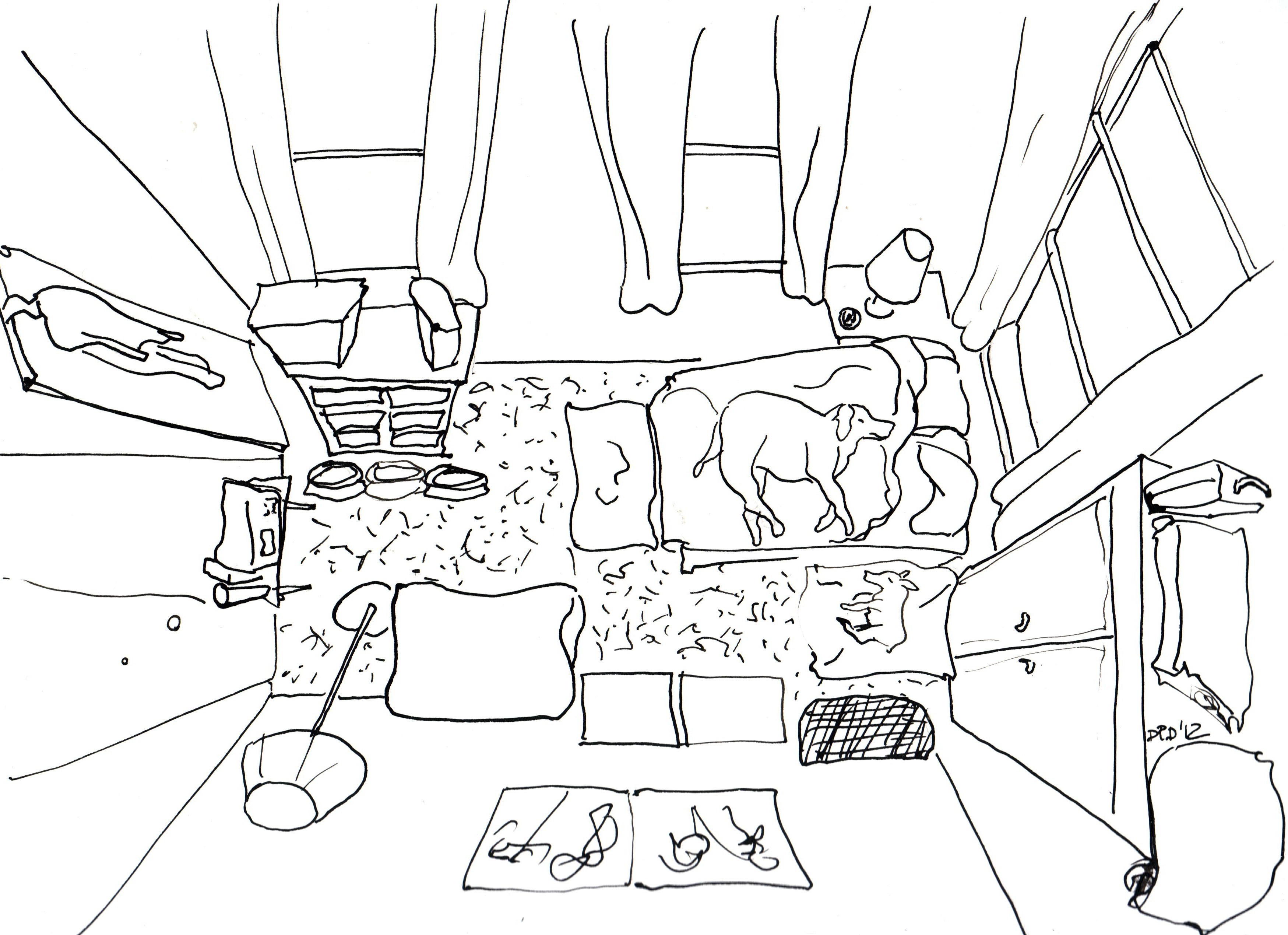
Pen-and-ink on Bristol paper, 9 x 12 in.
The dogs depressed me. That was the realization as I looked at them sleeping one morning. It was not that the amount of hair they shed created an even pattern in the hotel room carpet, or laid over everything else. Nor that some amount of hair clung to my clothing as I left for the day. The fact that the retriever, Sugar, heavy as she is, used me as a human security blanket once her owner went to work, plopping down against me like a lead weight, and frequently so throughout her slumber, since she must get up on all fours to resettle herself ― no, even that, annoying as it was, dug deeply into my psyche. Tucker, the terrier, ignored me completely, confining himself to a small, square comforter next to Mark’s bed, but still in the middle of my path to the clothes closet.
Sugar, in fact, deprived me of less sleep than my roommate Mark did as he prepared for work each day between 3:00 and 4:30 a.m. Mark and I had been neighbors in units above and below each other when we agreed to share a larger unit that became available. We had met earlier in the year when a mutual friend from Hawaii brought Mark along to an event where I was speaking. The need to reduce rent was so urgent I staved off all consideration of how a single room could adequately house two people and two dogs. Unlike the former units, this one had an attached bathroom and views of the city east, north, and west from the sixth floor.
I realized quickly saving $250 a month was not worth the cost of my health. After three weeks of inadequate sleep, I returned to my former room with my tail between my legs. It is temporarily quiet now; temporary because I never know how long I can actually continue paying by the week for this room. During the interim time away, the manager replaced the marble sink top, night stand and lamp, traded curtains for new blinds, and gave the walls fresh paint. It is a comfort to be back.
During this same period of time drama in and around the hotel escalated because management initiated a security guard system at night. Apollo, in Room 408, is one of the tenants who bucks the new system. Apollo does not like rules or restrictions. When I first met him in February, he was standing at the front door asking to be let in. His manner, probably exacerbated by drinking, changed to threatening hostility when I would not comply. Like his mother on the second floor, and a sister who occasionally visits the mother, he drinks vodka with milk. More than likely he uses drugs as well. Why he never has a key remains a mystery to me, unless it is that he leaves his key with the homeless that he brings in from the alley.
The first thing I learned about Apollo’s history was that he lost work in the construction industry months before. More recently, I was informed that he runs a check fraud operation from his room with the aid of his homeless friends. His relationship with the people he houses is not always good. One night he engaged in a protracted shouting fest with a he-she, first in the lobby, then from a window as he-she stood in the alley, then with the two of them in the hallway on his floor, and finally in the alley where the two of them screamed at each other as friends of Apollo interjected that he should get rid of him-her. But once back in the lobby alone he seemed truly defeated, in his inebriated or drug-induced way, by the inability of he and his love to get along. Gesticulating like a ham in a badly written play, he sat on the coffee table moaning the question why people just couldn’t get along. The manager, who stood looking on, finally said, Apollo, that is a question I can’t answer, and walked away.
Apollo’s den spawns events of nightmarish quality. Most recently a young woman attempted to get past the guard on her way to 408. The guard followed her up the first flight of stairs telling her she was trespassing. She did not respond. He got ahead of her and blocked her way at the top. The manager appeared, also telling her to leave. The manager then made the mistake of turning his back on the woman. She slammed her cell phone into his spine. What happened next is unclear to me, but she did bite him on the arm. A second-floor tenant aided the guard in pinning her down until the police arrived, as she screamed, thrashed, and promised to bite and knife them. The police muzzled her face and lead her away. The manager, brave soul, ended up in the hospital for treatment of a bite wound, released with a prescription for HIV medicine since the woman was a known needle user. She was delivered to a hospital for overnight observation but never arrested for assault. Word came later that she left the hospital that night. Because she was not arrested no test was made to determine if she was HIV positive or carried any other communicable disease. And as for Apollo, his minions continued to storm the castle. Later that night, they scaled the wall from the alley to access the fire escape.
I doubt that the dogs were aware of any of this. I rarely saw them exhibit much energy as we occupied the room, nor much interest in the sounds of the hotel. They were eager for the one or two daily walks to the park their owner led them on. Sugar sometimes objected to being left alone as I did hear her scratch against the door after my departure one morning. What depressed me that day had nothing to do with Sugar shitting or Tucker peeing on the carpet, which did not occur then but did happen often enough. No, it was the realization that the dogs slept all the time.




The 19th Annual LaborFest
7 Aug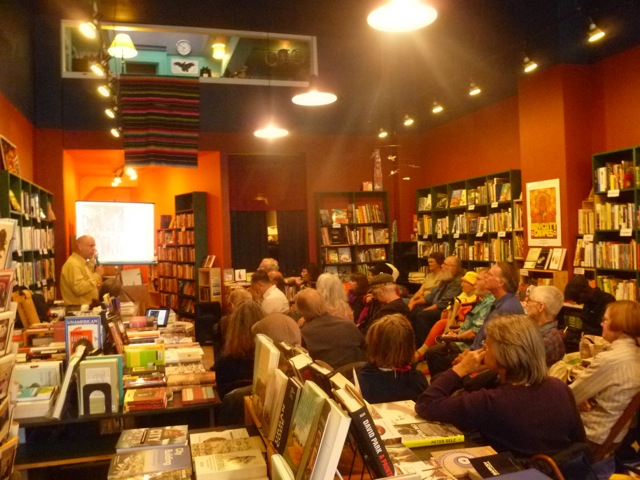
The Present Is the Past: Occupying the Commons, July 30, The Green Arcade, San Francisco. Photograph by Steve Zeltzer.
It was fun and hard work for the Organizing Committee putting together nearly eighty events for the month of July. But the process is collaborative and many of these events are actually organized by individuals not on the committee. This year’s theme was Occupy, Past Present and Future: Lessons of the Past for Labor Today. Presenting on the last day of programming, the evening before the closing party, I spoke on three events from unemployment activism and labor history that show us precedents for the ways in which the present Occupy Movement has utilized public space for political redress: the industrial armies of 1894 marching on Washington; the Ludlow, Colorado tent colony during the southern Colorado coal fields strike of 1914; and, the Bonus March on Washington in 1932. It was standing room only at Patrick Marks’s bookstore.
One of the anecdotes I opened with involved a conversation between two people from Ukiah, California, who walked past the Occupy SF encampment on Market Street in front of the Federal Reserve Bank of San Francisco, a site in use since early fall 2011. Dan was engaged in a conversation using his cell phone about company projects. Alma, his wife, and I were accompanying him to a local stationery store to purchase office supplies for the project where I am temporarily employed. We passed the camp, which is separated from the bank by a pedestrian throughway along the sidewalk and metal barricades at the bank’s portico edge . One couple struck me especially, a woman who was topless being held by a man, both swaying gently where they stood. I later thought of Paul Cadmus’s egg tempera painting What I Believe (1947-48), based on E.M. Forster’s essay of the same title; “Love and loyalty to an individual can run counter to the claims of the state. When they do ― down with the state, say I, which means that the state will down me” (see http://weimarart.blogspot.com/2010/10/paul-cadmus.html). In this painted idyllic vision of humanity, an area is taken up by individuals in peaceful assembly; the heterosexual couple to the right just beyond the grave could have been the couple Alma and I spotted that morning.
The woman’s nudity shocked Alma. Once Dan was finished with his business call, Alma asked him if he had seen what we just passed. He said no and asked who these people were Alma described. Alma replied, I don’t know, some homeless people. If the two of them had known that they passed an Occupy site, Dan would surely have derided the camp and its inhabitants. In a conversation I had with a cafe owner in my neighborhood about the incident, Brian told me that homeless people do join the camp because they will not be harassed by the city’s recently passed sit/lie law. Brian probably speaks with some accuracy because he is host to a number of homeless people at his cafe, many known by name and present on a regular basis. He is a very generous person allowing people in whom other business owners would keep out.
The anecdote prompted some people at the bookstore slide lecture to defend the Occupy Movement. While the momentum of the movement seemed to peak as municipality after municipality across the country found ingenious ways to dismantle encampments situated in public space, the tactics have shifted. Thus, today, occupation is alive and well, such as the occupation of an Oakland elementary school by volunteer teachers, parents, and students following the closure of five school sites by that city. The parents were expected to ship their children to charter schools and they are not happy with that. Nor should anyone else be when it comes to privatization. Privatization is only the encroachment of corporate business in the public sector, rewarding a few individuals with captive markets.
The peace activist A.J. Muste observed in 1962: “We are now in an age when men will have to choose deliberately to exchange the values, the concepts of ‘security,’ and much else which characterizes contemporary society, and seek another way of life. If that is so, then the peace movement has to act on that assumption, and this means that the whole picture of our condition and the radical choice must be placed before people―not a diluted gospel, a program geared to what they are ready to ‘buy now.’ ” (quoted by Nat Hentoff in Peace Agitator: The Story of A.J. Muste [New York: The Macmillan Company, 1963]). I embrace ongoing political protest and the occupation of public space. The work is not over.
 dpduckworth