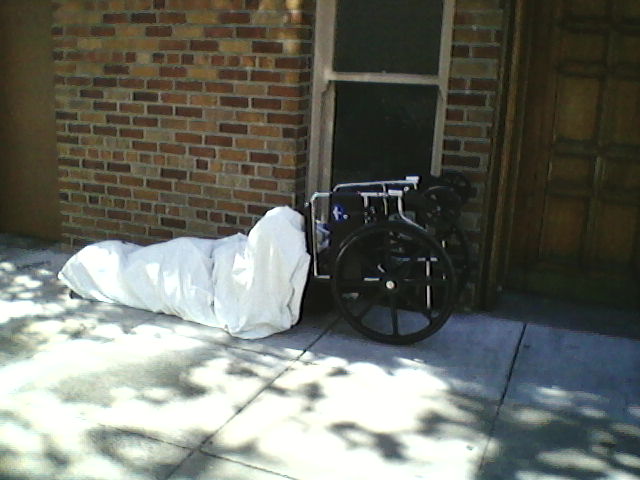
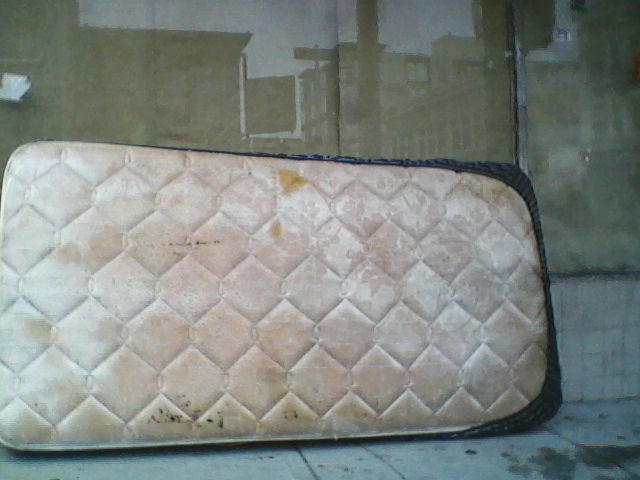
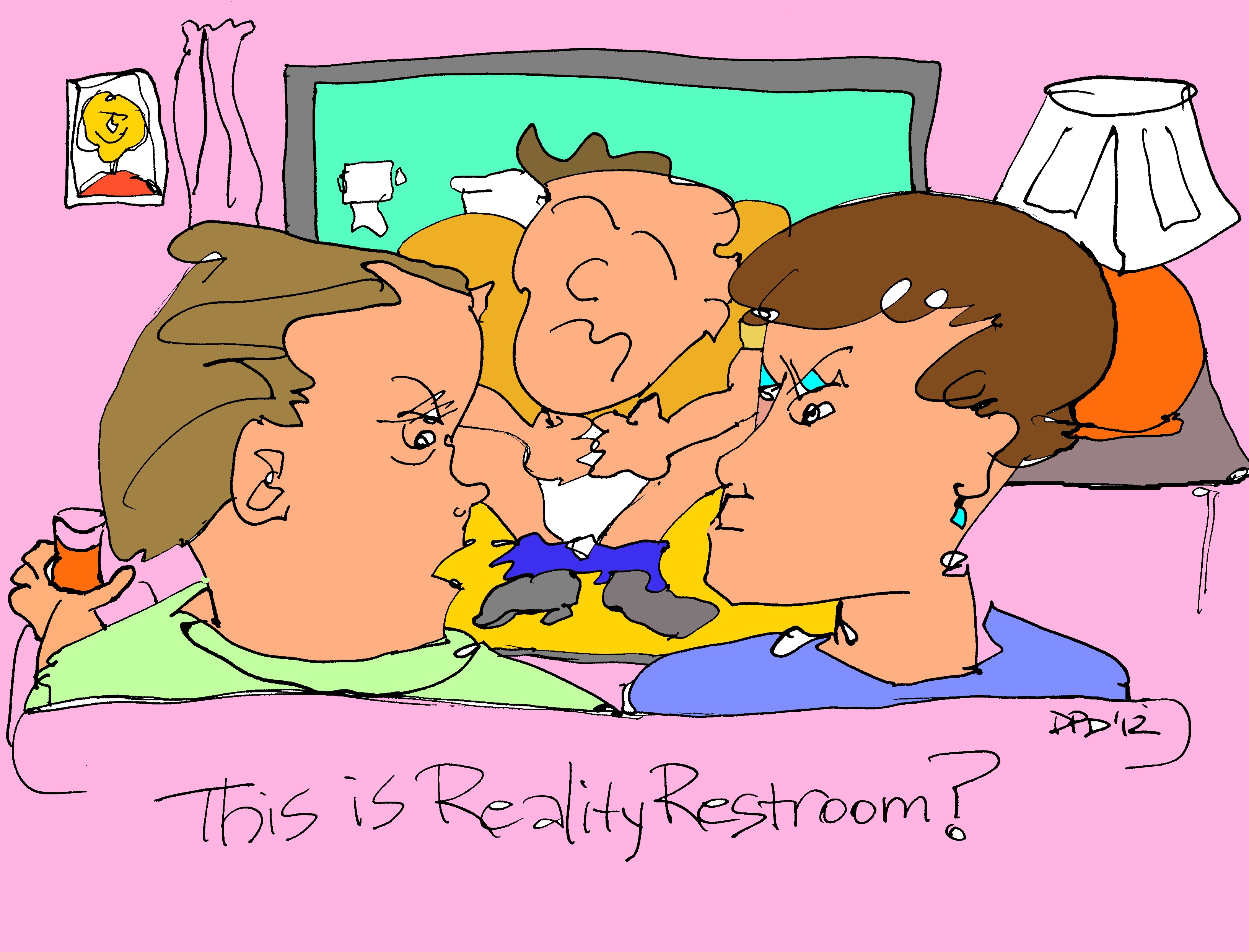
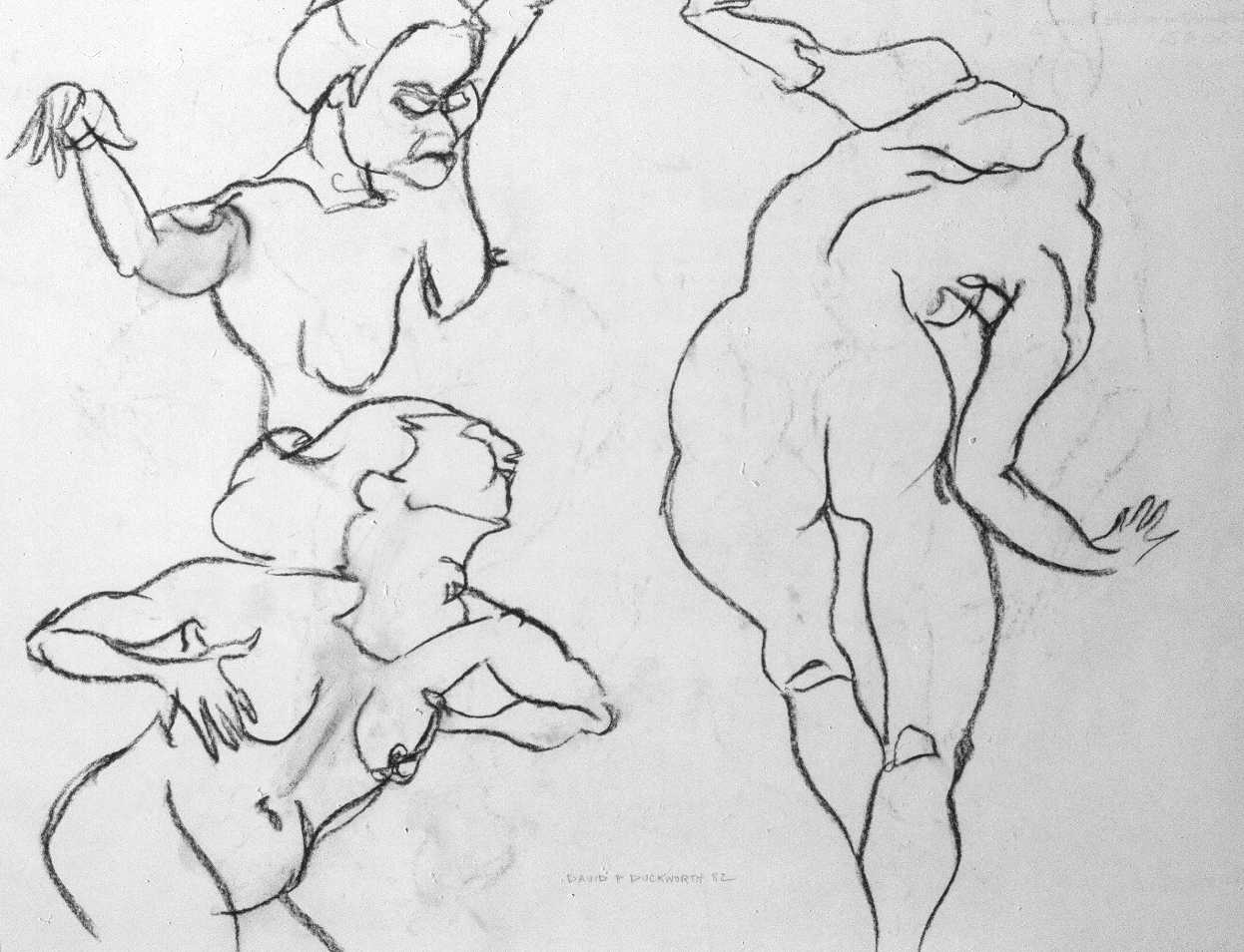
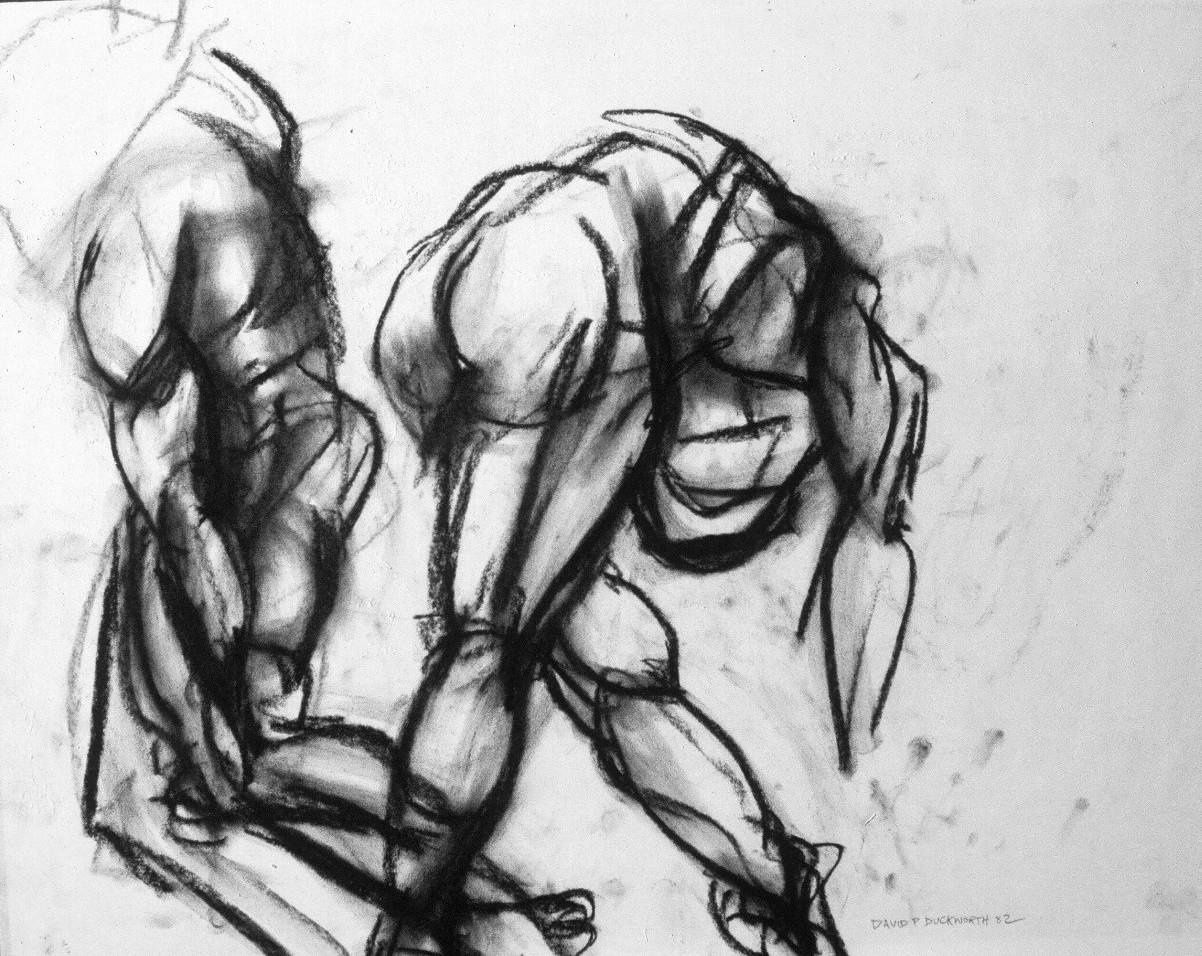
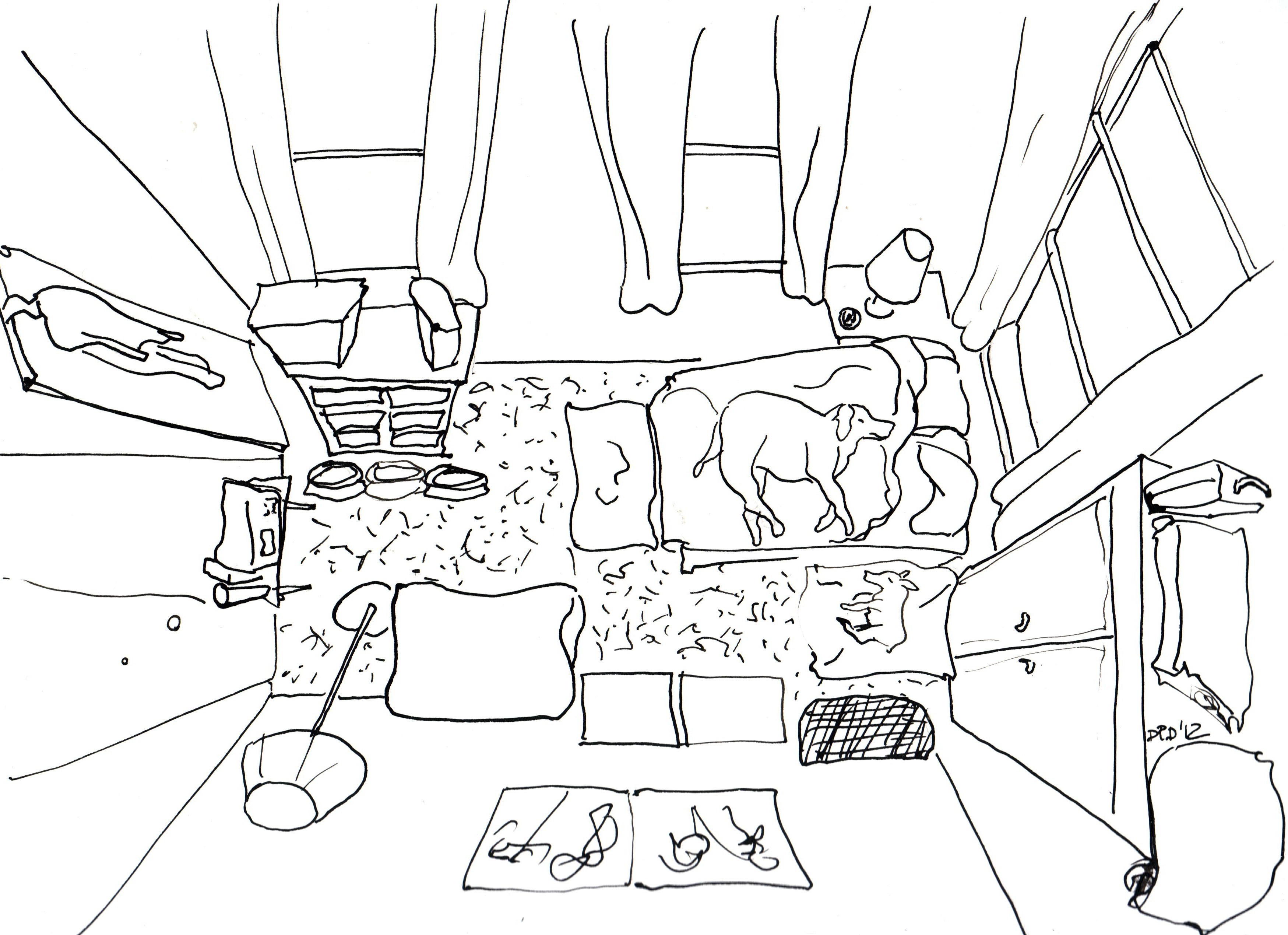
Pen-and-ink on Bristol paper, 9 x 12 in.
The dogs depressed me. That was the realization as I looked at them sleeping one morning. It was not that the amount of hair they shed created an even pattern in the hotel room carpet, or laid over everything else. Nor that some amount of hair clung to my clothing as I left for the day. The fact that the retriever, Sugar, heavy as she is, used me as a human security blanket once her owner went to work, plopping down against me like a lead weight, and frequently so throughout her slumber, since she must get up on all fours to resettle herself ― no, even that, annoying as it was, dug deeply into my psyche. Tucker, the terrier, ignored me completely, confining himself to a small, square comforter next to Mark’s bed, but still in the middle of my path to the clothes closet.
Sugar, in fact, deprived me of less sleep than my roommate Mark did as he prepared for work each day between 3:00 and 4:30 a.m. Mark and I had been neighbors in units above and below each other when we agreed to share a larger unit that became available. We had met earlier in the year when a mutual friend from Hawaii brought Mark along to an event where I was speaking. The need to reduce rent was so urgent I staved off all consideration of how a single room could adequately house two people and two dogs. Unlike the former units, this one had an attached bathroom and views of the city east, north, and west from the sixth floor.
I realized quickly saving $250 a month was not worth the cost of my health. After three weeks of inadequate sleep, I returned to my former room with my tail between my legs. It is temporarily quiet now; temporary because I never know how long I can actually continue paying by the week for this room. During the interim time away, the manager replaced the marble sink top, night stand and lamp, traded curtains for new blinds, and gave the walls fresh paint. It is a comfort to be back.
During this same period of time drama in and around the hotel escalated because management initiated a security guard system at night. Apollo, in Room 408, is one of the tenants who bucks the new system. Apollo does not like rules or restrictions. When I first met him in February, he was standing at the front door asking to be let in. His manner, probably exacerbated by drinking, changed to threatening hostility when I would not comply. Like his mother on the second floor, and a sister who occasionally visits the mother, he drinks vodka with milk. More than likely he uses drugs as well. Why he never has a key remains a mystery to me, unless it is that he leaves his key with the homeless that he brings in from the alley.
The first thing I learned about Apollo’s history was that he lost work in the construction industry months before. More recently, I was informed that he runs a check fraud operation from his room with the aid of his homeless friends. His relationship with the people he houses is not always good. One night he engaged in a protracted shouting fest with a he-she, first in the lobby, then from a window as he-she stood in the alley, then with the two of them in the hallway on his floor, and finally in the alley where the two of them screamed at each other as friends of Apollo interjected that he should get rid of him-her. But once back in the lobby alone he seemed truly defeated, in his inebriated or drug-induced way, by the inability of he and his love to get along. Gesticulating like a ham in a badly written play, he sat on the coffee table moaning the question why people just couldn’t get along. The manager, who stood looking on, finally said, Apollo, that is a question I can’t answer, and walked away.
Apollo’s den spawns events of nightmarish quality. Most recently a young woman attempted to get past the guard on her way to 408. The guard followed her up the first flight of stairs telling her she was trespassing. She did not respond. He got ahead of her and blocked her way at the top. The manager appeared, also telling her to leave. The manager then made the mistake of turning his back on the woman. She slammed her cell phone into his spine. What happened next is unclear to me, but she did bite him on the arm. A second-floor tenant aided the guard in pinning her down until the police arrived, as she screamed, thrashed, and promised to bite and knife them. The police muzzled her face and lead her away. The manager, brave soul, ended up in the hospital for treatment of a bite wound, released with a prescription for HIV medicine since the woman was a known needle user. She was delivered to a hospital for overnight observation but never arrested for assault. Word came later that she left the hospital that night. Because she was not arrested no test was made to determine if she was HIV positive or carried any other communicable disease. And as for Apollo, his minions continued to storm the castle. Later that night, they scaled the wall from the alley to access the fire escape.
I doubt that the dogs were aware of any of this. I rarely saw them exhibit much energy as we occupied the room, nor much interest in the sounds of the hotel. They were eager for the one or two daily walks to the park their owner led them on. Sugar sometimes objected to being left alone as I did hear her scratch against the door after my departure one morning. What depressed me that day had nothing to do with Sugar shitting or Tucker peeing on the carpet, which did not occur then but did happen often enough. No, it was the realization that the dogs slept all the time.
Tags: david duckworth, san francisco