Planet Home: Part II

12 Nov

“…a staid old house, where hoops and powder and patches, embroidered coats rolled stockings ruffles and swords, had had their court days many a time.  Some ancient trees before the house were still cut into fashions as formal and unnatural as the hoops and wigs and stiff skirts; but their own allotted places in the great procession of the dead were not far off, and they would soon drop into them and go the silent way of the rest.” — Charles Dickens, Great Expectations

“The negro [sic] has an artistic charm that the white man has not.  The negro has inherited the charm of music, the love of nature and the simplicity of life.” — “A Talk Given by Mr. Louis P. Wilson in the Salon of the Art Center Association,” typescript, 2 pp. Scrapbook 293: Exhibit of work of negro artists (first of two scrapbooks), The Records of the Harmon Foundation (Box No. 121, Manuscript Division, Library of Congress, Washington, D.C.)

I have come to detest lawns.  My step-father decided that a rock garden with shrubbery was preferable to a lawn as he designed the front landscape for our home in Southern California.  Still, the back yard featured a lawn with lovely jacaranda trees and a border of mint.  Very few neighbors on the block understood that an arid climate would not naturally support the production of lawns, and so, also cultivated rock gardening with heat and drought tolerant plants.  With an unlimited supply of water diverted from and piped in from sources hundreds of miles away, what resident would think about their use of an absolutely precious commodity?  Los Angeles and the history of its misuse of water is widely known.  Still to this day, over a century since it exhausted its own water tables, the city and county consumes water from afar.  The battle for the survival of Mono Lake (http://www.itvs.org/films/battle-for-mono-lake and http://www.monolake.org/about/film) is epic in proportions, a water source that, quoting the second website cited here, underwent dramatic change: “From 1941 until 1990, the Los Angeles Department of Water and Power (DWP) diverted excessive amounts of water from Mono Basin streams. Mono Lake dropped 45 vertical feet, lost half its volume, and doubled in salinity.”  Activists were able to stop the death of this lake.

The problem of natural resources is not confined to the illogic of pumping water to a naturally waterless terrain.  Communities across the planet are now fighting against the incursion of global corporations that have usurped local rights to water, begging the question, “Is water a human right or a commodity to be bought and sold in a global marketplace?” (http://www.thirstthemovie.org/).  Waterways have been besieged for decades by pollution at our hands.  When I was a child growing up, the use of natural gas seemed absolutely benign.  It is only now, in very recent time, that I understand that the extraction of natural gas through “fracking” pollutes water tables and waterways (http://www.gaslandthemovie.com/whats-fracking).

My interest here in the extraction of resources, though, cannot be separated from man’s desire to transform environments into aesthetic and fashionable enclosures for the pursuit of comfort and pleasure.  Man has separated himself from nature during a very long history.  The separation between civilization and wilderness, between communal ecosystems and forest and other natural ecosystems is age old and universal.  Man’s fear and abhorrence of nature runs deep.

Within the United States, the encroachment of industrialization produced an irrational formulation of a pre-industrial man representing a oneness with nature.  By the 1920s, finding a symbol for this mythic being was directed at African Americans.  Observing the effects of the industrial age, Daniel Gregory Mason, in his book The Dilemma of American Music, wrote: “Perhaps the  most insidious one is the jaded emotional state…The fatigue-poisoned mind and body, too dull to enjoy quiet beauty and true thought, crave the crude excitements so abused among us; restless speeding in motor cars from nowhere to nowhere;…violent plastic arts using harsh angles and garish colors; noisy, mechanical, over-accented music.  The ‘jazz age’…is a joyless age, incapable of the happy serenity of creative leisure.” (William Heard Kilpatrick quoting Mason in Our Educational Task As Illustrated in the Changing South [Chapel Hill, NC: University of North Carolina Press, 1930], pages 61-2).  Thus, the Negro, to use the term applied extensively at the time, long before popular usage of Afro-American or African American, was singled out for being an emotion-centered being, childlike, “primitive,” and, so, as close to nature as man could be.  The evidence of this belief could be found in the extensive writings of the period praising the qualities of Negro spirituals.  Never mind that popular music such as ragtime and jazz were also cultural products of African American creativity.  Music critics and musicologists before 1930, such as European American song collector William Francis Allen or European pianist and folklorist Albert Friedenthal, predominantly found in this output of musical creation another type of the “primitive,” an expressed belief by some in a “savagery” that could be linked back to Africa.  African American writer Benjamin Brawley perceived even in the spiritual something akin to the primitive.  Critiquing London-born Samuel Coleridge-Taylor, Brawley found his music based on Negro folk-songs to be “characteristic of the melancholy beauty, the barbaric color, and the passion of the true Negro music” (Brawley, The Negro in Literature and Art in the United States [New York: AMS Press Inc., 1971; reprint of 1930 edition published by Duffield & Company, New York], pages 164-5).

The modern Western mind has been searching for the primitive font of wisdom for several centuries.  Frances S. Connelly’s book, The Sleep of Reason: Primitivism in Modern European Art and Aesthetics, 1725-1907, is a good source for reading about eighteenth and nineteenth century attempts to derive inspiration from “primitive” cultural sources.  The cultures of Archaic Greece, Gothic Europe, even European folk cultures, served towards this end.  By the advent of Cubism early in the twentieth century, the artifacts of non-Western cultures were already being aggressively plumbed for aesthetic borrowing. Two occasions in New York during 1985 redirected my thinking about the use of cultural artifacts.  With the occasion of Te Maori: Maori Art from New Zealand Collections, an exhibition organized by The American Federation of Arts, the process of interpretation was no longer a Western enterprise.  Maori writers and spokesmen shaped both the exhibition and catalogue.  I saw this incredibly beautiful show at The Metropolitan Museum of Art.  Through the catalogue, I learned of a Maori oral tradition, which accomplished the feat of recording Maori history for posterity over centuries.  By contrast, the Museum of Modern Art (MoMA) offered “Primitivism” in 20th Century Art: The Affinity of the Tribal and the Modern, with a team of cultural analysts seemingly replaying the tropes of Western cultural appropriation and manufacture.  Although both exhibitions were breathtaking, MoMA’s show stirred considerable controversy, with criticism, such as Thomas McEvilley’s now classic essay, “Doctor, Lawyer, Indian Chief: ‘Primitivism’ in Twentieth-Century Art at the Museum of Modern Art,” questioning the very basis of placing Western and non-Western cultural objects within a comparative analytic framework.  The entire enterprise of colonialism in a post-colonial world had become suspect, and the narrative of great Western artists deriving inspiration from the forms of colonial subject manufacture had become hollow.  As much as I love African art, I knew then that, taken out of cultural context, objects considered art by Western standards did not speak for the culture from which these objects sprang.  The standard art history textbooks at the time relegated African art to a minor chapter.  These objects were described as fetish objects without any clues to the nature of the spirits they supposedly represented nor the character of the ancestors they supposedly worshipped.  The only obvious factor involved was that Westerners were fetishizing objects from outside their realm of experience.

This is why I greeted the film Oka! with mild concern.  That I wanted to see it was certain.  I just did not want my enthusiasm to be distracted by the burdens of representation.  The film was recently playing here in San Francisco for a very short time.  Based on ethnomusicologist Louis Sarno’s more than twenty-five years among the BaAka, or Bayaka, (“Pygmy”) in Yandoumbe, Central African Republic, the story tells of one Larry Whitman, played by Kris Marshall, who travels to Africa to record the music of this community.  The BaAka play the characters of this story, characters who represent people in Sarno’s life from an earlier generation.  Directed by Lavinia Currier, and co-written by Currier and Sarno, the film is filled with rich acoustic and visual textures.  The performance by a group of non-actors is excellent.  I am reminded of earlier attempts to film stories within traditional cultures using non-actors.  Director F.W. Murnau’s Tabu, a Story of the South Seas (1931) advertised the fact that only native-born South Sea islanders, “half-castes,” and Chinese played the roles portrayed in the film.  Michael Powell directed The Edge of the World (1937) at Foula on the Shetland Islands off the coast of Scotland, focusing on two families that are torn between preserving their native island culture and younger members leaving for a modern world.  Powell did use professional actors but drew the acting corps from true islanders.  Salt of the Earth (1954), directed by blacklist victim Herbert J. Biberman, involved actual Mexican American miners and their families in telling the story of the 1951 strike against Empire Zinc Company in Grant County, New Mexico.  Director Gillo Pontecorvo strove for realism in The Battle of Algiers (1966) by employing Algerian non-actors.  Rolf de Heer’s production of Ten Canoes (2006) involved an Arnhem Land, Australia community casting themselves as actors based on a 1936 photograph taken by anthropologist Donald Thomson and shown to director De Heer by actor David Gulpilil.  The BaAka are master storytellers, as Sarno relates in his memoir, Song from the Forest: My Life Among the Ba-Benjellé Pygmies (Houghton Mifflin Company, Boston, 1993).  The acting demanded of them for the film ushered in a new dimension of story telling and required a different understanding than their familiarity with the documentary film process (refer to http://okamovie.com/).

My only experience with Pygmy music was through Deep Forest, Michel Sanchez and Eric Mouquet’s 1993 debut album.  The musicians combined New Age electronics with UNESCO field recordings of music from Zaire, the Solomon Islands, Burundi, Tibesti and the Sahel.  The vocal recordings of the Pygmy on the album are enchanting.  In the film Oka!, the title taken from the Benjellé meaning “listen,” the music of the people and the sounds of the forest merge and separate in subtle ways, an orchestration that makes this film an aural pleasure.  Steeped in the love of music, having once had the boyhood ambition of later becoming a composer, Sarno was reawakened by a song heard on a Flemish radio station.  Leaving from Paris with a one-way ticket and what remained of his savings, Sarno traveled to Bangui in Central African Repulblic.

The journey that Sarno (and Whitman) take is problematic for its exploration of an exotic people.  Sarno’s first impression at the camp where the BaAka live, is that “the Pygmies of Amopolo had strayed far from their roots and had degenerated into a decultured people” (Sarno, 46).  But, like the narratives within Tabu and The Edge of the World, there are forces from the outside world greater than a people can merely deflect.  Amopolo is a government-directed community, the BaAka considered uncivilized by their Bantu neighbors.  They have been forced to leave their ancestral home in the forest in order to live a civilized life, which also does not permit them to hunt.  Amopolo is near the Sangha-sangha village Bomandjombo, where the BaAka depend on a steady supply of manioc, cigarettes, marijuana, and mbaku, a locally produced moonshine.  In exchange, the Sangha-sangha depend upon the BaAka for meat (illegally hunted) and raffia.  Sarno’s relationship to his hosts is problematic for the fact that from the beginning he provides money and other goods in exchange for the privilege of living with and recording the music of the BaAka.  As Sarno himself muses, “Yet what, I now wondered, could I have brought such a culture but corruption, jealousy, and rivalry, with my cigarettes and gifts?  What could I have been to them but a kind of Pandora’s box, unleashing hungers that could never be satiated?” (Sarno, 291).

Sarno’s place within his adopted community gradually changes, so much so that he enables the BaAka to return to the forest.  In the film, shaman Sataka and wife Ekadi, played by Mapumba and Essanje, respectively, live continuously in the forest, refusing to partake in the Bantu’s terms of civilization.  They function as a mythic ancestral couple.  Unlike Adam and Eve of the garden who did not know their god, they know the forest and the spirits within.  It is their wisdom that draws the BaAka away from conditions that are unhealthy.  In Sarno’s narrative, the forest-cleared, sandy encampments that the BaAka live in are rife with mosquitoes and chigoes, sand fleas that burrow into human flesh.  Malaria kills a number of people.  Excessive mbaku consumption and other forms of aberrant behavior are rampant.

Another thread within both Sarno’s narrative and the film’s focuses on the destruction of the forest by non-African logging interests.  When Sarno first arrived in Bomandjombo, the logging company was run by Yugoslavians.  Their business eventually failed.  An attempt to revive the sawmill failed in 1989.  In the film, the Chinese businessman Mr. Yi, played by Will Yun Lee, who manages the mill, has a keen interest in hunting animals, and hopes, through a corrupt Bantu mayor, to implicate the BaAka in an elephant hunt, forcing them permanently off the reserve for the crime of poaching and, thus, opening the land to unlimited logging.

I recently attended a SF Debate event hosted by the Commonwealth Club.  The resolution posed to the group was: “This House supports the Occupy Wall Street Movement.”  Opening pro and con arguments were formally presented by two members.  Thereafter, discussion was opened to attendees.  One of the criticisms of the Occupy Wall Street Movement was that the movement’s concern over income inequality was misguided.  A young person, by my consideration, of little practical experience or knowledge of history, offered his insight to correct this.  Outside of the homeless, a “miniscule” portion of people in our society (those apparently dispossessed of possessions), people in poverty still had many consumer goods, including flat screen TVs.  Obviously this was a sign that our economy was healthy.  Of course, as a person who is temporarily housed, but still homeless, I challenged the ability of anyone present to accurately assert the number of people homeless.  But I also challenged the notion that wealth could be measured in terms of the production of consumer goods.  Where is our moral compass when a health prognoses upon our society is based on common access to  a select group of goods within a steady stream of consumption?  The poor in this context are so much like the BaAka under the civilizing terms of Bantu supervision.

I often think in mythic terms when questioning the viability of an earth mastered and run by a human population with an unlimited appetite for its resources.  In San Francisco, I see signs of engagement with the earth that envisions a symbiosis not based on exploitation for the material consumption of plastic goods and electronic gadgets.  During many Sundays in 2010, I participated in communal activities at Hayes Valley Farm, a volunteer-run farm on land temporarily leased by the city (http://www.hayesvalleyfarm.com/).  The push there is to regenerate soil through practices that do not take healthy soil from other areas of the state; the products of the farm are simply handed out.  There is a green movement afoot that I want to see succeed, that will take us, in Joni Mitchell’s words, “back to the garden.”  A garden conceived in our own moral health and the health of the natural world surrounding us.

Untitled, digital photograph, Felton, California, 2006.
Silent Stone

6 Nov

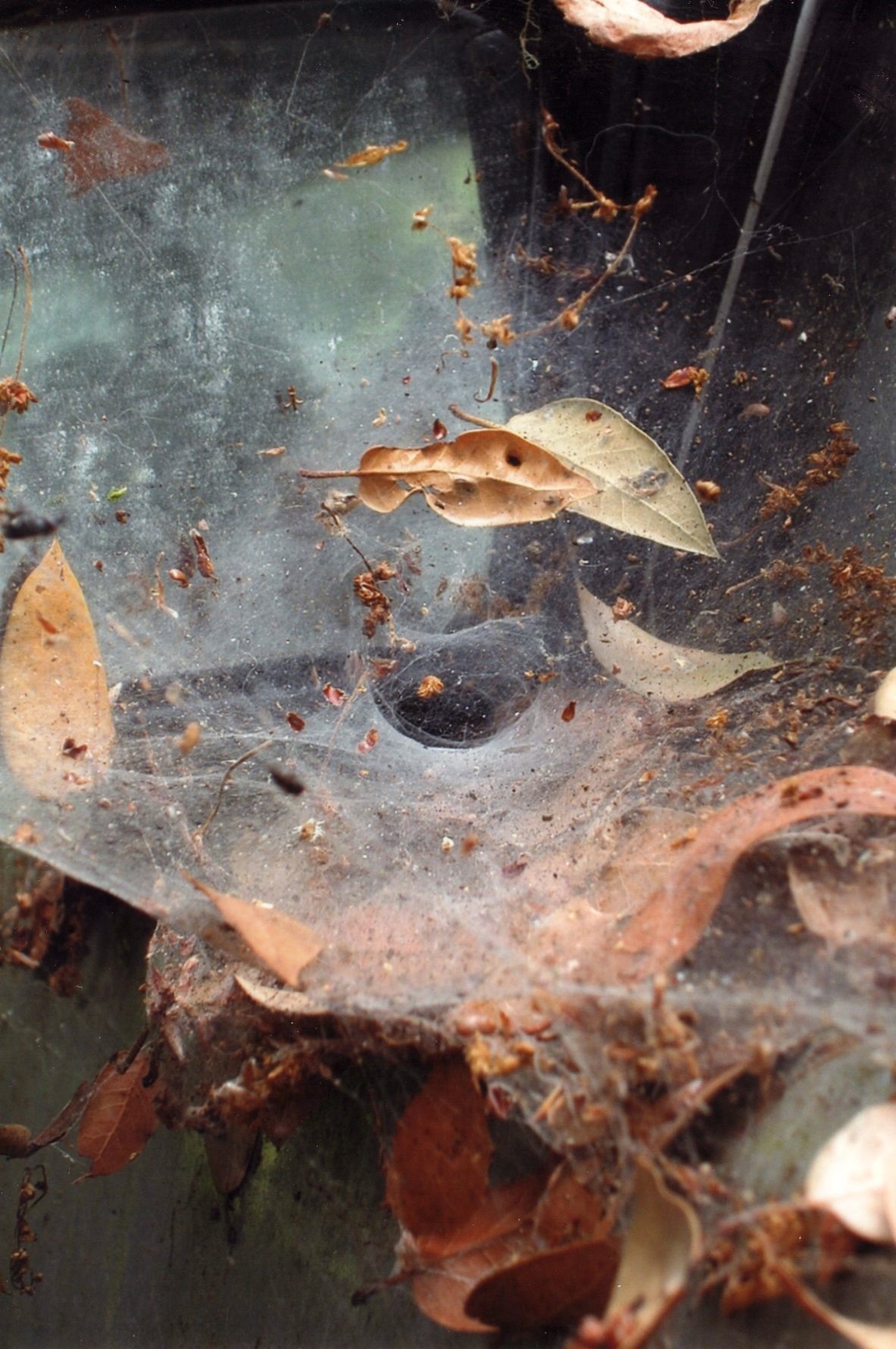
Memory piques my nostrils with pine scent and tars my fingertips with resinous stickiness.  The focal silence of stones recaptures and expands myths of self, long ago hunts along sandy bottoms.  A river fed from pine-belt mountain lakes scuttling the motherly hips of arid foothills.  Breaking upon a denuded plain of sand, rail rubble and asphalt.  Making its course to the sea.  But this is dense memory, pungent and warm.  Rarely plumbed; as precious as your occasional visits once were.  This was language heard in the long pause of night.  The whisper of water over stone.

Quarry machinery dominates our eastern view of the sky.  Asphalt roads circumscribe the breadth of the riverbed.  Everything the hand builds diminishes the valley’s native force, even the gifted direction by which my father speeds us through the clearing of rock and pebble from bulldozed land.  Our gardens of permanence are swiftly transforming, yet foreign to its temper.  The river only bears life upon the grace of distant winter snows.  Saturating the ground deeply enough to sustain chaparral and grizzled dwarf oak.  Retreating to the belly of evening sound under cricket and wind.  To this voice I cradle nightly.

We danced in the arms of a river wild spilling around granite barriers in the luxury of fat, black inner tubes, a river since tiered in concrete levees.  So enervated, we watch for bloodsuckers in its stagnant pools as it shrinks from its banks through the enduringly dry summer.  Boulders release the flaking filagree of dehydrated moss.  Bamboo shoot bunches near the heat prickly sand.  A gray and black speckled retriever trots.  Skin shimmies along protruding ribs.  Heat lifts shingle roofs above sheets of vaporized haze.  On moonless nights their porch lamps hover above the border of the riverbed’s solid black mass.

The river disappears to the south below Huntington Drive.  The road connected orange groves, dates, palms and town in a string of oases, which glittered in the days my great aunts drove miles from Los Angeles for canasta and gin.  You find a way station close to the mouth of the river road turnoff.  Perhaps you have been there the night you sit half in shadow on the edge of my bed, examining the boy enjoined to you godson at the baptismal font.  The street’s lamplight clothes your lips in hesitancy, rims the alcoholic wetness of your eyes in wistful sparkles, surrenders us to the darkness of a brief kiss.  In this chamber currents whisper forlorn praise to the manchild so named by desire.

The gullet of this valley is now an elevated freeway feeding many swollen communities.  Huntington Drive ossifies through commercial neglect.  Lone, stubborn weeds cling to the soft, fissile rock of empty lots.  Your stop was razed long before Mom spoke of it.  Yet I seek clues to your identity along the shopworn face of the drive.  A greasy spoon manager serves dripping chicken and fries to the chef from the adjacent steakhouse.  Clyde teases about the traditional honor accorded mountain oysters.  I watch the sports tavern gulp in sunlight through its swinging door, formulating questions which vanish as it closes, leaving me in the glare of a parking lot sequinned with the dust of sand and glass.

I’ve often wondered how the oldest gay bar in the county could have operated in this town, hidden along the dividing line of a polarized community; whites, black and chicanos appportioned to either track homes or “Rocktown.”  We race along the drive in a beat-up joy van.  Raiding a motel room, shock rebuts our movement.  Brad and Jimmy both lay in boxer shorts on the bed.  Strands of Brad’s long hair fall in meddled profusion screening terror within smoke-glazed eyes.  Shouts fill the room as I stand transfixed by their nakedness.  The group is mollified when the word “faggot” shoots through their confusion.  Its sting burns my cheeks as I break through the grip of everyone’s arms.

I am on a pilgrimage of pearls, continuing the journey that connected you to Mom twenty years ago.  Los Angeles, Band-Aid mecca for those healing themselves of former place.  I join both of you evenings at the Frog Pond.  The centers of fanning cactus petals in silver print hang opposite the forest green wall.  Indonesian frogs prance beneath parasols alongside Kahlua and Irish Creme.  You bring a colleague from your days in East Los Angeles community theatre.  Artifice distills Carlos’s narrative Pietà-of-self.  He describes the poacher Time with the deft strokes of a confectioner’s funnel, coaxing the merciful touch of youth by pleading my desire.  My flush of vanity infuses a pink hollow within this artful structure.  But I am led in the end to questions of you.

You once suggested we talk soon and said good night.  The long distance calls had been too infrequent since I left, prompting me each time to consider if we would penetrate the silence.  Perhaps the  murmur of unsettled currents had accompanied us in the Silver Dollar.  I wouldn’t listen along cramped corridors in the cloak of towels and a low blue fluorescent light, nor acknowledge our common need while on wooden bleachers under a video screen.  I wanted the years between and their story.  To know about the only person Mom spoke of as someone you deeply loved.  To know how you learned to live without him following the motorcycle accident.  I dial the phone sensing another opportunity for a beginning not realizing you have filled my lungs with your last breath.

Memory has been an act of defiance.  I’ve left signposts behind at the perimeter of former events: loading dock or gas station attendant were roles to escape from; the meanness and smallness of community attitudes to abandon.  Relationships end and begin, perhaps.  The silence of stones dislodges my denial.  Its focus is resonate of the richness of inner experience.  Memory piques my nostrils with pine scent and tars my fingertips with resinous stickiness.  There is a language I sometimes hear under the coverlet of night.  Whispered by a river.  Perhaps you have listened to it too.

Note: This was originally set in verse when it was composed in 1994.

Planet Home: Part I

30 Oct

Of all the species inhabiting this earth, homo sapiens is a destructive agent without a natural place here.  Yes, we have been here thousands of years, but the destruction we have wrought, and bring upon the planet especially now, fits neither within the limits of ecological balance nor our own logic of mind. Are we stewards of a home marked by biodiversity, but seemingly and virtually under our complete control?  It is troubling to know that the encyclopedia of wildlife I enjoyed reading about as a child is quietly vanishing at a rate beyond comprehension.  Man delights in cataloguing the natural world and mapping its natural systems, but seldom sees the true authorship of this world’s degradation.

My friend and radical visionary Faye Bernstein brought me to focus on the destructive presence of plastic in the world.  We engaged for a time in finding a solution to the removal of man’s waste floating in gigantic areas of ocean around the world.  Garbage masses within gyres.  Ocean currents are primarily driven by the global wind system.  The air mass creates a high-pressure system and drives a slow current which moves with the air in a spiral.  This spiraling system is a gyre; they are oceanic deserts with low biomass.  Gyres in the Northern Hemisphere rotate clockwise.  The North Pacific Subtropical Gyre is immense, home now to a modern age, mostly “plastic soup” larger than the size of Texas.  Charles Moore has been campaigning for man’s attention to this problem since 1997.  For the reader, his organization, Algalita Marine Research Foundation, is an excellent first step in seeking access to information about and proposed solutions to this problem at: http://www.algalita.org

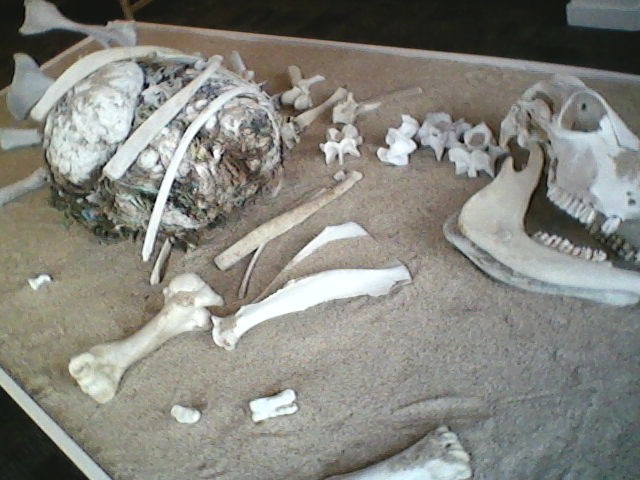
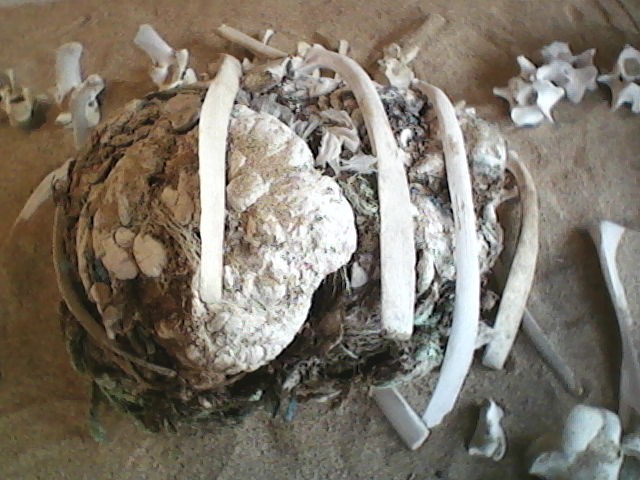
Currently, there is an excellent opportunity to begin thinking about the problem of consumer plastic, and a partial solution to reduce waste, at the EcoCenter, a SF Environment clearing house storefront about city ecology, at 11 Grove Street, across from the main branch of  the San Francisco Public Library.  It expands my knowledge beyond the aquatic life I have come to know about dying from ingesting plastic, including turtles and birds; this exhibit clearly shows the effect of plastic waste being consumed by animals on the ground.   I spoke briefly with artist/designer Ann  Sauvageau as she installed consumer bags for this exhibit, the bags produced through the program Bags Across the Globe (BAGS).   Savageau teaches sustainable design and textiles in the Design Program at University of California, Davis.  Sauvageau’s students assisted in sewing the bags and constructing a website for program information and Savageau’s blog: http://www.annsavageau.com/blog/?page_id=57.  I offer here my modest attempt at photographing the centerpiece of this exhibit with a cell phone.
“Camel Bezoar
This is a calcified mass, or bezoar, composed principally of plastic bags, as well as other indigestible debris such as plastic ropes.  It was taken from the stomach of a camel that died after eating the plastics.  It weighs 30 kilos (over 60 pounds).
It was provided by Dr. Ulrich Wernery, Scientific Director, Central Veterinary Research Laboratory, Dubai, United Arab Emirates.  Dr. Wernery has been researching the animals he has found that are killed by eating plastics and calls it ‘an epidemic.’  These include camels, sheep, cows, goats, and wild gazelles, oryx, ostriches, birds, as well as sea turtles.”
Halloween, America
You dress the world
For its demise.

The Past Revisited

27 Oct

It is axiomatic of American thought that the past will always be forgotten when speaking about the present.  Next year will mark the 100th anniversary of the beginning of the “Bread and Roses” strike in Lawrence, Massachusetts on January 12th.  I will be curating a local exhibition to commemorate that long, brutal strike.  And just as today’s Occupy Wall Street movement focuses on the 99% and 1%, the truth of 1912 was that 1% of the richest Americans owned 50% of the country’s wealth.  Conducting a difficult eight-week struggle during the dead of winter against “Textile Trust” mill owners, banks, state militia, police, clergy and local government, this strike involved thousands of immigrants, nearly half women, fighting for justice and human rights, a watershed moment in the history of American labor struggles.  LaborFest will be commemorating this event with a cultural and arts event at ILWU Local 34.

Spinning Room, Mechanic’s Mill, Fall River, Mass. Stereoscopic card. Kilburn Brothers, Littleton, New Hampshire, date unknown. Kilburn Brothers No. 617.

Immigrant Anna LoPizo was shot dead on the street, a crime local authorities unsuccessfully tried to pin on Joseph Ettor and Arturo Giovannitti for the words these labor organizers used to embolden workers to fight for better conditions.  A young Syrian immigrant named John Rami died from a wound inflicted by a militiaman’s bayonet.  (Read Bruce Watson’s Bread and Roses: Mills, Migrants, and the Struggle for the American Dream, Viking, 2005, or visit, http://www.breadandrosescentennial.org/node/77).  And yesterday, Iraq veteran Scott Olsen was hospitalized with a fractured skull and brain swelling after possibly being hit by an Oakland Police Department tear gas canister (see http://www.baycitizen.org/occupy-movement/story/iraq-vet-critically-wounded-occupy/ or http://www.indybay.org/newsitems/2011/10/25/18695124.php).  Please add your name to a petition asking for an investigation, even though an announcement has been made that an investigation will take place: http://org2.democracyinaction.org/o/5966/p/dia/action/public/?action_KEY=8589

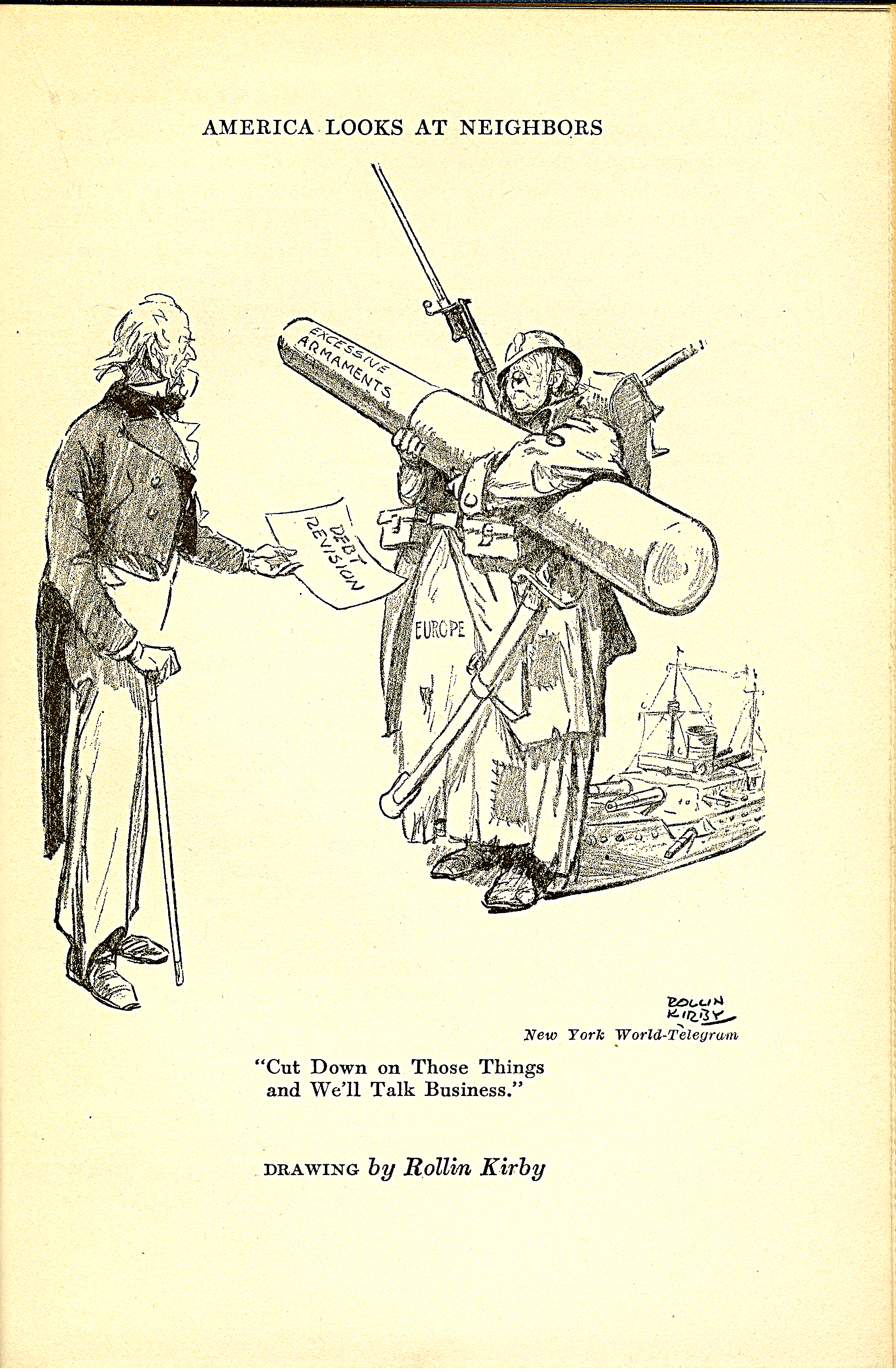
It seems we will never stop the use of physical force.  Whether Ludlow, Hiroshima or Vietnam, physical force has been the desired catalyst for change throughout our history.  When I unearthed the post-World War I cartoon that appears below I was stupified.  Of course, our dictates are reasoned when leveled by Uncle Sam.  And so on down the chain of command.

“America Looks At Neighbors,” New York World-Telegram, 1932 (Rollin Kirby, artist).


.

Temporarily Housed

13 Oct

“…Pause you who read this, and think for a moment of the long chain of iron or gold, of thorns or flowers, that would never have bound you, but for the formation of the first link on one memorable day.” — Charles Dickens, Great Expectations

Of course we are all temporarily housed throughout life.  Because of my Reiki practice I came to think of the physical body as a temporary dwelling.  With Reiki, the practitioner is not actually trying to affect the outcome of the course of the physical body’s various trajectories.  Rather, the practitioner provides loving support as the recipient experiences the changes of the body.  If it were entirely matter and energy then the phrase, dust to dust, would be apt, as if we begin inert and end inert.  That does not even account for our relation to life cycles and what formation and decomposition take part in.  We are always reaching beyond that simple quotient, though, whether we believe in an afterlife or karmic return.  Even atheism carries with it the desire to weigh life in terms of its limitations and find transcendent truths about living.

That I have arrived at the kind of temporary housing that began on Friday astounds me.  It is to be known as the widow’s house.  The son refers to it simply as that.  It is the largest dwelling I have ever occupied.  There is so much of it I just want to find a safe corner and pile straw.  The house is in probate and my time within is unknown.  So, unlike Shaughn, the lady I continue to assist in moving, I will not try strive for the impossible.  Where she brought everything she could possibly squeeze into someone else’s apartment for three months, I will keep my possessions in storage.  And while my daily needs will be met, I will limit the multiple desires that come within the American ethos to possess house and home.

There are angels.  They are available to each and every one of us.  They are angels because, like the codified vision of an ethereal being winging in from an indiscernible origin, they appear when we are not looking for them.  They bear news, information, commiseration, concern, and any number of other things.  They arrive when we cease to believe in intervention.  They intercede because we need to know that life is in many ways beneficent and kind.  In my present case, the son knew I was homeless and offered temporary dwelling.  I know him as a patron of the bookstore where I occasionally work.  Other generous interventions came of late.  One of my morning coffee mates presented me with a personal check that represented a pooled collection from several concerned people.  He is one of three people I see every morning at an Internet cafe.  They have become like family even though we do not know each other as deeply as family members tend to.  A dear friend from my New York Reiki circle sent me cash more recently.  I am deeply grateful.

I am also curious about that part of ourselves which precipitates intervention.  There is a relevant tale by O. Henry, a short story called “The Green Door.”  Rudolf Steiner is an adventurer.  His luck is sometimes with him, it sometimes is not, as when he loses “watch and money” for the allure of adventure, for his willingness to tempt fate “led him into strange paths.”  For Henry, true adventure is not set to a goal, it, instead, reaches for the unknown.  Henry’s characters are individuals within the large city.  Many paths cross and one cannot be sure where any one particular crossing may lead.  As with Hermann Hesse’s character Harry Haller in the novel Steppenwolf (a man who finds he cannot be at home with human society), Steiner is led through a door to unexpected, more magical, turns of event.  Haller’s door is entrance to Pablo’s Magic Theatre.  Steiner’s search for a green door, instigated when handed an advertisement card by a man on the street, leads to his intervention in a young woman’s distress, finding her unemployed and hungry from three days lack of food.  A note is required here about the “negro” who hands out cards to passersby: his character is typical of popular representation from the period, the author employing stereotypical racial characterization that barely rises above the pathetic images of its time.  Steiner, though, is not Haller.  Steiner, a piano salesman, partakes of the city as a consumer, albeit more willing to explore the dark shadows alone, than, say, the consumers of spectacle George Chauncey describes visiting the Lower East Side of New York in his book, Gay New York: Gender, Urban Culture, and the Making of the Gay World, 1890-1940, or Anne Douglas points to slumming in Harlem in her book, Terrible Honesty: Mongrel Manhattan in the 1920s.  The reader realizes that intervention works both in the unknown woman’s circumstances and also Steiner’s, for he will leave Adventure for Romance, having been smitten by her, and thus prove that, contrary to Henry’s assertion, Romance and Adventure cannot coexist within the single quest.  Certainly Steiner will move beyond the nights and dark shadows of the city to embrace the flower that his charitable act has nurtured.  Thus, Henry reaffirms the comfort that capitalist society endorses.  Hesse, on the other hand, critiquing Weimar Germany between the wars, bravely sends Haller on a journey that not only reminds the reader of the horrors that capitalism creates through greed and war, and partakes of the liberating influence of hedonism, but beyond, proposes a greater enlightenment through disintegration and reintegration of the self.

If the body is to be considered a vessel for the containment of the soul, then “house and home” begins within.  If not properly cared for, the body can become a prison cell enclosed by the dis-ease of mind and the dark side of the spirit.  I anguish inside every time I see a homeless person adrift, but tethered by the noticeably visible, damaging circumstances of body and mind.  A man screamed tonight as he hurried along the sidewalk.  He carried a single suitcase.  He cursed over and over again.  And his body jerked in spasmodic motion every few feet, the movement appearing like a marionette on strings.

In a Sea of Darkness, digital photograph, 2006.

Homeless in San Francisco: Month Two, Day Thirty-Four

4 Oct

I was not prepared for a story about homelessness to include two lovely song birds.  But that is what Pat Moran and Eula Jane Wyatt’s music and Wyatt and Christine Rodgers’s voices produced Saturday night during the final performance of Elizabeth Gjelten’s “Hunter’s Point.”  The play with music was produced by Strange Angels Theater and presented at St. Boniface Church Theater.  The songs, sung solo and duet, centered on Biblical redemption, in earthy, moving tones.  Eva, played by Wyatt, is homeless, occupying a tower in an area of Hunter’s Point, where shipyards were once active.  She rides a bicycle and spends her days at the public library conducting research to find the perfect home, a utopian community, where psychiatrists and social workers do not enforce harmful drug regimens, where she can consume the essential nutrients that will bring her to wellness.  Her sister Ruthie, played by Rodgers, keeps in contact by cell phone, maintaining a bank account for Eva’s use.  Eva is determined to be alone, it is safer that way.  She avoids speaking to her sister.  Her past is troubled and marked by horrible psychic disturbances which the audience gleans through the dramatized voices from Eva’s mind and dialogue provided by Ruthie and Eva.  At the outset of the story, Ruthie must tell Eva firsthand that their father has passed away.  She finds an individual known simply as Hunter, played by Carlos Aguirre, to locate her sister.  Hunter  makes his money illegally on the street performing gifted beat box rhythms, which the audience enjoys several times during the evening.  Aguirre also plays a Sarajevo resident, Zulko, who befriends Ruthie during her business trip there to write a piece for an online travel guide enterprise.  We learn that Ruthie is continually on the move across the globe, not just in her role as a journalist, but more importantly because of the rootlessness which constitutes her life.

Eventually Eva must decide if she will accept housing, while Ruthie must decide if she can accept Zulko’s wish to create a home for her.  Thus, both women are exploring homelessness in very different ways.  The acting was tremendously good, including Allison L. Payne’s role as the librarian.  Aguirre shows an incredible talent as both beat box performer and actor.  St. Boniface was the most appropriate place for such a performance as the church is very active in attending to the needs of the hungry and homeless in the Tenderloin.  The church is host to The Gubbio Project where “sacred” sleep and sanctuary can be found: http://thegubbioproject.org/

For three days now I have been assisting a homeless woman’s move into temporary shelter.  And she has lots of money.  Shaughn, the former building manager at 50 Golden Gate Avenue, hired me to first rearrange her possessions, located in the storage area of a parking garage on Hayes Street.  I was lured by tales of the El Dorado of her misfortune, as I learned that Shaughn was paying $40 per hour for assistance moving her possessions out of an apartment in the building last Friday.  By the time I came to her aid on Saturday, the rate had dropped down to $15.  According to Shaughn, her landlord (and former employer) had bought out her lease and she had until 4:00 PM on Friday to vacate.  By her own words, she was “desperate” for the check she received in compliance.

Shaughn has the storage space for thirty more days.  What I found there belied the fact that she had spent two weeks with hired help packing.  Granted, much of what I did not see had gone to storage in Novato.  But what remained looked to be so shabbily packed as to suggest a total lack of managerial organization.  Personal belongings, including a wardrobe, were piled against a square corner area, wedged in by parked cars and concrete pillars, just outside the storage unit.  Within the storage space there was even more confusion.  On Saturday we sorted and moved boxes and large objects into a shoddy semblance of order.

While working, I asked Shaughn about her origins.  As we lifted skirts and sweaters, blouses and coats, that had fallen off hangers and out of sheeted bundles onto the garage floor, and hung them from a water pipe near the ceiling of the storage unit, Shaughn recounted her beginnings in a rural, mountain town in Virginia.  One of nine children from a father who had remarried several times, she seemed to gladly revisit the time when domestic industry revolved around women who baked apple, pecan, and cherry pies.  As a maturing child, she graduated from chores in the house to chores in the field.  She enjoyed the trips to her aunt’s where canning provided enough food for ten for the winter.  I could tell she was quite capable with her hands and had a load of tools stored for any need.  She talked about the racism and provincialism of that community and how she would be greeted upon an imagined return, Oh, you’re ______’s daughter.  I did not know where she was going next, so I asked her if she was excited about her new apartment.  She then informed me she would be apartment sitting in the building next door.

Shaughn explained how she would use the storage space to  take photographs of antiques for listing on eBay, for she is forced to dispossess of the many antiques she amassed during former business days.  I once worked with a woman in New York who collected so many chairs, and only chairs, that she had to keep them in storage.  Shaughn is not unlike the chair collector, or more, aptly, aspires to be like Imelda Marcos, for all the shoes gathered in that dirty garage space.  She told me that the forty to fifty boxes I saw were nothing compared to the number of shoes already stored elsewhere.  The antique business belonged to a time in Shaughn’s life before managing buildings, when she still lived in a three-bedroom house in Novato, a community in “its own little world,” according to a friend who had worked in retail service there.  Shaughn was forced to downsize after vacating that home.  She has passed through several incarnations, including years spent as a massage therapist and the “six years too long” of the seven she served under the owner of the property at 50 Golden Gate.

Over the last three days, Shaughn complained incessantly about what the packers had not done according to her directions.  They were to blame for the post-volcanic chaos we sifted through.  The truth of her situation was divulged while I stood with a heavy bundle of clothing in my arms, greeting one of her new neighbors down the hall with a hello.  Shaughn quietly let me know that she wished not to advertise her move to the building because the sublease was illegal.  She had just as many complaints about the former occupant (another illegal lessee?), an Italian opera singer, because he was so filthy.  She practically heaved her displeasure about the black hairs he left all over the tiled bathroom floor.

In 2008, I readily knew that Shaughn is an individual who only looks after herself.  She is ingratiatingly smooth, though.  But she is also vindictive.  And yesterday she talked confidently of revenge.  She explained that she had a surprise for her former boss; she will sue him for $60,000 for overtime during her former job.  Does misfortune ever really harm people like Shaughn? Or her former boss?  Remember the bankruptcy case of Donald Trump?  Twenty-five years later, I can still remember when the announcement was made to all workers at MBW Advertising in New York that the business would close in one week because the owner, Michael Weiss, the profligate son of the company’s founder, had filed bankruptcy.  He and his wife were back in business several months later, no matter the rumors that overspending on cocaine and cars may have contributed to financial disaster.

My great uncle Bob was a man who never recovered.  His life did change, though.  He lived most of his adult life suffering from catatonic schizophrenia following an episode during college that I never learned the cause of.  He lived in institutional care in the San Bernardino area for many years.  His sisters brought him to the house on holidays.  Often he was just present without speaking or engaging with us in any other way.  Other times, he was warm, but only made small talk.  He was one of the most handsome men I have ever known.  And I loved the gentleness of his eyes.  He married a woman from the same institution named Marcella.  They shared a house in San Bernardino County for about ten years and then divorced.  I saw the house the day his sister Jo drove us there to pick them up.  It was a long drive.  The wooden slat building, with small, broken windows, was a dilapidated structure that sat on what must of been a former agricultural field.  It was a lonely looking shelter in a valley with mountains in the distance.  Uncle Bob was encouraged to paint while in institutional care.  With impasto strokes, he painted narrow, claustrophobic street scenes, near wharves, eerily vacant of any human presence.  He also painted flora and birds frozen on perches.

Robert Hammerly, untitled drawing, gouache or watercolor on card, date unknown.

Homeless in San Francisco: Day Twenty-Eight

28 Sep

15-year-old Frank Kavanagh has twenty-five cents in his pocket and his surplus clothing tied in a handkerchief.  He landed in New York from Hartford, his parents, once tired of supporting him, sending him away.  His first lesson in the big city is that people take in your assets and station quickly.  As my Vietnamese-American friend Jesse, who runs a fantastic sandwich shop on Steuart Street and travels to Hong Kong and Vietnam each year, tells me, in Vietnam people can smell the money on you.  Counting his coins, Frank is questioned by one adult “Montague Percy” about his circumstances as they sit beside each other in City Hall Park.  Percy deftly leads the boy to a saloon where the promise of free food acts as the carrot-on-the-stick.  Percy tells the boy to eat while he liberally orders as many drinks as he calculates Frank’s coins will procure him.  As with all of Horatio Alger, Jr.’s boy heroes, Providence comes in the form of another individual’s intervention to offset the negative weight of life’s scales of justice.  It is only moments after Frank has been fleeced that the street “arab” Dick Rafferty, a tad younger than Frank, takes in the “country” (boy) by explaining the street environs of the city and leading Frank to his first job as an escort to a blind beggar.  Needless to say, in this dime novel Telegraph Boy, or, Making His Way in New York, the beggar is a fraud and Frank moves on penniless to find another avenue for work in the city.

Poor Alger escaped New England by the dead of night following accusations he had engaged in unnatural acts with two boys under his Unitarian tutelage.  He arrived in New York in 1866.  He became one of the most published authors of the nineteenth century.  (An excellent source for biographical information on the author is found in Edwin P. Hoyt’s Horatio’s Boys: The Life and Work of Horatio Alger, Jr.)  For boy readers like Frank, who had slept in beds every night before his unfortunate fall from family grace, the teeming city of New York and its lower and upper class environs must have provided exotic adventure, just as the West in Alger’s later novels must have served.  When I was a young adult, the city as a site for excursion was fascinating.  I have lived in three large metropolitan areas since leaving a small town in what we referred to as the “sticks”: Los Angeles, New York, and, now, San Francisco.  I have also visited many other large cities.  What I have discovered is that provincialism exists wherever you go; this state of mind has nothing to do with the size of the town or city of one’s residence.  I was amused the day the waitress serving me at a restaurant near the pier in St. Petersburg, Florida, offered me, with wide-eyed sincerity, advice about traveling by bus to Tampa, across the bay: “Oh, I wouldn’t travel there.  You never know what’s going to happen.”  Downtown Tampa turned out to be the sleepiest location I have ever seen.  Perhaps, as a European American woman, her fear was based on the presence of seemingly  idle African American men in this area.  St. Petersburg, by the way, hosts a municipal museum at the pier.  The feel of the museum’s interior is more like Ripley’s Believe It or Not; baseball cards exhibited under glass were situated across from an Egyptian mummy case propped against a wall.

One thing I learned from my mother and stepfather was to open my arms to anyone, no matter their circumstances.  Thanksgiving Day was a celebration that could include the oddest assortment of people.  The large city is a place of open arms, unlike say, an Arlington, Virginia, where people passing by jogging will greet you with a compulsory Good Morning, but gossip about and judge you with distrust otherwise.  In Los Angeles, I lived above a man who must have been a Voudon priest for the sound of shrieking chickens and the sudden silence that followed their demise.  My neighbor Linda next door would often invite herself over, even once unexpectedly inviting herself and her husband to dine with my domestic partner Rod and I.  On Marble Hill in New York, my first neighborhood in that city, the stoop was meeting ground for neighbors.  There were Chrissie and Ellie, two cigarette-smoking 14-year-old going-on-adult women, who preferred my company, and my roommate Liz’s, to their own parents.  There was Peanut, who came to visit his brother Wolf, who was eventually convicted for the murder of a young Yale graduate (I harbored doubt about his guilt).  There was Henry, one of the most beautiful men I ever knew, in temperament and heart, gunned down the day he tried to prevent a robbery at the cleaner’s across the street.  There was Michael from Jamaica, who first found my disfavor after he beat his pregnant wife because of the news that the child was not his, and then later suffered a gunshot wound to the leg in his own apartment.  Joe, who had worked for a sculpture factory and created plastilene figures of young girls clad only in T-shirts and socks (probably of his daughter whom he no longer lived with), disappeared after pulling the trigger of the gun.  Michael assured me that Joe was only examining the gun when it went off accidently.  My suspicion, though, was that it had something to do with the business they were engaged in selling cocaine.  And there was a younger Michael, a native of New York, who eventually relocated to the South Bronx to live with the “mother of [his] child” (I never did learn her name).  He only had to warn me once not to visit him where he lived, as I would learn the inhospitality of the neighborhood in ways I would not want to see.  Our relationship was particularly close as he seemed to like the company of older gay men.  Mark and Denise and Michael and Phyllis were perhaps our closest friends in the complex.  Mark was a fantastic story teller.  I never challenged his stories because I could never hear enough from him.  Only Mark could tell you that on a cold winter night during a drug experience he descended to the bottom of the Spuyten Duyvil, the connecting waterway between the Harlem and Hudson Rivers, a treacherous stretch for its swift currents, in his underwear and resurfaced with ice cycles in his hair (and live to tell it!).

Any community is open to a myriad number of sins.  I look with disbelief at a banner in my Tenderloin neighborhood affixed to a lamppost: “409 Historic Buildings / Downtown Tenderloin Historic District / Yeah, We Are Proud.”  With all the number of years of lived experience behind me, I know that the sins of the street are too numerous in my neighborhood.  The streets here are a living organism of incredible vibrancy and decay.  People mill about at street corners always looking both ways.  They speak to each other with broken glances in the direction of their conversation.  People dive through trash cans, sell and buy drugs, look each other up and down and say hello to the  unwary stranger, scream and fight each other, challenge automobile traffic, sell their meagre possessions on the sidewalk, ask for handouts and move constantly as if movement itself will effect some chance of better luck.  But this is not new.  Nineteenth century America is rife with literary and artistic anecdotes about fraud, malice, murder, and mayhem.  Contrary to Donna Dolore’s assertion following BDSM shoots, “I would leave a shoot feeling really invigorated, a stronger person.  It made me see what my body was capable of.” (Caitlin Donohue, “Because the Princess Says So,” San Francisco Bay Guardian, September 21-27, 2011, page 24), I seek fortification away from where I live.  (Note: in deference to SM, I have an incredibly gifted friend in New York named Barbara Nitke who has been shooting photographs of the SM scene for over ten years.  I have learned through her work alone that SM offers pleasure, immersion, and transcendence.)  But I cannot seek the immersive here in the hood, while physical escape is the only transcendence I hope to find.  I no longer embrace humanity the way I once did, be it because of age or fear or lack of confidence in humanity.  I do not engage the Tenderloin at all.

Of the few foreign cities I visited, Amsterdam and Paris were both hospitable in ways I could not expect.  While in Amsterdam in 1998 for Gay Games, the owner of a gallery invited me to join him for tea.  While in Paris, my host Philippe ensured I had adequate company while he took his family on vacation: a brother and his partner and numerous friends kept me entertained.  Upon Philippe’s return we engaged in the fun of an impromptu performance; working with his daughter Alice, we created a suit and hat from cut paper with crayons for detailing what I would wear to the polling precincts on Election Day.  “Des 4×4 pour tous” (SUV’s For All) was the motto drawn on the stovepipe hat, a statement to counter the anti-environmental politics of one of the leading parties participating in the election.  Surprisingly, an SUV owner took the statement to heart, believing we were advocating a SUV for every citizen of the city.  Now, wouldn’t that be a community without sin.

Philippe Barnoud, untitled photograph from performance “Des 4×4  pour tous,” 2008.

Homeless in San Francisco: Day Twenty-Four

24 Sep

“…we switched on the light — doped with fatigue and despair — to see the bed aswarm with escaping bedbugs like a hundred maddened crocodiles fighting frantically in a small pool of boiling water.” — Ned Rorem, Paris Diary

I read Rorem’s account of bedbugs years ago.  I was a precocious reader at a young age, equally at ease with James Fenimore Cooper, Charles Dickens, Victor Hugo and Patrick Dennis’s entertaining fiction Little Me.  Of course, I did not understand everything I read; Hesse was a fascinating but daunting challenge.  Rorem did not appear during those early years.  The passage from Paris Diary about his experiences with bedbugs is the only passage I still remember from that book.  Who can forget a description of this kind, with the hallucinogenic qualities of a story of Poe, another one of my childhood favorites.  Still, I was not even close to a living knowledge of Cimex lectularius.

While living in my first San Francisco building upon my return to the city I learned a great deal about the bug.  Probably a third or more of the units at 50 Golden Gate Avenue became infested.  Neighborly gossip pinpointed its introduction to a single apartment unit, much as Patient Zero functioned as a fanciful explanation for the origin of HIV/AIDS.  Of course, Bedbug Zero was slovenly and non-caring; he, in fact, was quite comfortable living with them.  He refused to allow his apartment to be sprayed, evidence enough of his disdain for the other tenants.  But perhaps the greatest disdain was actually evinced by the building manager Shaughn.  She did her duty, calling in the exterminator every time a reported incidence of infestation occurred.  We knew, though, that poisonous spraying did nothing to kill eggs, nor eradicate the presence of their adult kin within walls.  A few of us banded together and became proactive.  Diatomaceous earth was purchased and laid out around beds and along every crevice.  I put it outside the door to the apartment, the white powder hinting at Christmas on a ratty, soiled red carpet.  This incensed Shaughn who complained the substance broke vacuums.  Her real reason, though, for complaint was the nuisance it caused as she showed empty apartment units to prospective tenants, including the unit around the corner that had become infested and driven out our neighbor.

By the time I moved away I could sigh with relief that I had escaped bedbugs.  In another three months that unit was hit.  I realize today I was simply lucky.  I should have thought about my luck the day I was introduced to Hotel Kinney.  The building manager mentioned that the mattresses in my assigned room were covered in plastic to prevent bedbugs.  His words did not register appropriately.  Had I looked at those mattresses I would have seen torn plastic covers and known the danger was not over.  This past week I received a single bug bite.  I did not think about it since I have been bitten by spiders during my sleep, and, after all, when I had seen bedbug bites on other people they appeared in profusion, a feast of Thanksgiving Day proportions.  When I removed the bedding to launder, I took notice and made a report.  That was followed by a spraying not just in my room alone, but also several other units.  The following day I woke with bites over ankles, arms and neck.  This time, my bedding was put in plastic and new bedding was issued.  The room was sprayed again.  Still, the plastic covers remain torn.  I have put diatomaceous earth along all baseboards and encircled all furniture legs, an action that was not advised by the manager.  The lines are now drawn for what promises to be a protracted battle.

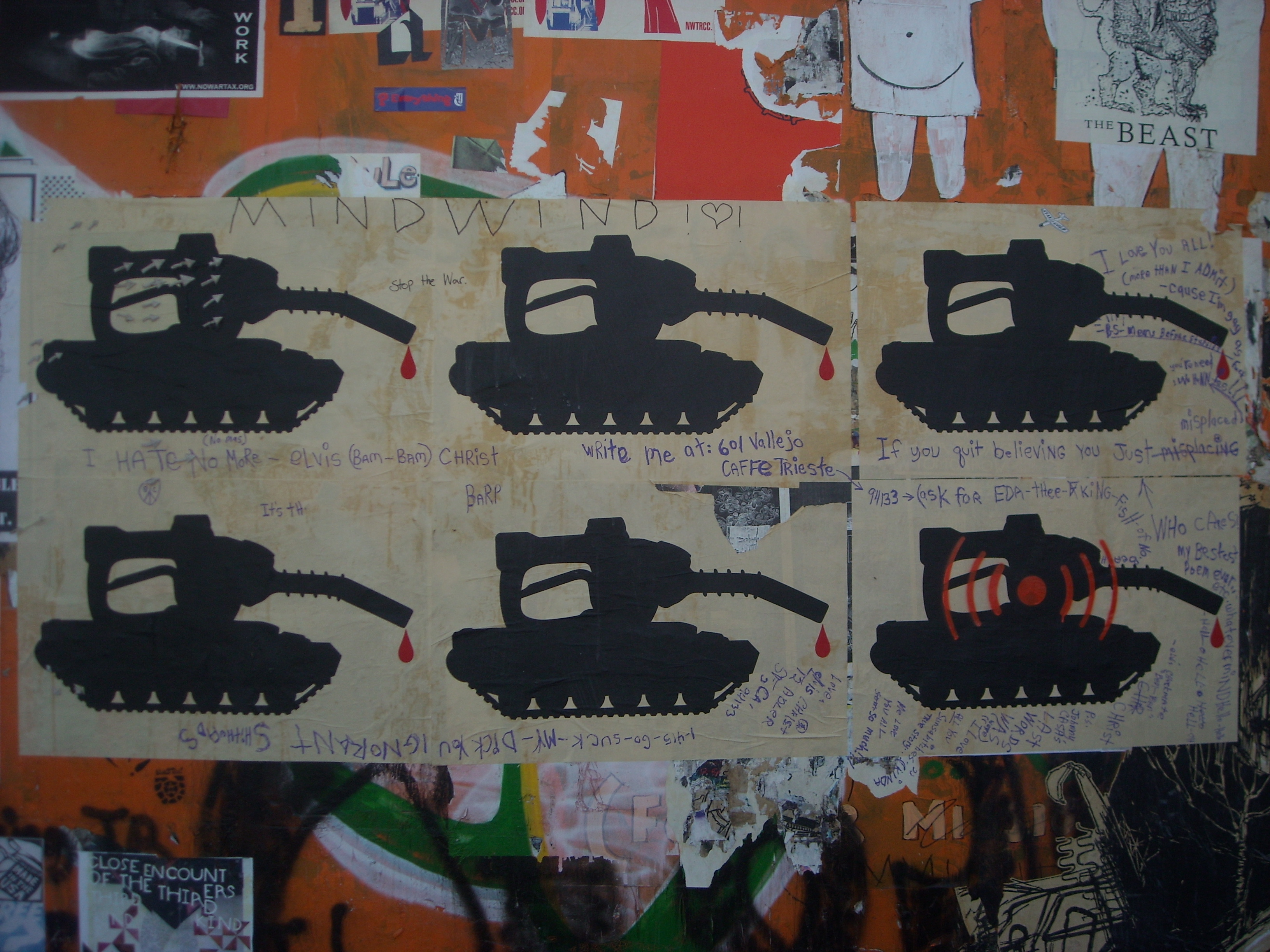
Untitled photograph, wheat-pasted posters on a wall in the Mission, 2008.

Homeless in San Francisco: Day Twenty-Three

23 Sep

About 6:20 yesterday morning a man was stabbed by his girlfriend.  I noticed the Fire Department rescue vehicle pull up in front of the building next door.  Then a police car arrived.  Policemen were asking him questions and relaying information on walkie-talkies.  I never saw him nor heard him speak.  I only knew better about his circumstances when I went downstairs and greeted the front desk clerk before leaving for the day.  The clerk gave me the details as he walked down the steps with me to the front gate.  He motioned with his right hand to one end of the block and the other, telling me this happened about once a week; either it was a stabbing or a shooting.  As I looked over my shoulder from the intersection, I watched the clerk buzz and then open the gate to the hotel entrance at the scene of the crime.

Untitled photograph taken from somewhere along Highway 1 on a road trip with Max Yawney to Santa Cruz, 2011.

Homeless in San Francisco: Day Twenty-One

21 Sep

I must have pissed my neighbor off.  On Sunday morning I awoke to my alarm clock.  It was 7:00 AM.  Outside of occasional verbal noise from the street, everything was quiet.  I went down the hallway to shit and shower.  On my return, he had turned on the radio to a Gospel Hour program, loud enough that it could be heard down the hall.  The incident triggered an association from long ago when I lived in Union City, New Jersey, across the Hudson River from Manhattan.  The block was made up of one- and two-story buildings, a patchwork of family dwellings and apartment buildings and striptease beer halls.  Eventually I wrote a poem about my time there, focusing in particular on a neighbor.  One excerpt reads:

“Her whines rode his growls in volleys / As their words evaporated through pink petalled drywall / Enriching the central hallway’s cool insulation / With unintelligible meaning / New voices since old had passed / When this building once housed the aged / When its green tar and shingled sides looked like home / Each morning they honed the anger of their dialogue / To a pitch and intensity that would break and subside / As she announced largely the bus she’d have to catch”

I am reading Carey McWilliams’s Ill Fares the Land: Migrants and Migratory Labor in the United States (1942).  During the late 1930s, McWilliams, for his expose Factories in the Field: The Story of Migratory Farm Labor in California, and John Steinbeck for the novel The Grapes of Wrath, were notorious for revealing the conditions of labor in California agricultural fields.  Both writers were vilified by a corporate-funded national press, accused of being “Reds” (Ill Fares the Land, 43), followed by vituperation from members of Congress who described The Grapes of Wrath, in particular, as “dirty, lying, filthy” (Ill Fares the Land, 47).  I purchased McWilliams’s book from my favorite New York bookstore, The Strand, where I found many useful and interesting volumes on American society from the 1940s.  My plan was to introduce a text on an aspect of the Mexican American experience to the students attending my course Minorities and the Critical Decade: World War II and After.  But, there were many different racial and ethnic groups involved in migratory labor at that time.

Steinbeck focused on White Americans from states such as Oklahoma relocating to California.  McWilliams, though, in his second book, looks at a wide variety of groups nationwide.  Ill Fares the Land takes into account the forces creating the need for migratory labor.  Of course there was the Dust Bowl effect over several decades where soil had been exhausted through monocultural practice, with single crops like cotton, and the subsequent erosion of the land through flood and wind.  McWilliams outlines the rise of a corporate or industrial agriculture.  In this setting, large farms and conglomerates push small farmers out of existence and crop mechanization makes human labor obsolete.  Sharecropping, a holdover system from slavery that granted individual farmers time on land as tenants, was replaced by transient, seasonal labor.  One feature of the new industrial agriculture was the harnessing of a large labor pool in the regions where crops were to be harvested.  In fact, costs could be lowered by suppressing the wages of these workers.  The key to accomplishing that was by recruiting into the area a larger pool of workers than actually needed.  For corporate conglomerates and absentee owners, the contracting agent exploited the situation by recruiting labor from thousands of miles away, including Mexico.

Individuals and families were often stranded after the harvest was over, having been so exploited by fees against wages for transportation to the region and credit systems for food, housing, and, in some cases, equipment and tool use.  In order to safeguard the health and safety of these workers,
it was then up to government entities to intervene, usually at county and Federal levels, because the corporate businesses refused to provide workers with adequate wages and amenities for safe living.  Even then, the measures taken were never enough to service all in need.  Various diseases were rampant with these populations during the work season.  Hunger was common.  Nutrition was dismal.  And housing was anything approximating what we think of today as housing.  Imagine living in converted chicken coops, barns, wagons for the convenience of moving the housing unit, sheds, open land without the protection of a strutured dwelling or trees (Mexican families in agricultural areas of Texas) or situated over or near swamp land (onion cultivation).

Human warehousing continues to this day.  I volunteered as a tutor at a welfare hotel in New York situated in what was the Martinique Hotel.  The community organization Hudson Guild provided the tutors in a room adjoining the hotel’s former ballroom.  Our Homework Help program took place on Monday afternoons.  The children were welcome on their own volition.  One young girl, about the age of nine, would join me.  She resisted any attempt to help her with learning, but she insisted on being at my side.  I finally realized she was an angry individual and that the only service I could provide was being present in a nonjudgmental way.  A younger, male child spent his time in the ballroom picking up wooden chairs and smashing them against the floor.  He never joined us.  His destruction was systematic.  He would work on a chair until it was in as many pieces as he could effect.

I had an interesting conversation recently with a friend of a friend from the Midwest.  My friend Donald was eager that I meet this person.  We had coffee together at a cafe.  The Midwesterner was extremely tight lipped.  Drawing conversation from him was difficult.  I introduced the topic of an effort underway in Brooklyn, New York, whereby citizens without the aid of government are taking inventory of abandoned and empty housing units in their neighborhoods.  I spoke about the great number of empty buildings I remembered from my time in New York.  I even suggested that perhaps government intervention could possibly make available temporary housing in unoccupied buildings.  This remark really set off our guest.  Of course, I could understand.  He inherited many acres of farm land from his family, which he did not farm, instead letting the land to Amish farmers who apparently were not paying their rent.  He had not worked for the land he inherited, but he believed anyone who owned property had a right to use it as they saw fit, intervention be damned.  He ended the conversation by looking Donald squarely in the eye and saying, I’m ready to go.

My landlady in Union City was a likable character, whom I refer to as Toby in the poem.  She lived on the first floor behind my unit and the across-the-hall neighbor’s.  My departure from the building is described as follows:

“Oddly, the landlady’s sometime supervision of my affairs / Laced the hollowness of my days with a spirited warmth / Though her accounts of televised baseball / And Friday night bowling meets / Dissolved with my decision to leave at year’s end / As I mechanically repacked possessions / And daily bid goodbye to littered streets and windy fields / Toby ordered an eviction across the hall / For which I discovered taped to a glass pane of the front door / The words scrawled on a disemboweled envelope, / “Tony – Sorry we couldn’t make it, Sharon.”

East River, Kraft paper, paper bags, wall plaster, house paint on plywood, circa 1983-84.