Tag Archives: david duckworth

Four in a Room

24 Aug

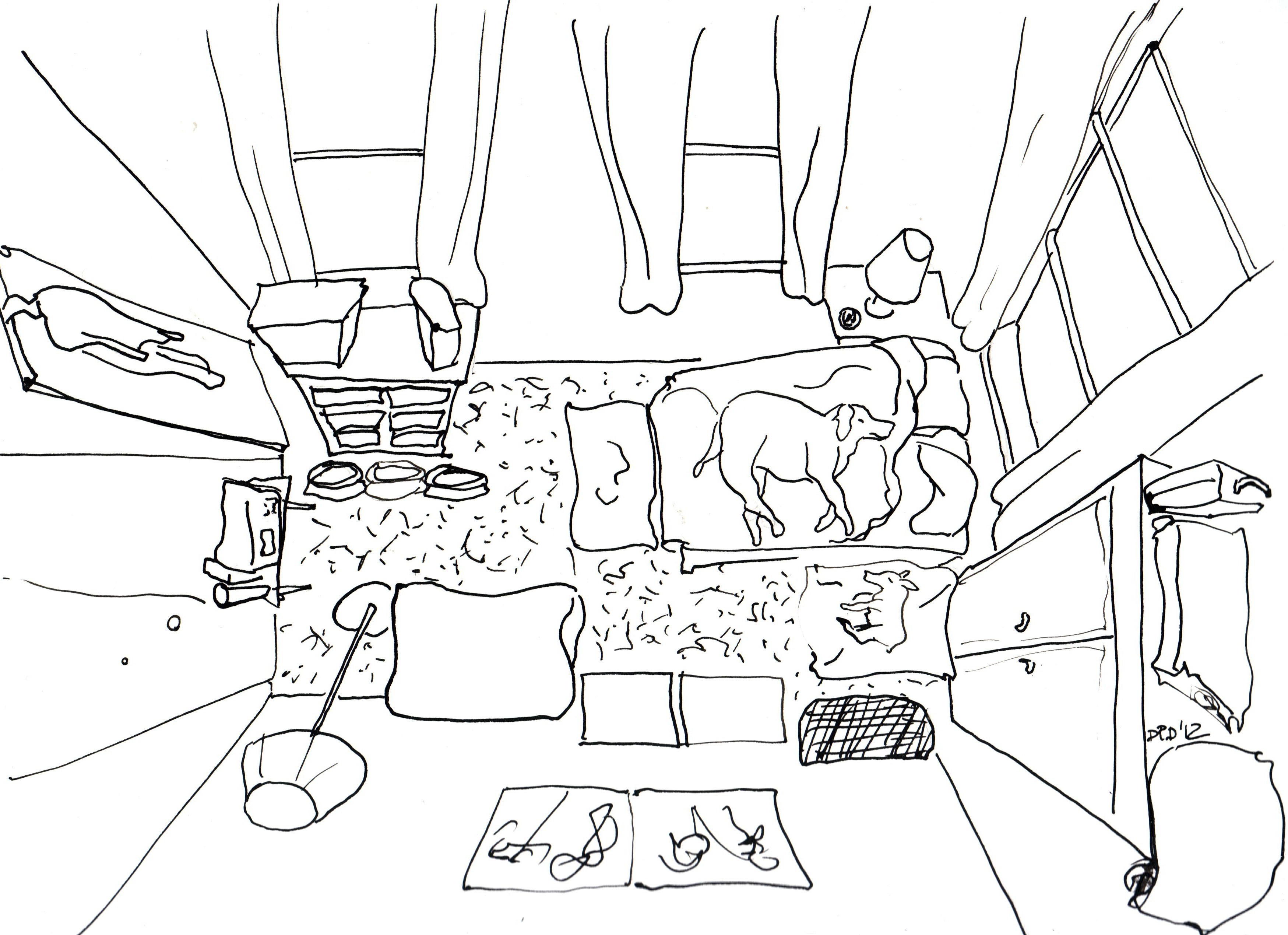
Pen-and-ink on Bristol paper, 9 x 12 in.

The dogs depressed me.  That was the realization as I looked at them sleeping one morning.  It was not that the amount of hair they shed created an even pattern in the hotel room carpet, or laid over everything else.  Nor that some amount of hair clung to my clothing as I left for the day. The fact that the retriever, Sugar, heavy as she is, used me as a human security blanket once her owner went to work, plopping down against me like a lead weight, and frequently so throughout her slumber, since she must get up on all fours to resettle herself ― no, even that, annoying as it was, dug deeply into my psyche.  Tucker, the terrier, ignored me completely, confining himself to a small, square comforter next to Mark’s bed, but still in the middle of my path to the clothes closet.

Sugar, in fact, deprived me of less sleep than my roommate Mark did as he prepared for work each day between 3:00 and 4:30 a.m.  Mark and I had been neighbors in units above and below each other when we agreed to share a larger unit that became available.  We had met earlier in the year when a mutual friend from Hawaii brought Mark along to an event where I was speaking.  The need to reduce rent was so urgent I staved off all consideration of how a single room could adequately house two people and two dogs.  Unlike the former units, this one had an attached bathroom and views of the city east, north, and west from the sixth floor.

I realized quickly saving $250 a month was not worth the cost of my health.  After three weeks of inadequate sleep, I returned to my former room with my tail between my legs.  It is temporarily quiet now; temporary because I never know how long I can actually continue paying by the week for this room.  During the interim time away, the manager replaced the  marble sink top, night stand and lamp, traded curtains for new blinds, and gave the walls fresh paint.  It is a comfort to be back.

During this same period of time drama in and around the hotel escalated because management initiated a security guard system at night.  Apollo, in Room 408, is one of the tenants who bucks the new system.  Apollo does not like rules or restrictions.  When I first met him in February, he was standing at the front door asking to be let in.  His manner, probably exacerbated by drinking, changed to threatening hostility when I would not comply.  Like his mother on the second floor, and a sister who occasionally visits the mother, he drinks vodka with milk.  More than likely he uses drugs as well.  Why he never has a key remains a mystery to me, unless it is that he leaves his key with the homeless that he brings in from the alley.

The first thing I learned about Apollo’s history was that he lost work in the construction industry months before.  More recently, I was informed that he runs a check fraud operation from his room with the aid of his homeless friends.  His relationship with the people he houses is not always good.  One night he engaged in a protracted shouting fest with a he-she, first in the lobby, then from a window as he-she stood in the alley, then with the two of them in the hallway on his floor, and finally in the alley where the two of them screamed at each other as friends of Apollo interjected that he should get rid of him-her.  But once back in the lobby alone he seemed truly defeated, in his inebriated or drug-induced way, by the inability of he and his love to get along.  Gesticulating like a ham in a badly written play, he sat on the coffee table moaning the question why people just couldn’t get along.  The manager, who stood looking on, finally said, Apollo, that is a question I can’t answer, and walked away.

Apollo’s den spawns events of nightmarish quality.  Most recently a young woman attempted to get past the guard on her way to 408.  The guard followed her up the first flight of stairs telling her she was trespassing.  She did not respond.  He got ahead of her and blocked her way at the top.  The manager appeared, also telling her to leave.  The manager then made the mistake of turning his back on the woman.  She slammed her cell phone into his spine.  What happened next is unclear to me, but she did bite him on the arm.  A second-floor tenant aided the guard in pinning her down until the police arrived, as she screamed, thrashed, and promised to bite and knife them.  The police muzzled her face and lead her away.  The manager, brave soul, ended up in the hospital for treatment of a bite wound, released with a prescription for HIV medicine since the woman was a known needle user.  She was delivered to a hospital for overnight observation but never arrested for assault.  Word came later that she left the hospital that night.  Because she was not arrested no test was made to determine if she was HIV positive or carried any other communicable disease.  And as for Apollo, his minions continued to storm the castle.  Later that night, they scaled the wall from the alley to access the fire escape.

I doubt that the dogs were aware of any of this.  I rarely saw them exhibit much energy as we occupied the room, nor much interest in the sounds of the hotel.  They were eager for the one or two daily walks to the park their owner led them on.  Sugar sometimes objected to being left alone as I did hear her scratch against the door after my departure one morning.  What depressed me that day had nothing to do with Sugar shitting or Tucker peeing on the carpet, which did not occur then but did happen often enough.  No, it was the realization that the dogs slept all the time.

Plum, Window, Rose

8 Aug

The 19th Annual LaborFest

7 Aug

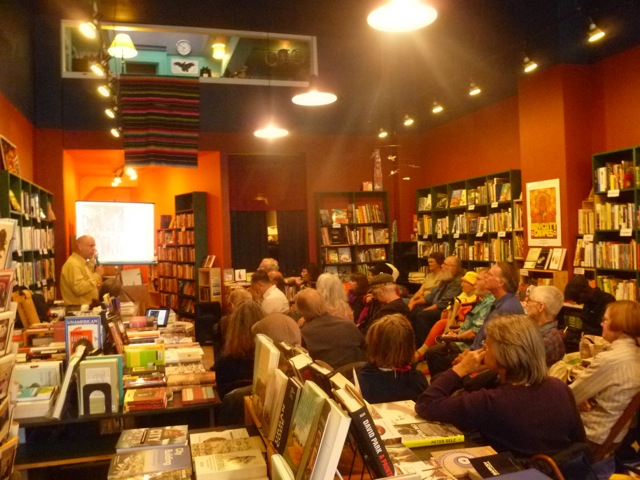
The Present Is the Past: Occupying the Commons, July 30, The Green Arcade, San Francisco. Photograph by Steve Zeltzer.

It was fun and hard work for the Organizing Committee putting together nearly eighty events for the month of July.  But the process is collaborative and many of these events are actually organized by individuals not on the committee.  This year’s theme was Occupy, Past Present and Future: Lessons of the Past for Labor Today.  Presenting on the last day of programming, the evening before the closing party, I spoke on three events from unemployment activism and labor history that show us precedents for the ways in which the present Occupy Movement has utilized public space for political redress: the industrial armies of 1894 marching on Washington; the Ludlow, Colorado tent colony during the southern Colorado coal fields strike of 1914; and, the Bonus March on Washington in 1932.  It was standing room only at Patrick Marks’s bookstore.

One of the anecdotes I opened with involved a conversation between two people from Ukiah, California, who walked past the Occupy SF encampment on Market Street in front of the Federal Reserve Bank of San Francisco, a site in use since early fall 2011.  Dan was engaged in a conversation using his cell phone about company projects.  Alma, his wife, and I were accompanying him to a local stationery store to purchase office supplies for the project where I am temporarily employed.  We passed the camp, which is separated from the bank by a pedestrian throughway along the sidewalk and metal barricades at the bank’s portico edge .  One couple struck me especially, a woman who was topless being held by a man, both swaying gently where they stood.  I later thought of Paul Cadmus’s egg tempera painting What I Believe (1947-48), based on E.M. Forster’s essay of the same title; “Love and loyalty to an individual can run counter to the claims of the state.  When they do ― down with the state, say I, which means that the state will down me” (see http://weimarart.blogspot.com/2010/10/paul-cadmus.html).  In this painted idyllic vision of humanity, an area is taken up by individuals in peaceful assembly; the heterosexual couple to the right just beyond the grave could have been the couple Alma and I spotted that morning.

The woman’s nudity shocked Alma.  Once Dan was finished with his business call, Alma asked him if he had seen what we just passed.  He said no and asked who these people were Alma described.  Alma replied, I don’t know, some homeless people.  If the two of them had known that they passed an Occupy site, Dan would surely have derided the camp and its inhabitants.  In a conversation I had with a cafe owner in my neighborhood about the incident, Brian told me that homeless people do join the camp because they will not be harassed by the city’s recently passed sit/lie law.  Brian probably speaks with some accuracy because he is host to a number of homeless people at his cafe, many known by name and present on a regular basis.  He is a very generous person allowing people in whom other business owners would keep out.

The anecdote prompted some people at the bookstore slide lecture to defend the Occupy Movement.  While the momentum of the movement seemed to peak as municipality after municipality across the country found ingenious ways to dismantle encampments situated in public space, the tactics have shifted.  Thus, today, occupation is alive and well, such as the occupation of an Oakland elementary school by volunteer teachers, parents, and students following the closure of five school sites by that city.  The parents were expected to ship their children to charter schools and they are not happy with that.  Nor should anyone else be when it comes to privatization.  Privatization is only the encroachment of corporate business in the public sector, rewarding a few individuals with captive markets.

The peace activist A.J. Muste observed in 1962: “We are now in an age when men will have to choose deliberately to exchange the values, the concepts of ‘security,’ and much else which characterizes contemporary society, and seek another way of life.  If that is so, then the peace movement has to act on that assumption, and this means that the whole picture of our condition and the radical choice must be placed before people―not a diluted gospel, a program geared to what they are ready to ‘buy now.’ ” (quoted by Nat Hentoff in Peace Agitator: The Story of A.J. Muste [New York: The Macmillan Company, 1963]).  I embrace ongoing political protest and the occupation of public space.  The work is not over.

The Seamstress and The Poet

23 Jul

Transport

16 Jul

Heaven, Earth

16 Jul

Marat / Sade

15 Jul

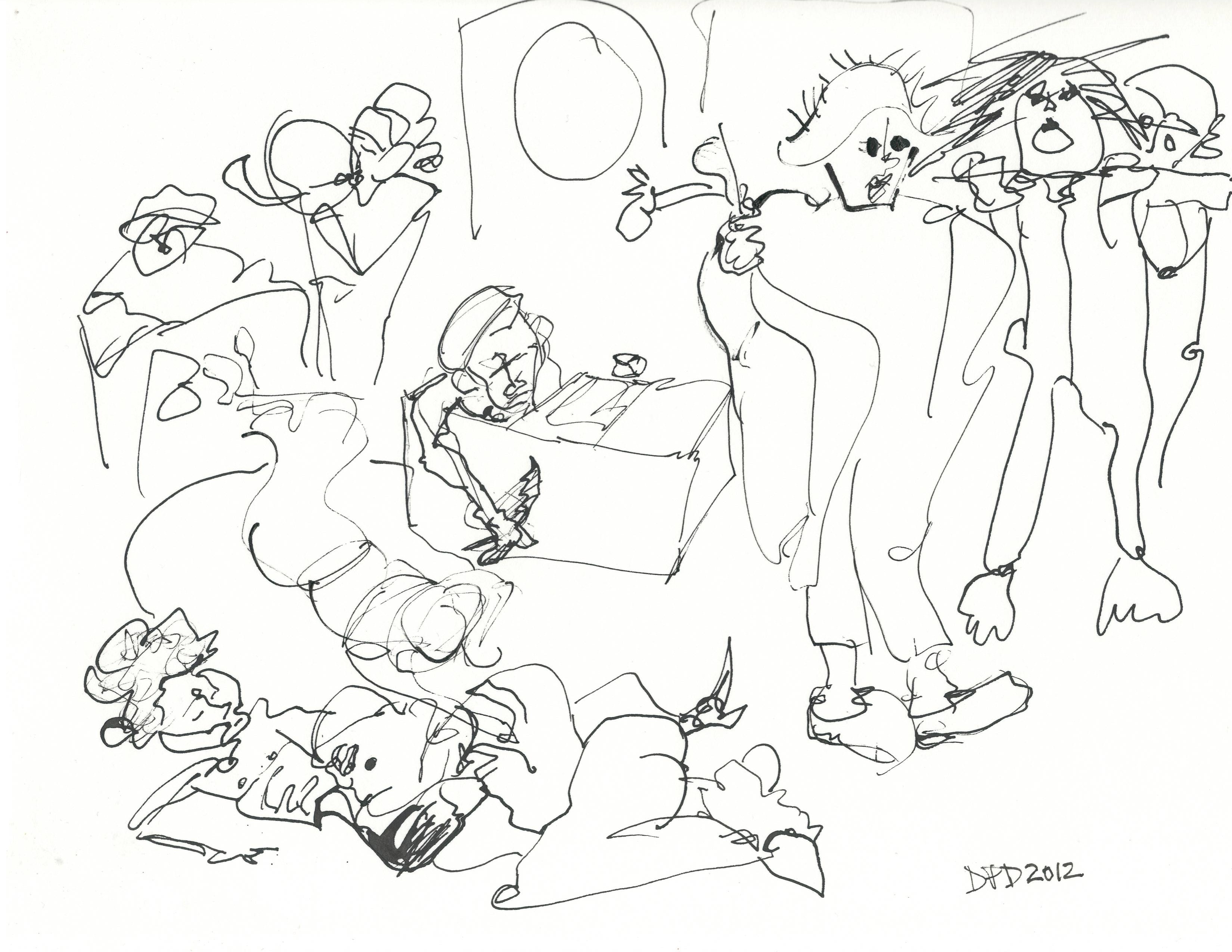
Marat / Sade, 2012. Pen-and-ink on Bristol paper, 9 x 12 in.

Rushing this to press, I write to encourage you to see Thrillpeddlers’s production of Marat / Sade at the Brava Theater on 24th Street in the Mission.  It will run through July 29th.  I was blessed with an invitation from a friend to watch the opening night performance.

As with their revival of Pearls over Shanghai in 2009, you will not be disappointed.  Raucous and darkly humorous, with a strong ensemble cast, revolution is examined through “[t]he persecution and assassination of Jean-Paul Marat as performed by the inmates of the asylum of Charenton under the direction of the Marquis de Sade.”

A Drug Solution

11 Jul

El Coyote, 1986. Graphite on drawing paper, 12 x 18 in. Collection of Phyllis Aycock and Michael Schreiber.

Lately I have been promoting an idea whose time has possibly come.  Drug use was a central feature of adolescence when I grew up in Los Angeles County.  Pot, acid, bennies, and other sundry pursuits, besides Coors beer and Spanada wine, were the means to enhanced recreation for my peers.  There was an incredible innocence to all of this.  My friend Cindy never considered that the glue she sprayed into brown paper bags and huffed would corrode her brain.  She had a big heart, but she wasn’t the smartest girl on the block.  Bruce was the most obvious example of drugs gone wrong; he often talked about god and the word was that he once saw Jesus on acid.

I hope for enlightened attitudes about marijuana and peyote.  Nature provided them and man has had a sacred, and sometimes profane, relationship with both for centuries.  The fact that marijuana is illegal, and prescribed medicines that lead to addiction are not, is a certain sign of how ludicrous the laws are governing controlled substances.  The Obama administration continues to raid medical marijuana dispensaries in the State of California even though the use and distribution of medical marijuana was legalized by the citizens of this state.  Beyond that, we could really use hemp in this country from our own manufacturing base, rather than importing its products from Canada and countries of the European Union.  Hemp is extremely versatile: paper, rope, textiles, food products.  As for peyote, the above drawing was created the morning after an evening of peyote.  How can one fault the blessings of such a natural substance?

My feelings, though, regarding drug use overall have changed.  The innocence of my youth did not contemplate substances like methamphetamine.  By the time crack was devastating communities during the 1980s, I knew the era of innocence was dead.  When I found out later that the C.I.A. supported Nicaraguan Contra funneling of these drugs into these communities, drug trafficking and consumption took on the darkest overtones I could imagine.  The level of violent crime directly connected to drug trafficking and use today is frightening.  Over 55,000 Mexican nationals have been killed because we use drugs, including marijuana, that come over the border to satisfy our desires.

The proposal is simple: create housing for individuals who use a substance to the point where they begin to harm society.  The housing would be equipped to provide all daily needs.  The drug of choice would be available in this housing 24/7 in unlimited amount.  The individual would, though, be cut off from society, no longer able to mingle with others.  Monitoring would include surveillance of the premises, but no intervention would be used.  If the drug user were to consume their drug of choice to the point of death, nothing would be done to prevent a terminal outcome.

Although I am not serious about this proposal, for various reasons, including the moral and ethical dimensions regarding compassionate intervention, I have mused on the notion purely for its novelty.  As I have talked to others about the proposal, many interesting suggestions have been made that would augment the original.  For instance, one friend suggested allowing people to watch a residence via the surveillance equipment, providing another mode of reality entertainment.  Another friend suggested creating communities on Treasure Island, relegating individuals to communities based on a common drug.  Some suggestions have been truly bizarre.  I discussed the possibility, with a friend, of local government manufacturing the drug so as to weaken the hold that manufacturers of illegal drugs have on society.  My friend proposed the arrest of dealers, which would lead to the arrest of manufacturers.  The manufacturers would then be held in custody and forced to continue producing the drug for the housed users.  And, as a ghoulish nod to Soylent Green, once the drug user expires, the body would be converted into food for surviving users, with the enhancement of drug traces in the recycled body product augmenting the supply of drug already circulating within the housing system.

As farfetched as the idea appears, popular culture has provided the model for decades now.  In W. Somerset Maugham’s 1939 novel Christmas Holiday, the character Simon Fenimore gives voice to the belief that as long as people believe they are receiving what they want, they will be easily controlled: “…I should give the people the illusion of liberty by allowing them as much personal freedom as is compatible with the safety of the state…”  The most frightening moment of George Orwell’s 1949 novel 1984 occurs at the Chestnut Tree Cafe as Winston Smith settles down to a glass of gin, “…his life, his death, and his resurrection,” perhaps the same Victory Gin we see him administering in his home at the beginning of the story, a potion that after an initial shock to the body begins to make the world look more cheerful.  His vain attempt to wrest himself from the power of the State already brutally eclipsed, his re-education through torture and other devices in the Ministry of Love complete, Smith is ready to accept prescribed reality once again.

The Nag

1 Jul

Image

The days of wine and roses, and then the days that wine and roses are no more.

Group Employment Preparation

29 Jun

Another day at the races, as I used to hear as a child.  Yesterday I attended an introductory group employment preparation (IGEP) event administered by the City and County of San Francisco.  I truly believed I had crossed the threshold into the County Adult Assistance Programs (CAAP) Personal Assisted Employment Services (PAES) Program, which would then connect me to a Federally-funded JobsNow4 program.  Having spent over two months trying to reach this point (see post dated May 11, 2012), I would become qualified as a potential part-time employee at the bookstore where I work on-call.  The store owner applied for these funds to hire a worker through JobsNow3, but can only hire an individual engaged in PAES.

There were a number of us seated waiting for the presentation to begin.  The session was already thirty minutes behind schedule when a six-foot-five transgender woman walked in, dressed in a skimpy, form-hugging blouse and spandex shorts, pink house slippers, and a wig that she paid constant attention to with a comb.  A moment later another woman walked in, announcing to the security officer in English that the gentleman at her side was her interpreter.  Using English, the transgender lady asked the woman where she was from.  “Fresno, why?”  “Oh, you said you use an interpreter.  What language do you speak?”  “I’m bilingual, I speak Spanish and Asian.  Some Chinese and Laos.”  From there the bilingual woman began a complaint about the room being full of hot air that persisted until she asked the security officer if she could sit outside while we waited.  She clarified to the transgender lady that she wasn’t speaking about anybody’s personal funk, no, more that the room was stuffy.  As she sat, she began to slightly asphyxiate, claiming loudly that she couldn’t breathe, wherein someone else suggested she was experiencing claustrophobia.  I was relieved when she stood outside, but it did not stop the noise.  I could hear her scolding her interpreter that he couldn’t blame her for the fact that he did not have a cell phone.

The slide presentation from an overhead projector was pleasant enough.  The facilitator used a very soothing voice and appeared to be genuinely connected to the service he was providing us.  I sat next to the transgender lady, who was fascinated by the shadows projected against the wall produced from her fluttering hands.  Following the presentation, half of us were led to a second “classroom” to be processed out by signing a form.  A scrawny, middle-aged woman, who looked as if she had spent ten years battling methamphetamine, sat across from each of us during the signing procedure.  The City and County employee was noticeably perturbed by the transgender lady towering over her, either because the person was decidedly nonchalant and bored or because she was preoccupied with combing her hair the entire time.

Sadly, once I asked about JobsNow4, no one could answer questions about the program.  But they did give me a telephone number to use to reach the offices for the same.  This was the straw breaking the camel’s back.  I already knew from the day’s presentation that we were expected to go through a training program, a half-Monday every two weeks, for three months, beginning September 17th.  When I spoke to the JobsNow4 representative about qualifying, I was informed that qualification would begin after graduating from the three-month training.  In other words, I would be eligible to become a potential employee for the bookstore sometime after January 1 of next year.

It is amusing now to think that one stop along the way involved sitting one-on-one with a City and County employee during an event referred to as Triage.  The worker, completely separated from all of the other workers I have spoken to now over the last two months, asked me a series of pointed questions that no potential employer would ask.  The questions roamed through matters of physical health, including diseases and medication, mental health, criminal history, and job experience.  I had offered a copy of my resume, expecting discussion about my job skills, to which a refusal was made.  But as I later answered her questions about experience, I overwhelmed her to the point where she requested the resume with great reluctance.  Clearly, City and County forms are not designed for a life history like mine.

Rather than sit through six sessions designed to enable a person to enter the job world, I believe I will forgo the service, and thus the opportunity to work at a bookstore, and return to searching for employment as I know how.  At least, when I sit with interviewers, I will not be forced to list the medications I use nor take in concerns about air or wig quality.