Tag Archives: david duckworth

Spring Art and Literature Gala, “Reclaiming Cinco de Mayo”

29 Apr

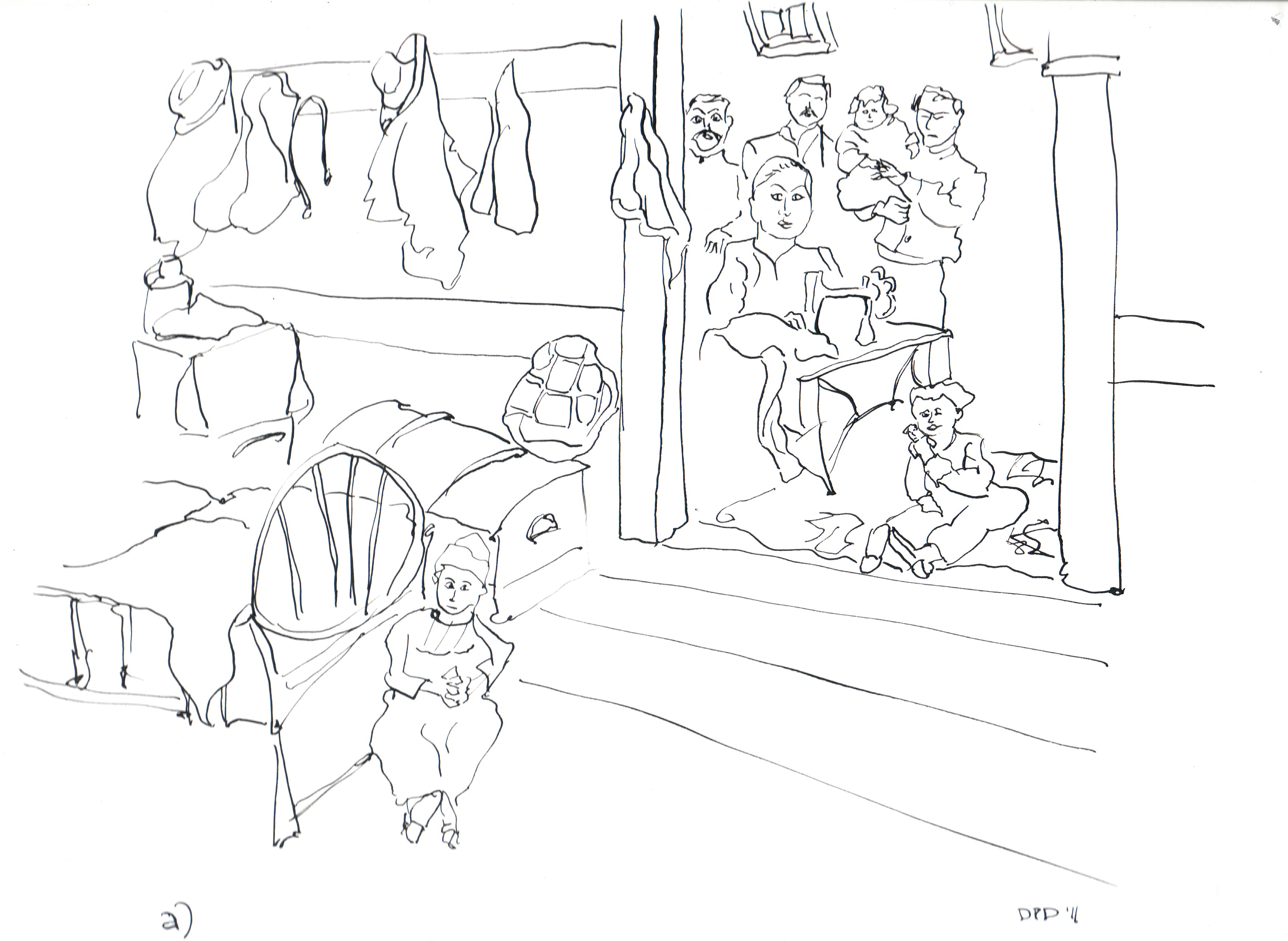
Seamstress, 2011. Pen-and-ink on Bristol paper, 9 x 12 in. After photograph: “While older children and adults work on various steps in the garment making process, they also care for younger children, prepare meals and consider their options.” Photographer: unknown, ca. 1900. Kheel Center 6153pb2f6-13

I invite you to attend a celebration being held on Saturday, May 5th, from 6 to 10 p.m., at the Eric Quezada Center for Culture and Politics, which will include a live and silent auction.  Three of my drawings, including the above, will be auctioned.  You can view a second drawing, “Stanyan and Haight,” at the November 21, 2011 posting.  “Seamstress” was exhibited at The Legacy of the Triangle / Protecting Workers Today exhibition, City College of San Francisco Mission Campus and ILWU Local 34 Hall, February 22—March 9 and March 25 and 26, 2011, respectively

The gala will be at 518 Valencia Street, with a $25 admission fee.  The event benefits the San Francisco Living Wage Coalition and Las Hormigas in Cuidad Juarez.  For more information, contact the San Francisco Living Wage Coalition at (415) 863-1225, sflivingwage@riseup.net, http://www.livingwage-sf.org.

Tents II

13 Apr

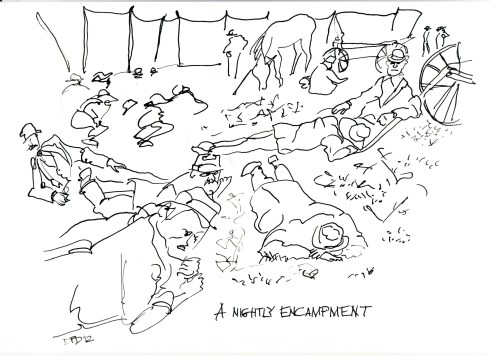
A Nightly Encampment, 2012. Pen-and-ink on Bristol paper, 9 x 12 in. Based on photograph.

“…He seems to be profoundly impressed with the sufferings of mankind and with a belief that there is a deep-laid plan of monopolists to crush the poor to the earth.” — a reporter on Jacob Sechler Coxey, as conveyed in the Pittsburgh Chronicle Telegraph of March 22, 1894

It appears pleasant enough: men sprawled across a grassy area as if at a picnic.  The arduous journey, though, that the many different groups traversed in order to converge on the Washington capitol  in 1894 was anything but a picnic.  Kelly’s Army, the largest of the “unemployed armies,” began their march from San Francisco, organized by Colonel William Baker and led by Charles T. Kelly, a thirty-two-year-old compositor in one of the city’s printing businesses.  Arriving in Council Bluffs, Iowa from Omaha, Nebraska on April 15, the men slept on damp ground.  Upon relocation to Chautauqua grounds three to four miles east of the city, the army slept in the mud and spent the next day standing in cold rain with flurries of snow.  That an otherwise unused amphitheater at Chautauqua Hill housed a militia company instead of Kelly’s men was no mistake: the militia officer in charge kept them out.  Eventually an indignant citizenry demanded the removal of the militia.  Kelly’s army had drawn an estimated 30,000 of the curious to Council Bluffs; the same curiosity followed the various unemployed armies wherever they passed.  Although their demands were lodged with the governor, the people held the railroads responsible for the calling out of the militia and the mistreatment of these men.  Not dissimilar to today’s social discontent over a government run by corporations, this was an intriguing tale of populist agitation to reform government, captured sympathetically in Donald L. McMurry’s 1929 book, Coxey’s Army: A Study of the Industrial Army Movement of 1894 (Little, Brown, and Company; see page 24 for the above quotation and pages 164-6 for the above account; unless otherwise noted, quotations that follow are from same, indicated by page number).

A financial panic in 1893 preceded the movement of these armies, for which the monopolists or “plutocrats” were blamed,  an upheaval in markets resulting in runs on the banks, business closures, and massive unemployment.  This was not the first time the nation’s workers suffered from widespread unemployment.  Franklin Folsom points out, in his book Impatient Armies of the Poor: The Story of Collective Action of the Unemployed, 1808-1942 (University Press of Colorado, 1991), that the first in a recurring cycle of “full-scale, national, modern depression[s]” occurred in 1819 (page 18).  Perhaps two million or more were unemployed in 1894 (see McMurry, page 9, for various estimates).  At the Populist Party’s first national convention in Omaha in July, 1892, a platform was adopted, reading, in part: “We meet…in the midst of a nation brought to the verge of moral, political, and material ruin.  Corruption dominates the ballot-box, the legislatures, the Congress, and touches even the ermine of the bench.  The people are demoralized…The newspapers are largely subsidized or muzzled; public opinion silenced; business prostrated; our homes covered with mortgages; labor impoverished; and the land concentrated in the hands of capitalists…The fruits of the toil of millions are boldly stolen to build up colossal fortunes for the few, unprecedented in the history of mankind; and the possessors of these, in turn, despise the republic and endanger liberty.  From the same prolific womb of governmental injustice are bred the two great classes of tramps and millionaires” (7).

We have come full circle since the cry for reform of 1894.  Today’s Occupiers are dismissed as individuals uninterested in finding jobs and their camps are cited as public health nuisances.  The branding of reform movements as communistic lost its political edge.  Certainly there were anarchists and socialists in 1894.  “Petition in boots” was the phrase applied by Coxey to his endeavor and was perhaps coined by Carl Browne, one of Coxey’s lieutenants, who had long dreamed of a march on Washington.*  The British editor W.T. Stead attributed the origin of the phrase to a Professor Hourwitch at the University of Chicago, who compared the march of Coxey’s army to the “petition in boots” of the Russian peasants, marching “in bodies to present their grievances” (33, ftn. 1).  A Senator Wolcott of Colorado railed against the armies arriving at the Capitol by urging his colleagues to “stand together against socialism and populism and paternalism run riot” (112), the last key word a reflection of a federal government forced to provide for its unemployed.  But the industrial armies’ detractors appeared to focus, for the most part, on labeling the individuals comprising these organized, determined, and highly disciplined bands as tramps, “hoboes,” the “shiftless,” or “vagrants” (apparently even “walking bums” were despised by their own class in regard to those who lacked the “skill and nerve” to hop fast-moving trains).  McMurry carefully describes the estimated forty to sixty thousand “professional hoboes” in the United States during the early 1890s in order to differentiate the “tramp liv[ing] by his wits at the expense of society” from  the unemployed workers comprising the industrial armies converging on Washington (see 12-14).

Coxey was a successful business man based in Massillon, Ohio.  The owner of a sandstone quarry and producer of sand for steel and glass works, Coxey also held extensive farming interests.  He envisioned a federal government that would relieve the unemployment crisis through his Good Roads Bill, which instructed the Secretary of the Treasury to issue 500 million dollars in legal-tender notes for the construction of roads throughout the nation.  The bill would both secure work and circulate money.  Coxey followed this proposal with his Non-interest-bearing Bond Bill, which would authorize any governmental entity to issue such bonds for financing public works projects, the bonds possibly deposited with the Secretary of the Treasury as security for a loan of legal-tender notes.  Coxey, like members of the Greenback Party or Greenbackers, opposed a monetary system based on the deposit of gold bullion because political power then followed the dictates of private banks and corporations, sole determinants of the value of production and labor.

Like the Occupy movement today, the “Coxeyites” or “Commonwealers,” as these various marching groups became known, received popular sympathy.  Their long journey was aided by stays in locales where the armies might receive provisions or shelter for the night.  At Canton, Ohio, a number of Coxey’s men were housed overnight in the jail; at Louisville, Ohio, a number of the men slept in the city hall.  This particular army did carry a circus tent wherein the men slept on straw.  The armies were sometimes greeted by populist sympathizers with brass bands, crowds of onlookers, and supportive speeches in halls.  Train hopping and train stealing were frequently aided by railroad workmen willing to turn an eye or state governors unwilling to call in militia when demanded by railroad corporations.

At times, political sentiment in the Capitol also ran in the industrial armies’ favor.  In an open letter to the press, Senator William S. Stewart, of Nevada, addressed this direct petitioning of Congress, as Coxey progressed through Ohio, by defending the ballot as the only legitimate means of “retain[ing] [the] right to life, liberty and the pursuit of happiness.”  But he did agree with the overall sentiments of the Coxeyites when looking back on the previous two decades, observing that: “…now a ‘soulless despot of alien origin’, whose name was Money, was ‘monarch of the commercial world’, and administrative and legislative bodies were his servants” (72-3).  While Brigadier General Ordway assembled militia in the Capitol to stop Coxey’s arrival, Populist Senator Peffer, of Kansas, who had introduced Coxey’s bills to Congress, prepared for an open reception of the petitioners, referring to the perception of his senatorial colleagues as an “‘American House of Lords’, out of touch with the people” (107).  In the House of Representatives, Haldor E. Boen, of Minnesota, introduced a resolution instructing the Secretary of War to “provide camping grounds and tents for all organized bodies of laborers that came into the district” (109).  All for naught as Coxey, Browne and Christopher Columbus Jones were arrested on the steps of the Capitol building without having had an opportunity to utter a word on their petition.  As a result, fifty or more people from a crowd gathered at these steps were beaten by police clubs for having cheered Coxey.  Coxey’s intended speech included the observation: “…Upon these steps where we stand has been spread a carpet for the royal feet of a foreign princess, the cost of whose entertainment was taken from the public treasury without the approval or consent of the people.  Up these steps the lobbyists of trusts and corporations have passed unchallenged on their way to the committee rooms, access to which we, the representatives of the toiling wealth producers, have been denied.  We stand here today in behalf of millions of toilers whose petitions  have been buried in committee rooms, whose prayers have been unresponded to, and whose opportunities for honest, remunerative, productive labor have been taken away from them by unjust legislation, which protects idlers, speculators, and gamblers” (119-20).

*Franklin Folsom reprints part of a speech made by Joseph R. Buchanan to a San Francisco labor group in 1886 in which Buchanan outlines a march on Washington for the unemployed (Impatient Armies of the Poor, 147).  Folsom also details Carl Browne’s involvement in Dennis Kearney’s rise to power in San Francisco.  Kearney, an Irish immigrant who formed the Workingmen’s Party of California (WPC), saw the advantage he would have advocating against Chinese American labor: in 1877, one month after witnessing participants of a Workingmen’s Party of the United States rally join an organized group of “hoodlums” to demolish more than twenty Chinese laundries on July 23, Kearney changed his former support for Chinese laborers, and their reputation for working hard, to cries of “The Chinese must go!” in his speeches.  Browne became one of three members of the WPC executive committee and a large stockholder in the corporation controlling it.  Browne’s weekly paper, the Open Letter, served the same party.  Eventually Browne became Kearney’s private secretary (ibid, 131-6).

Visit Me in Paris

8 Apr

While I will not be able to travel there, perhaps you will.  At any rate, go and see my art in a group exhibition, “Écritures en migration(s): Histoires d’écrits, histoires d’exils,” at Paris University 8 à Saint-Denis, on May 11 and 12th.  The exhibition is to be part of an academic program.  I will exhibit one pen-and-ink drawing and four stencil designs, executed by my friend Philippe Barnoud.  You can visit the colloquium website at: https://sites.google.com/site/ecrituresenmigrations/

Bread and Roses Exhibition on View at LaborFest Website

29 Mar

The January exhibition of art at International Longshore and Warehouse Union, Local 34 Hall, celebrating the one-hundredth year commemoration of the Bread and Roses strike of Lawrence, Massachusetts, has moved to a virtual location: laborfest.net.  If you did not have a chance to visit the art in January, you can see it now.

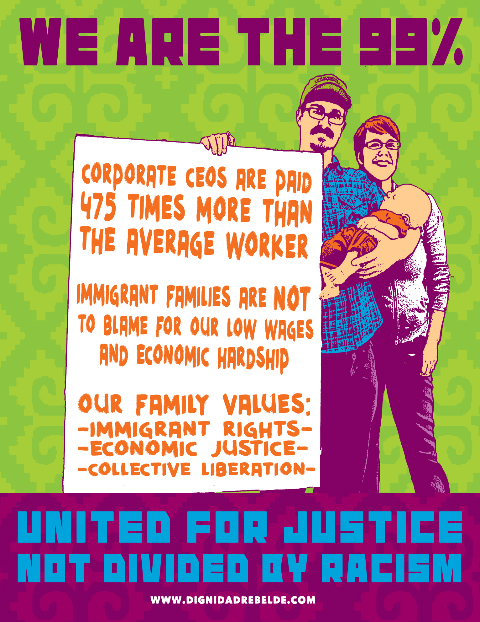
Melanie Cervantes, San Leandro, and Chris Crass. United For Justice, Not Divided By Racism. Print. Courtesy of Melanie Cervantes. DignidadRebelde.com. 

Bubbling Up

18 Mar

The Red Door Cafe window, Post.

A window along Polk.

Graffiti on a laundromat sign, Post and Franklin.

Streets

26 Feb

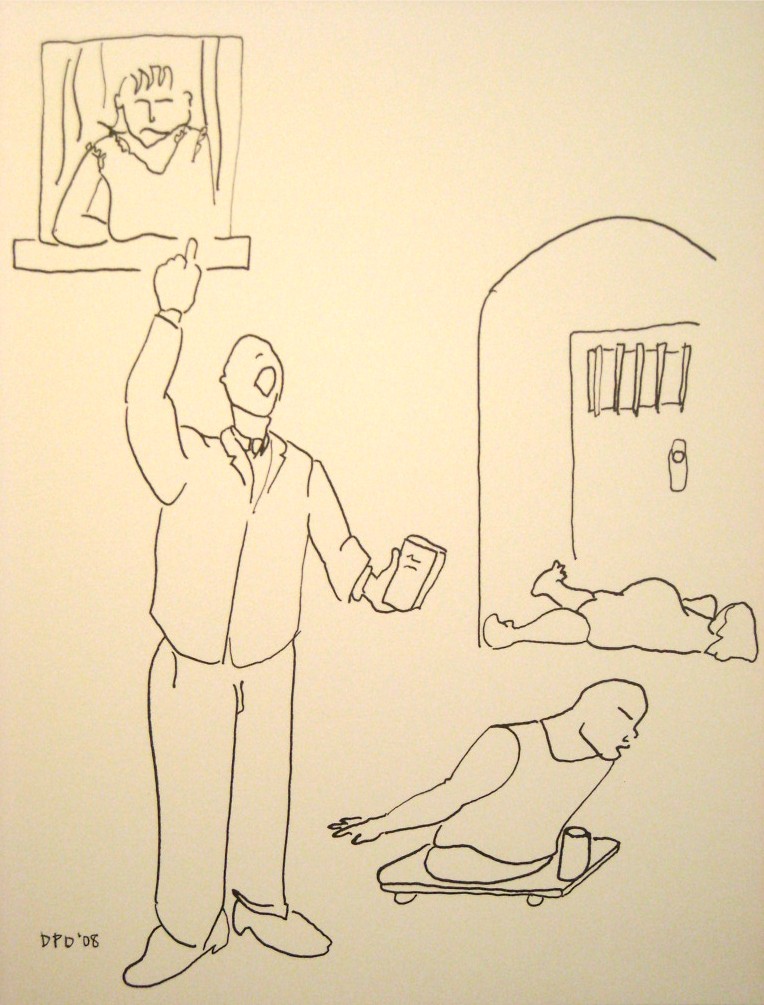
Untitled, from the series Short Tales from the American Landscape, 2008. Pen-and-ink on Bristol paper, 9 x 12 in. Collection of Patrick Marks.

Bodies litter sidewalks, asleep under blankets.  Bodies move in slow procession along the streets of the city, with belongings attached in back packs or  valises or shopping carts.  Bodies congregate at the 16th and Mission plazas, like pigeons en masse.  Yesterday morning I discovered a young man was asleep in the shower room of the hotel with the door locked.

It’s time to move.  The 21-day limit at the hotel arrived today.  The managers avoid the city’s residency requirements by keeping people moving.  Move.  Keep moving.

An American Love for Automated War

22 Feb

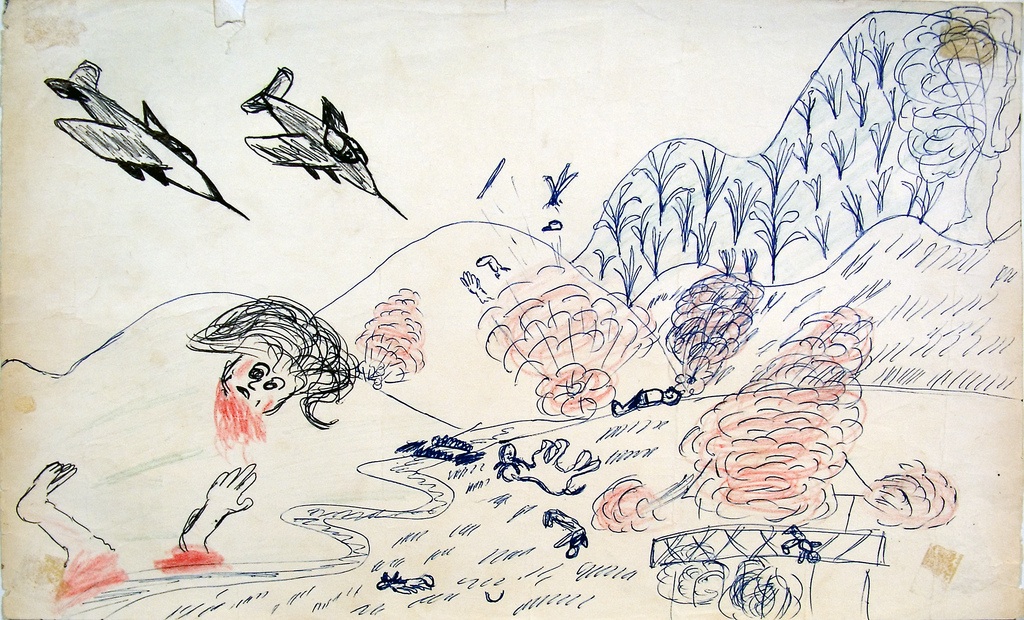
Drawing created by a displaced 27-year-old Laotian farmer in 1972. Courtesy of Fred Branfman.

What sadness!  Formerly, the fragrance of ripening rice

would fill the ricefields

I would see flowers opening their blossoms everywhere

in the forests

How beautiful it was for us!

— by a 20-year-old Laotian man, a traditional singer

It was a fertile land, a land of temperate weather and lush landscapes, rich in forests, jungles and mountain scapes.  Rice was the main crop of the region.  Water buffalo, cows, pigs, horses, ducks and chickens were staple livestock.  People lived in small villages where a pagoda might serve as a focal point.  Needs were simple enough that marketing was limited to occasional trips to purchase textiles and clothing.  Then the American bombers came.

From 1964 to 1969, the American government conducted a secret air war against the Laotian people occupying the Plain of Jars, the people there known locally as the Lao Phouen.  The Plain of Jars, so named because of receptacles found in the region believed to be from an ancient Mon-Khmer race, was located in the central Xieng Khouang province.  Editor Fred Branfman’s book, Voices from the Plain of Jars: Life under an Air War (Harper Colophon Books, Harper & Row, New York, 1972) documents the complete disappearance of a civilization through the testimony of survivors from this American-waged Guernica, survivors who were eventually herded into encampments outside the southern Laotian city of Ventiane.

It was the political victory of the Pathet Lao (“nation of Laos”) in May, 1964 that prompted the American government to act.  The United States had earlier attempted to control the Plain: from 1955 to 1963, funding Ventiane regime and far-right coups at a cost of $480.7 million; expanding a right-wing Lao army from a few thousand in 1954 to over thirty thousand by 1960; organizing a separate army of Meos, Laotian hill tribesmen originally from China, under the leadership of the C.I.A.; and establishing Air America bases owned by the C.I.A. (see Branfman, pages 12-13).  Following Western loss of control of most of the Plain, United States influence shrank to an area southwest of the Plain, where the C.I.A. directed the military base Long Tieng (Branfman 13-14).  Strategically, the United States had used northern Laos for Meo and American special forces teams entering North Vietnam on espionage, sabotage and assassination raids, from the 1950’s on; radar sites aiding American bombers attacking North Vietnam in the mid-1960’s; and, also, as a base for carrying out espionage missions into China (Branfman 16 fn. 14).

According to a U.S. Senate Staff Report, quoted by Branfman, the air war was meant “to destroy the social and economic infrastructure of Pathet Lao held areas,” with clarification from Branfman that “it was meant to hurt them by depriving them of local food supplies, disrupting transport and communications, killing off potential recruits and rice porters, demoralizing the civilian population, and eventually causing a refugee flow away from the Plain” (17-18).  Indeed, every aspect of civilian living became targeted under this “automated battlefield.”  Villages were bombed to smoldering ruins.  Rice paddies were destroyed.  As civilians fled to forests and jungles, these refugee sites were destroyed.  Even attempts to live in holes dug in the ground and farm at night were without avail; reconnaissance and electronic aircraft filmed and tracked the people below everyday for five and a half years (Branfman 18).

I found a copy of this book two months ago quite by accident.  Although a teenager in 1972, I was completely unaware of this remarkable testimony from the survivors of an American automated air war.  The words of these people, many who could not understand why the United States was bombing, saddens me greatly.  The drawings that are included are harrowing visions of the destruction we wrought against a people we held absolutely no compassion for.  What are we ignorant of today as our government acts secretly elsewhere in the world?

Branfman continues to educate people about the morality of automated war and the targeting of civilian populations.  You can learn about his life-long peace and justice work, and greater detail about the bombing of the Plain of Jars, at his blog: http://fredbranfman.wordpress.com.  His website, Truly Alive: Facing Death in the Prime of Life, at www.trulyalive.org, addresses psychological and spiritual principles with concern for societal and biospheric well-being.

Note: the above poem appears on page 37 of Voices from the Plain of Jars.

It’s 4:45 in the Morning

7 Feb

Thus the day began with the neighbor in number 21 turning on his radio as if a concert had been demanded by the whole building.  I do not know this person.  This was my first morning waking up at the Westman Hotel on Mission Street between 16th and 17th Streets.

As all good things come to an end, my stay in the Sunset district house in probate ended on Saturday morning.  The estate had been settled and work men were already preparing the walls for painting.  I spent the weekend looking for a hotel where I could pay for the coming week.  The No Vacancy signs were out in full force.  Before my final resting stop, I visited a variety of hotel lobbies that typically were cluttered and run down.  At a hotel on 16th Street between Valencia and Mission Streets, two garbage cans heaping with refuse greeted me as I was helped through the street-level door by a resident, a young woman who looked as if she had not eaten in a long time.  The hunger in her eyes, though, spoke of drugs or sex.  At the top of the stairs a clerk quoted a price of $200 for the week.

The Westman is protected by two iron gates, one street level and the next second-floor level across from the manager’s unit.  The building is run by a South Asian couple.  The husband first stared at me as if I were not to be trusted.  They let me inspect the room, but not without resistance.  Once paid, they became cordial.  As I waited to finish the business transaction, a couple leaving paid their good-byes to the manager’s wife.  The woman leaving noticed the cash in my hand and advised me not to display money in the hotel, a clear warning that I take seriously.

I went to find number 20 one flight up.  As I reached the top of the landing I witnessed a young woman in number 18 bent over strewn clothing on the floor, her door fully open, muttering some dissatisfaction.  She noticed me and complained that one would think they could clean the place for the fifty dollars she had paid them.  She moved towards me as if she had picked up a new scent.  She looked like a drug user, so I moved away for fear of becoming the money conduit for further recreation.  She continued to say hello to me, though, whenever I passed by.  When she hears steps outside her room, she opens her door with a Lennie shout-out: “Lennie, is that you?” “Lennie, are you there?” “Lennie, come here.”  Lennie must either have the money or the drugs.

Number 20 is a quiet affair: one chair, one stool, one dresser, one closet, one wash stand with mirror, and a bed.  On the dresser is a television.  The hotel advertises cable TV.  A towel, roll of toilet paper, and bar of Del Webb’s TownHouse soap are issued upon payment.  There are bathrooms on each floor, but the only shower I have found is one floor down.  The walls and other surfaces of unit 20 look as though every army in modern history has camped here.  There are small peepholes through walls between units, peeling paint, and cockroach stains.  Small, personal graffiti is everywhere, my favorite inscription written above a chair next to the door of the room.

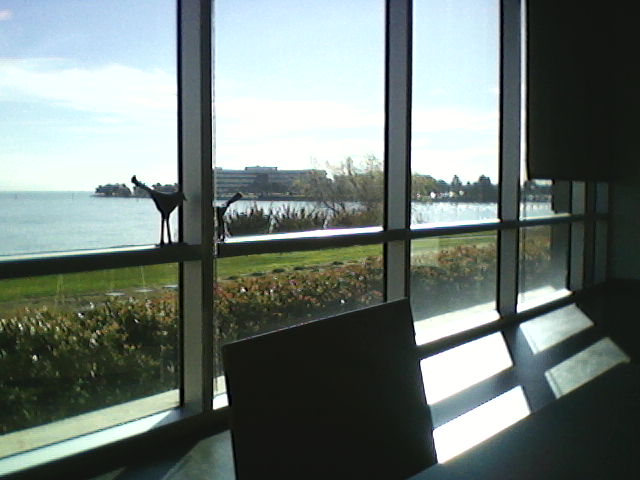
I planned to wake at 5:30 so that I could prepare for travel to a temporary job site in Sierra Point, on the bay in South San Francisco.  I am part of a contracting crew doing document control for a pharmaceutical company.  Because of this morning’s blaring noise I left early.  A free shuttle from Balboa Park BART station takes me to the job.  The ride is short but picturesque.  It is a time when I can meditate.

The work place itself offers space for lovely day dreaming as the glass pane windows along the back facade face the bay directly.  The employee cafeteria is spacious.  The company provides ample free food daily, including three kinds of fresh fruit, organic energy bars, organic yogurt, organic juices, and various healthy snacks and bottled drinks.  Free Peet’s coffee is brewed early in the morning.

I have never experienced this kind of serenity on the job.  It is not something I would even look for otherwise.  But I seek it out in the morning before the work day begins and thereafter during breaks.

In the dingy reality of a hotel room and its environs I believe there must also be beauty.  It will be found with love, courage, and the aid of balance.

Minorities and the Critical Decade: World War II and After

30 Jan

Minorities and the Critical Decade: World War II and After

Join me for a ten-session course beginning Wednesday, February 1st.  This is offered through International Free University, and, yes, it is free.  You will find me in Room 215 of the Science Building at the Ocean Campus of City College of San Francisco, from 6:00 to 8:30 p.m.

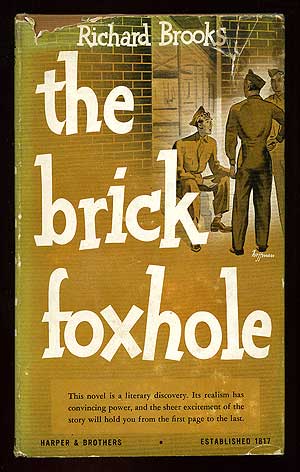
This course looks at the rise of consciousness in American society towards minorities and minority rights through the lens of popular culture and social discourse during and following World War II.  American participation in World War II pressed American society to live by the ideals of the democratic society it espoused as it battled fascist states overseas.  This not only resulted in the reevaluation of laws denying Chinese, Indian and Philippine Americans citizenship, but also challenged Jim Crow laws segregating the Black and White races.  By the end of the 1940s, challenges to anti-semitism were prevalent and homosexuals were being viewed by some as an emerging minority.  On the other hand, the incarceration of Japanese Americans struck an unspoken blow to citizenship and civil rights in the United States.

Through the lens of popular culture, including short stories, novels, cartoons, plays and film, and the fine arts, narratives focusing on minority representation are examined and contextualized both within the realm of popular cultural production and discourses from the social sciences.

Squimmy

24 Jan