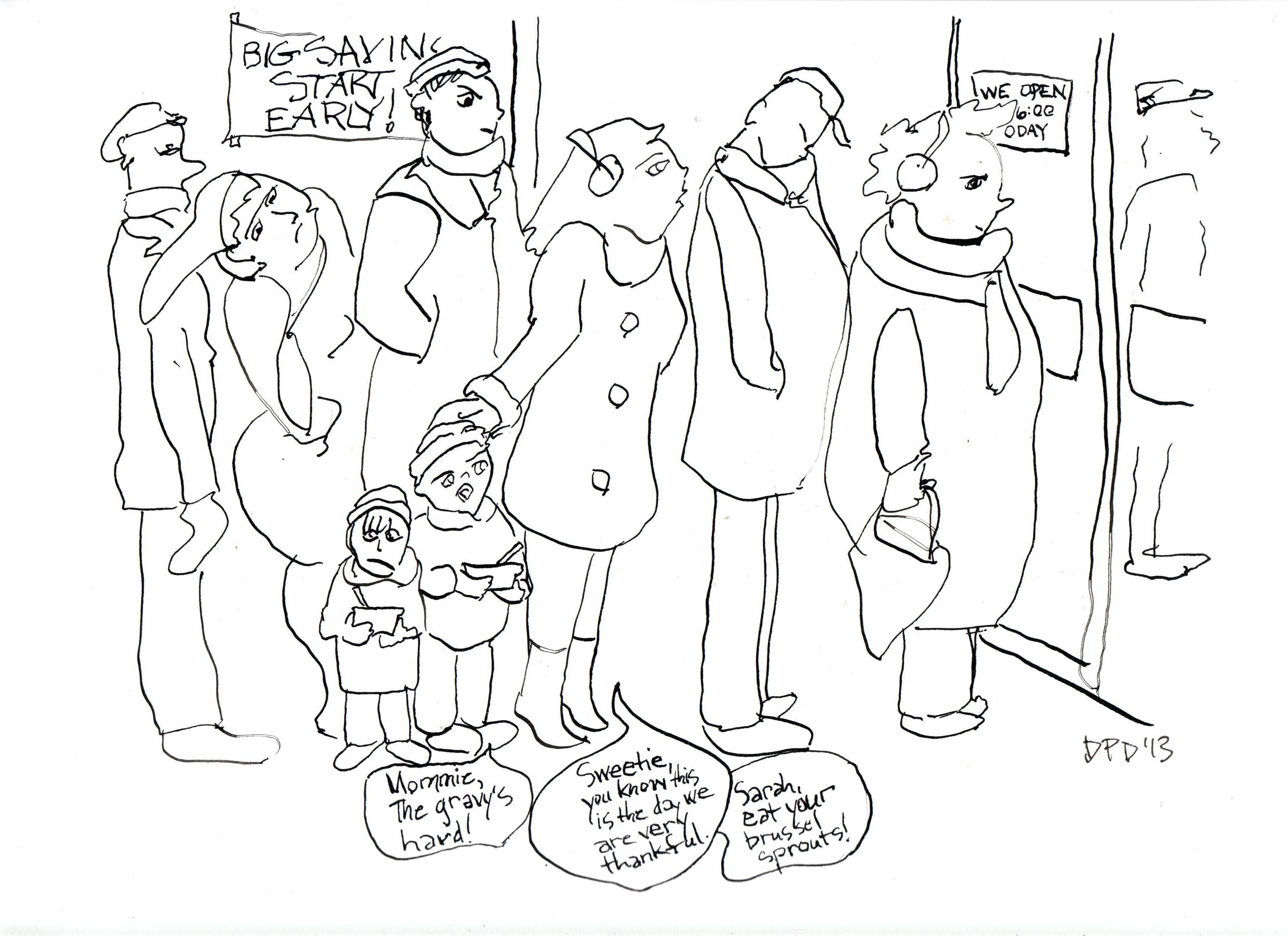
 David Duckworth, A Time Honored Tradition, 2013. Pen-and-ink on Bristol paper, 9 x 12 in.
Tag Archives: david duckworth
A Time Honored Tradition
14 DecBook Reading with Takashi Tanemori
28 NovSaturday, December 7, 6:30pm
The Path to Forgiveness, The Way to Peace:
An Evening with Takashi Tanemori
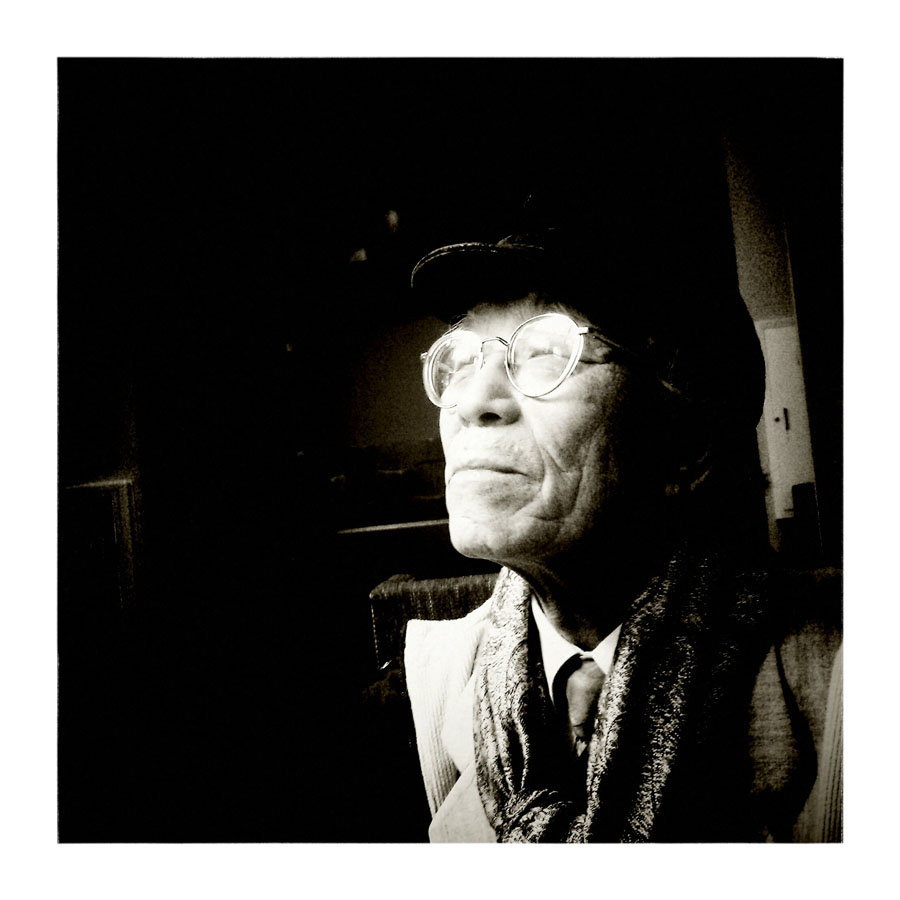 Takashi Tanemori, survivor of the 1945 nuclear attack on Hiroshima, Japan, and long-time peace activist, will be present during a reading of his memoir, Hiroshima: Bridge to Forgiveness. Losing both parents and two sisters to the atomic blast and its aftereffects, Tanemori became an Oyanashigo – a street urchin – who struggled to stay alive by searching waste sites and garbage cans for food in the ashes of postwar Japan. At the age of 18, he emigrated to the United States, becoming a laborer in the agricultural fields of Fresno. Currently a Berkeley resident, Takashi’s road to forgiveness spans decades of life experience, forging the bitterness of revenge into a devotion to peace and harmony. Founder of the Silkworm Peace Institute, a nonprofit organization dedicated to international peace, Takashi shares his life story through speaking engagements, conflict resolution seminars, workshops on The Seven Codes of the Samurai (“Peace through Forgiveness”), his writing and artwork.
Elizabeth Weinberg, John Crump and David Duckworth will read excerpts from Hiroshima: Bridge to Forgiveness. Takashi Tanemori will speak on exercising forgiveness and achieving peace.
Elizabeth Weinberg is the Executive Director of Silkworm Peace Institute. John Crump is co-author of Hiroshima: Bridge to Forgiveness. With an active interest in history, Hiroshima was his first book effort. Recently, he co-authored Thunderbolts of the Hell Hawks, about pilots of the 365th Fighter Group in WWII. David Duckworth is an artist, cultural historian, and lecturer on World War II era material culture.
The Green Arcade (bookstore), 1680 Market Street, at Gough and Haight, (415) 431-6800

WildCare
5 Nov David Duckworth, The Escape Artist, 2013. Pen-and-ink on paper, 9 x 12 in.
I began volunteer duties at WildCare’s San Rafael hospital in April of this year following four training sessions. This is where I spend Sunday afternoons. The hospital is one of several facilities in Northern California that cares for wild animals in physical distress. I chose the “bird room” after listening to Francoise, a long-term staff person, present during a training session. The largest birds we care for are crows and ravens, although I have not yet met a raven during my work. Ducks, hawks, woodpeckers and other birds are treated in facility areas outside of our own.
My fascination with crows is what brought me to WildCare, following advice from a friend who has been a volunteer helping shore birds for over ten years. Crows are highly social beings. Fearless too; I have watched an aggressive crow chase a hawk out of its territory. They are also ruthless towards other species of birds. Stories abound to their intelligence and ingenuity. As omnivores, the dishes we prepare for them are intentionally colorful: mouse parts, smelt parts, grapes, scrambled eggs, orange slices. At a young enough age, it is possible to feed them from these bowls using tweezers, something I take great pleasure in doing. They swallow whole making a peculiar gobbling sound as the food drops down the gullet.
Spring is the busiest time of year in the bird room as birds give birth to their young in the wild. Babies fall out of nests or are abandoned by parents. Birds are attacked by domesticated pets, especially cats. Birds fly into windows and glass doors or are hit by traveling cars. The rodenticides we liberally feed the environment poison birds. Lead poisons birds of prey. Tar and oil disable water birds. Birds are beset by diseases.
When the patient arrives, a health assessment is made. Broken bones may be set. Open wounds are treated. Nutritional and medicinal needs are prescribed. The bird room itself is equipped with incubators that provide oxygen-rich, warm environments. Small cages also serve to house patients. Crows and pigeons are eventually moved to walk-in cages. Release back to the wild is the ultimate goal for every patient, but some, alas, do not make it during the first twenty-four hours.
I never thought I would like a pigeon, but once you have tube fed a young one you fall in love. The most difficult part of this volunteer work is holding in your emotions. It is not permissible to speak to the birds, nor cuddle them. The smaller song birds tend to be skittish. Calm, controlled, quiet movement is required when working around the patients. Still, for all the restraint required, just being with the birds is richly rewarding.
For more information about how you can contribute to WildCare’s various programs, visit: http://www.wildcarebayarea.org.
Extraction
4 OctCall for Work for an Exhibition on the Theme of Extraction
Next year LaborFest will participate in the 100th year commemoration of the Ludlow mining strike in Colorado, better known as the Ludlow Massacre. This strike in Southern Colorado coal fields lasted from September 1913 to April 1914 and represents one of the bloodiest strikes in American history. To help commemorate this important moment in labor history, LaborFest will host an exhibition of art works on the broader theme of Extraction. Submission of art is sought for a possible exhibition at The Emerald Tablet in North Beach, San Francisco during the month of July 2014.
From earliest man’s extensive deforestation of the world for the purpose of creating fuel, extraction of the earth’s resources without environmental stewardship characterizes man’s efforts still today. Witness mountaintop removal and fracking, or ocean trawling, processes which leave in extraction’s wake widespread environmental destruction and no thought for earth cycles of replenishment. Likewise, the human body can be viewed as the site for extraction, whether in terms of energy, strength, endurance, or will, as today’s governmental and global corporate entities seek to extinguish workplace health and safety standards and workers’ unions or seek out human populations willing to perform labor who cannot rely on safeguards for health and safety nor compensation for a living wage.
Work is sought which addresses Extraction in any of its features: systemic, historically continuous, unsustainable, destructive, and/or dehumanizing. Work is also sought that counters a negative view of the extractive processes transforming the world with visions of a just relationship between human consumption and human and earth integrity. Please send three to four digital images in .jpg format and a short biographical statement to David Duckworth via duckdiva@yahoo.com. Include textual information for the following: title of work, medium, date of execution, dimensions. All submissions must be received by November 15, 2013.
For more information on the Ludlow Strike, please visit the post “Tents I”, dated January 13, 2012, at the blog dpduckworth.com. Or refer to either Scott Martelle’s Blood Passion: The Ludlow Massacre and Class War in the American West (Rutgers University Press, 2007) or Zeese Papanikolas’s Buried Unsung: Louis Tikas and the Ludlow Massacre (University of Utah Press, 1982). For information on LaborFest, please visit laborfest.net. For information on David Duckworth’s background in curating exhibitions, please visit the Curriculum Vitae page at dpduckworth.com.
 David Duckworth. Untitled, from the series Short Tales from the American Landscape, 2008. Scanned pen-and-ink drawing, 9 x 12 in., with digitally manipulated positive-negative reverse.
Welcome to the Hungry Neighborhood
1 Oct
Upon arriving at an SRO in North Beach on July 1st, I assumed I was leaving behind the interior noise of a hotel housing miscreant behavior. As with the drug addict whose name I’ve blocked from my mind, four doors away, knocking at my next door neighbor’s door at any hour of the morning; when Jose did not immediately answer, she would speak through the door as if the barrier were a mere inconvenience to the conversation she was determined to have. Sometimes Jose would wait a very long time to respond, perhaps hoping she would go away, but in any event prolonging my misery. Of course, miscreant may be too harsh a term. During the course of sixteen months at the St. Clare I met really decent people, people who, like myself, had become unmoored from the stability in life many others take for granted.
The interior of this SRO is quiet. My neighbors are for the most part older Chinese Americans who live peacefully and treat their neighbor with respect. Their children are grown living with families of their own in the East Bay.
Yet, ironically, the noise, although not internal to the building, surrounds it on almost every side. Besides the boisterous camaraderie I hear emanating from the interior of The Basque Hotel restaurant and bar across an alley, the street noise along Broadway is exceptional at times. This is a block with five nude lady businesses on or close by: Little Darling San Francisco, Condor Topless A-Go-Go, Roaring 20’s (with a Play Girl Love byline), Hungry I Club Topless Entertainment, and Garden of Eden (“A Taste of Paradise” just beyond the entrance). Granted, the barkers and occasional show girl standing near an entrance are discreet in their greetings; “hey buddy, come in and relax a little” in a familiarly coaxing manner like your best friend offering a Bud during televised football or your mother tempting you with fresh-baked cookies.
The noise results from the fact that these businesses attract a host of miscreants along the sidewalks, people who will spend half their evening under the neon canopy of the block. They are predominantly male. They don’t always get along with each other.
I cannot imagine a single one of these businesses having an iota of the breathtaking artistry of Crazy Horse saloon in Paris. (For a look at a visually stunning, yet at moments tediously long, documentary about the Parisian pleasure stop, see the 2011 film of the same title, directed by Frederick Wiseman). My own experience by comparison pales. I have seen many go-go boys at small bars attempting gyrations as if unseen hands were moving them through physical therapy following hip replacement. The exception was Splash! in Chelsea, equipped with an actual shower behind the main bar, where the boys always put on a show.
North Beach, though, is a haven of many small quiet blocks. I am glad I arrived.
Upon Leaving
23 Aug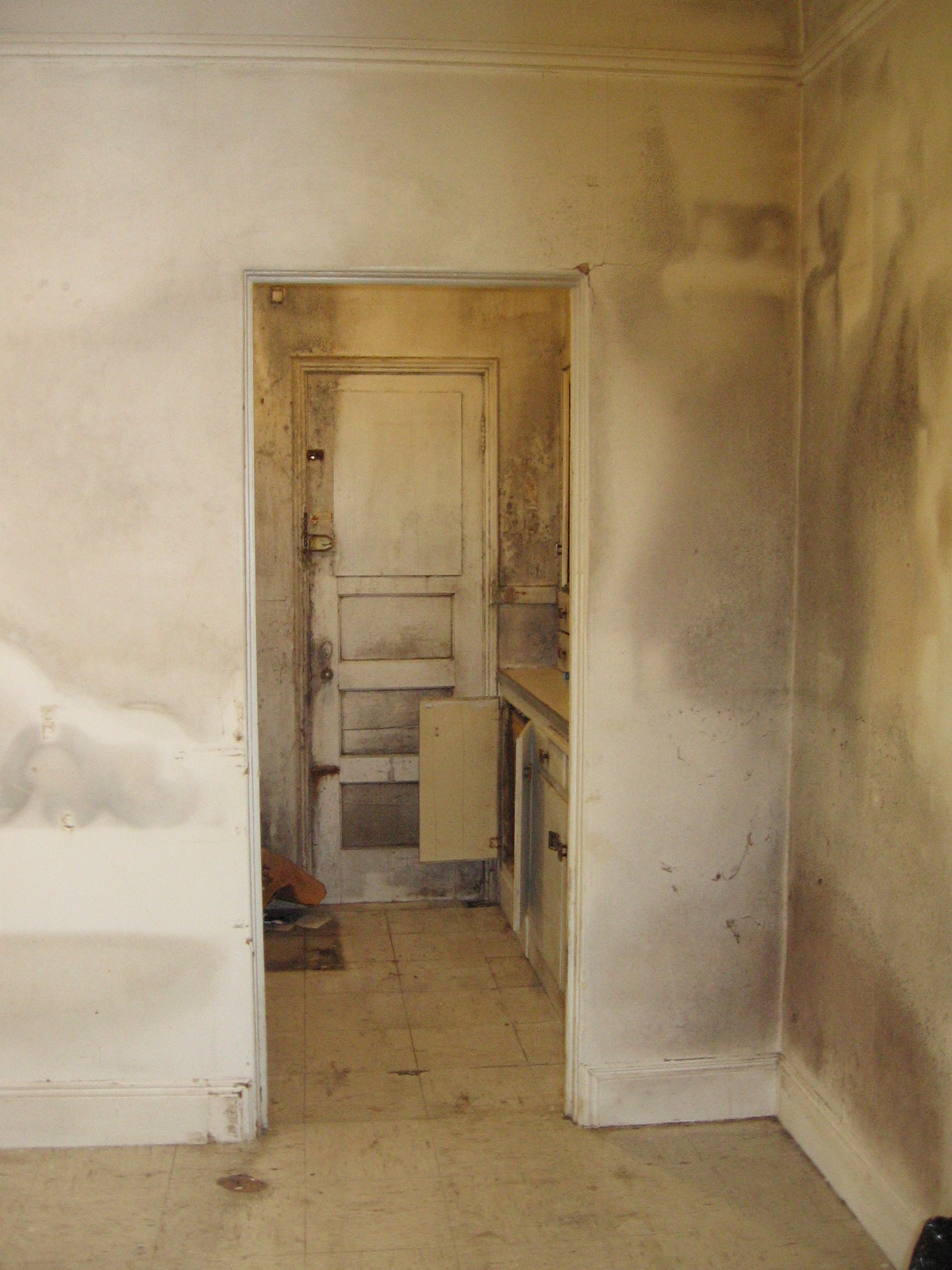
Mark Blackwood, Untitled. Digital photograph, 2013.
Mountains graced the abode of a certain fellow. For decades, this retreat in the heart of San Francisco provided space to a slow accumulation of packaged goods. By the time this dear mouse left the mortal world, a legacy of clutter was testament to his name. Every square inch of space was utilized to welcome the arrival of each new commodity. A set of lower cabinet shelves in the kitchen housed stacks of unwrapped National Geographic magazines. Metal shelving units graced living room, hallway and bathroom to support unopened boxes of VCR players and recorders, a voluminous amount of uncut plastic-wrapped packages of recording discs, 8mm projecting equipment and metal lockers of 8mm films, DVD and Blue Ray discs, an inventorium of unknown proportions. Sisters arrived from the South; they came and left, unable to account for the narrow passageways betwixt these mountainous ranges through which they once and only navigated the apartment. Nay, it was left to the building manager to take account of a hermetic life lived in electronically animated seclusion. Just an initial trip to remove the first truckload of film discs resulted in $500.00 worth of sales to a San Francisco video store known to pay $1.00 and $2.00 per second-hand disc. But for all the organizational worth of this seasoned hand at the follies of human entries and exits, what to do with three unopened cases of Vaseline?
Solidarity Across Borders
24 Jul Hiroko M. Kurihara. Preliminary digital design for quilt, Take a Number.
LaborFest 2013 Art Show, “Solidarity Across Borders”
This year’s LaborFest art exhibition covers the struggles of workers not only in the Bay Area, but also globally, including garment workers and the struggle to defend their lives, health, and safety. Whether the struggle for health and safety over one hundred years ago at the time of the Triangle Shirtwaist Factory Fire in New York City, or today’s life-threatening conditions in Bangladeshi sweatshop mills — both connected through the display of Hiroko M. Kurihara’s quilt piece, Take a Number — art is a powerful vehicle to convey the contradictions inherent in production and consumption as workers attempt to bring justice to their lives.
This exhibition features the work of Philippe Barnoud, Carol Denney, Nikos Diaman, Hiroko M. Kurihara, Peter Max Lawrence, Charles Lucke, Doug Minkler, JoAnneh Nagler and Martin Webb. Additionally, a display of photographs from around the world capture May Day actions in 2013.
Join us at International Longshore and Warehouse Union (ILWU) Local 34 Hall, 801 2nd Street, at King Street, next to AT&T Stadium, San Francisco (parking available at the union hall).
Opening Reception: Friday, July 26, 1:00 to 3:00 p.m. Featuring the music of Carol Denney and Friends.
Additional viewing hours: Saturday, July 27, 11:00 a.m. to 4:00 p.m.; Monday, July 29, 5:00 p.m. to 9:00 p.m.; Tuesday, July 30, 7:00 p.m. to 9:00 p.m.
Exhibition curated by David Duckworth. For further information, please consult: http://www.laborfest.net
LaborFest Kicks Off With Incredible Events
13 Jul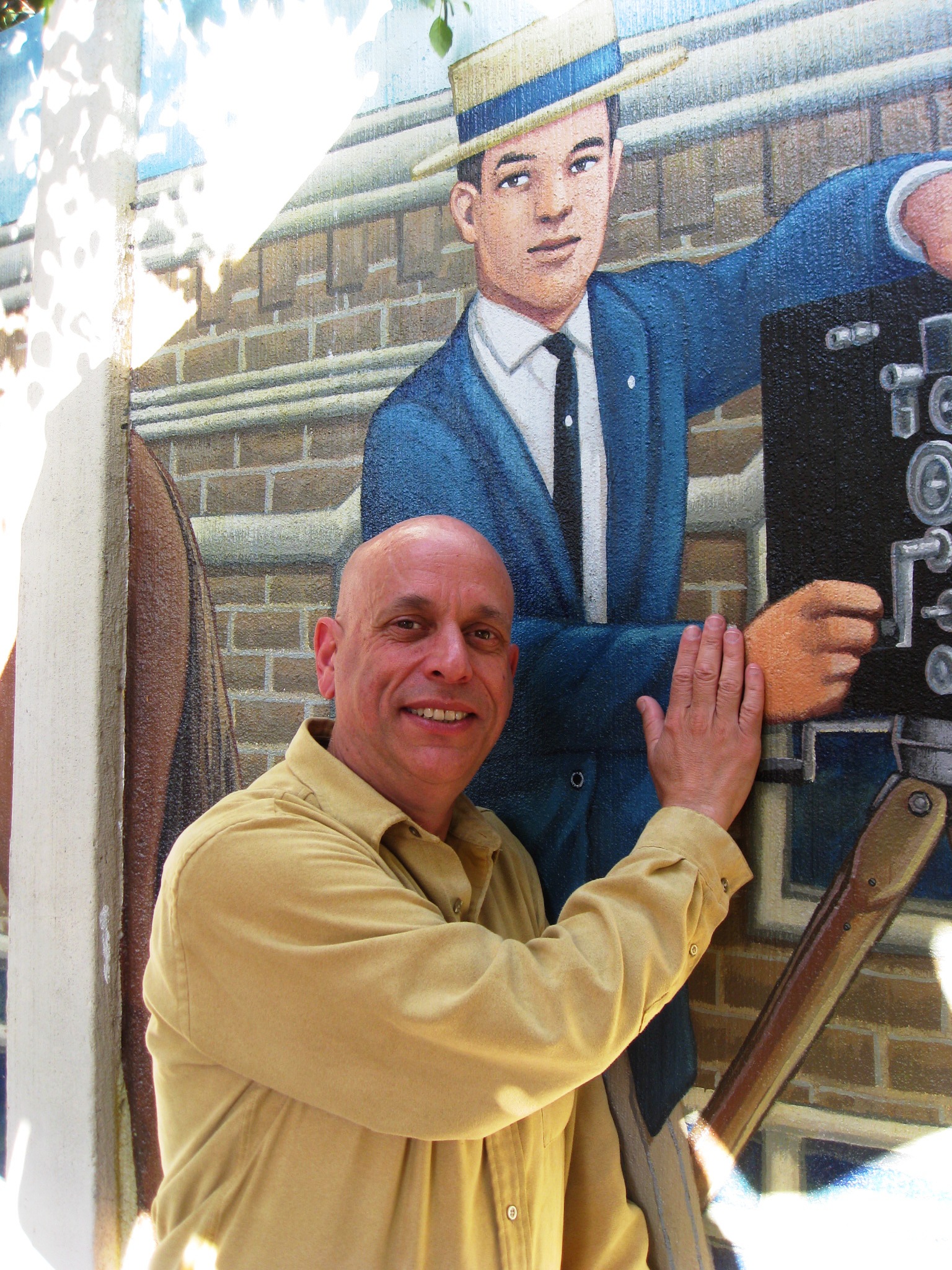
Author standing in front of image of Jess Robbins, cameraman, Essanay Film Manufacturing Company, Niles. Mural by Laura Ramie. Photograph by Melinda Gould.
I thank Melinda for the impromptu photo session at the home of Rena and David Kiehn in Niles. We only had a few minutes before a screening on Saturday evening of A Corner in Wheat (1909), The Cry of the Children (1912), and the feature film, The Whistle (1921), starring William S. Hart. This was my first opportunity to view the mural the Kiehns had commissioned artist Laura Ramie to paint. My great-uncle Jess, pictured here, is one of several historic figures along a wall behind the Kiehn house who were important in the development and operation of the Essanay Film Manufacturing Company, including film’s first matinee idol cowboy, Gilbert M. “Bronco Billy” Anderson. In 1907, Anderson and George K. Spoor had created the company in Chicago. By 1912, Essanay set up its West Coast shop.
The Niles Essanay Silent Film Museum today honors this early history. Weekend screenings of silent film not only include Essanay features, but films from other companies as well: http://www.nilesfilmmuseum.org/index.htm. David Kiehn is a resident historian who authored a book on Essanay’s history, Broncho Billy and the Essanay Film Company (Farwell Books, 2003). Ramie’s mural can be seen in its entirety at: http://www.ednapurviance.org/specialevents/lauraramie_nilemural.html. The artist also maintains a blog at: http://lauraramie.com/blog/?p=59.
This was LaborFest’s first year to collaborate with the Museum. On Saturday and Sunday, we also engaged excursions on the Niles Canyon steam train, another first in our twenty-year history of presenting events on labor and culture. The train ride is a lot of fun. The history of trains in Niles Canyon dates back to the building of the Transcontinental Railroad. Steam locomotives were in operation from the 1860s to the 1950s. As with LaborFest and the Niles Essanay Silent Film Museum, the operation of these trains is entirely a volunteer effort. Information on Niles Canyon Railway schedules can be found at the Pacific Locomotive Association website: http://www.ncry.org/.
Since our theme encompassed railroading and labor, what better way to culminate the weekend than a Sunday matinee screening of the feature length film, The Iron Horse (1924), directed by John Ford and starring George O’Brien. This film commemorates the building of the Transcontinental Railroad. But beware histories embedded in films. One of the intertitles during the film explains that White labor was not available for rail construction, so Chinese laborers were employed. But, in fact, Irish American labor had first been employed. The decision of these workers to strike led to the hiring of Chinese immigrant workers, who were considered hard working and docile. Docile they were not as they eventually struck as well. I may have counted two Chinese “extras” in this film. Otherwise, White actors in “Chinese face” portrayed Chinese workers.
On Saturday at the Museum, Laurence H. Shoup’s lecture on the 1894 Pullman strike in California covered enough ground to correct any misconceptions about the building of this railroad. Shoup is the author of Rulers and Rebels: A People’s History of Early California, 1769-1901 (iUniverse.com, 2010). Still, one must understand narrative in the context of its times. The Iron Horse is an engaging drama with a grand structure.
My thanks go out to the entire staff of the Museum for their time and effort in helping shape this programme. We were able to draw entirely from their archives; the choices were germane, provocative, and entertaining. Rena Kiehn, the Museum’s public relations director, was indefatigable in coordinating communication between the three volunteer organizations, creating copy, and publicizing the events. Melinda Gould, who as an event attendee happened to be on hand with a camera, took photographs under the challenge of intense, direct sunlight.
Finally, mention should be made here of the screening of the U.S. premiere of Ken Loach’s documentary, The Spirit of ’45. Shown at the Victoria Theatre in San Francisco on Friday evening, this LaborFest event enabled an American audience to visit the immense changes that occured in Great Britain following the closing of World War II. One of the film’s respondents, Dot Gibson, chair of the National Pensioners’ Convention, was on hand to introduce the film and take questions following. With their economy in shambles, the British people bravely moved to nationalize health services, mining, transportation, utilities, and housing. They succeeded in this and maintained these entities and services until the era of Prime Minister Margaret Thatcher. The film also explores the insidious dismantling and privatization that followed.
For more information about LaborFest events through the end of July, please visit: http://laborfest.net/.
Waterboarding: Last Gasp for Habeas Corpus and the Geneva Conventions
24 May Timothy Feresten. Untitled photograph. Martha and Stas wheatpasting during performance of Waterboarding: Last Gasp for Habeas Corpus and the Geneva Conventions.
At the time Julia Sher’s video of this performance was created I was hoping to upload to YouTube. The site did not host film this long, but they do now. Since the video has “sat on a shelf” for such a long time, in retrospect, it would seem to be irrelevant to today’s political landscape. Yet, at least with the ongoing incarceration of Bradley Manning, the power and authority of the state over the individual is still extremely important. The video can be viewed at: http://www.youtube.com/watch?v=c9L5PcUHkTg
The event took place at the Jonathan Shorr Gallery September 30, 2006, following the passage of the Congressional Military Commissions Act of 2006 earlier in the week. Role playing the parts of a State now authorized with absolute power over the citizen or non-citizen individual, John Landino, the interrogator, assisted by gallery visitors, coordinated the apprehension and interrogation of David Duckworth as detainee. After being suited, hooded and strapped to a canvas gurney, Duckworth was paraded along a section of a New York city street while under continuing interrogation. Returned to the gallery for “torture,” Duckworth was then stripped and covered with wet plaster cloth. Visitors then applied torn texts from the Military Commissions Act, the Taguba report, a U.S. Army document on Iraqi prisoner abuse, and news accounts covering habeas corpus, torture, the rights of detainees, the United States and its obligation as signatory to international treaties governing these issues, and the moral path of this country in its war on terrorism. Live spontaneously-composed music was provided by musicians; digital collage created by Beverly Richey follows video. The work was collaboratively devised by Duckworth, Landino, and Richey; texts and materials were collected by Duckworth. Video edited by Duckworth.
Other still photographs from event can be seen at an earlier post here, dated May 16, 2012.
This film is carried forward in loving memory of Ezra Talmatch.
 dpduckworth