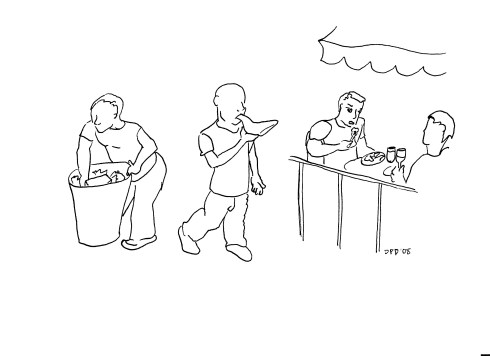
 Untitled, from the series Short Tales from the American Landscape, 2008. Pen-and-ink on Bristol paper, 9 x 12 in.
“Parade of Pain” is a term journalist Thomas Ewing Dabney, the former Financial Editor for the New Orleans States, introduces in a chapter of the book, Revolution or Jobs: The Odenheimer Plan for Guaranteed Employment (New York: The Dial Press, 1933). Three years into the Great Depression, Dabney wrote this piece of boosterism advancing a proposal of Sigmund Odenheimer to increase general employment. The numbers of unemployed were staggering. Four million were without jobs at the beginning of 1931 with that number doubling by the end of the year, representing a truer number of twenty-four million when factoring in the number of dependents (ftn. 2, pg. 27). Efforts to address the problem had been ineffectual. In 1930, with 2,429,000 unemployed, President Herbert Hoover appointed a Committee on Unemployment. The presiding Colonel Arthur Woods, former committee chairperson under President Warren G. Harding’s Conference on Unemployment from 1921-22, created a proposal for “a billion dollar highway-reforestation-public works development” (96-7). When the number of unemployed hit the ten million mark in 1931, Hoover put Walter S. Gifford, President of American Telephone & Telegraph, at the head of a newly created Unemployment Committee, who served for one winter season. Gifford favored private business expansion over any new public works projects (see quotation p. 98). Curiously, projects earmarked from the $332,000,000 voted by Congress in fall 1932 for emergency measures included: 1) $1,500,000 improvement to Chanute Field, Illinois (later Chanute Air Force Base), 2) $55,000 improvement to Charleston navy yard, and, 3) $130,000 improvement to Boston navy yard. None of these projects were deemed necessary by either the War Department or the Navy Department. According to Dabney, all construction in 1932 dropped to half of the 1931 output (100).
By the time unemployment reached 11,420,000 in February 1932, Congress created the Reconstruction Finance Corporation (RFC). The first action taken by the RFC was the “shovelling [of] money into the banks, and into Big Business, to pay off the banks and bolster bonds” (100). Between February 2 and November 30, banks received $806,750,000, the greatest portion to a few large institutions — $90,000,000 was awarded to the Chicago Central Republic Bank and Trust Company (also known as City National Bank and Trust) a few days before bank board member, Charles Dawes, resigned as head of the RFC, while Amadeo Giannini’s San Francisco-based Bank of America received $64,000,000. “Half a billion” went to railroads, and smaller amounts were doled out to crop-marketing organizations and farmers for crop production. Of the $146,535,000 earmarked for construction projects, and thus, job creation, not a dollar was put into effect by the end of 1932 (for statistics, see pp. 101-3).
These large amounts of money, for their day, mean nothing without translating that legislated funding into actual benefit to the lives of ordinary people. Dabney cites the case of Louisiana, the first state in the Union to receive unemployment-relief loans. There the day’s pay was set at a maximum of $1.50, with four days the maximum number of days for the work week. Total wage could not exceed $6.00, and that was limited to one person per family, no matter the size of the family. Average employment was one and a half days a week. The Mississippi bridge at New Orleans was the first such public works project under this funding. The wage-rate on that job was 25 cents an hour, with a ceiling on hours worked at 30 per week. Thus, the maximum a worker could receive was $7.50 per week (105-6).
Odenheimer was the president of Lane Cotton Mills in New Orleans. He had been with the company for forty-six years. During Odenheimer’s studies at University of Karlsruhe, in Germany, he came under the spell of socialism, perhaps suggesting, for Dabney at least, an unusual concern for the plight of the worker on the part of an employer. He was a firm capitalist, though, during his rise in American commerce. Early in his career, Odenheimer invented a cotton bagging made of cotton fiber at a time when the “jute trust” had doubled the price of its product. By obtaining a patent and then offering the right to manufacture this product to others without royalty, he managed to defeat the jute trust. He continued to innovate and engage the cotton industry in new methods of manufacture and distribution. He was one of the few cotton manufacturers to weather the onslaught of the Great Depression. Odenheimer first proposed his idea on unemployment at an Association of Commerce luncheon in November 1932. Simply put, he sought an amendment that would authorize Congress to legislate on hours of labor. With a congressional “Hours of Labor Commission,” any employer with, say, five or more employees would not be allowed to exceed a total number of hours per week, determined by the Commission on an economically dynamic scale (137).
While distributing worker hours to those unemployed by scaling down hours held by those employed seems simple enough, Dabney chose to stay clear of “the economic riddle”: “…foreign debts, business cycles, tariffs, debtor-and-creditor nations, budgets, the farm situation, the gold standard or armaments” (17). Dabney cites the collapse of purchasing power as the cause for the crash of 1929, with too much invested in profits and new capital investment and too little in wages, or consuming power. The author uses a frequently recurring equation that results in the phrase “purchasing-consuming-producing power” (70).
While it is true of this nation’s history that workers have always had to bear the brunt of recurring cycles of national depression since 1817, the idea, inherent in Dabney’s argument, that production and consumption are factors of unlimited quantity when unharnessed, does not accord with the concurrent history of corporate profit motivation. Louis Adamic provides a set of questions of what profit motivation produces in the cycle of manufacturing and distribution in his book, Dynamite: A Century of Class Violence in America, 1830-1930 (London: Rebel Press, 1984; first published in 1931 and revised by the author in 1934). In looking at racketeering and sabotage, two elements that rose hand-in-hand with industrialization in the nineteenth century and had been professionalized at the time of his writing, Adamic asks from the workers’ point of view:
“…have not [the capitalist class] laid waste the country’s national resources with utter lack of consideration for their human values — forests, mines, land and waterways? Did they not dump cargoes of coffee and other goods into the sea, burn fields of cotton, wheat and corn, throw trainloads of potatoes to waste — all in the interest of higher incomes? Did not millers and bakers mix talcum, chalk and other cheap and harmful ingredients with flour? Did not candy manufacturers sell glucose and taffy made with vaseline, and honey made with starch and chestnut meal? Wasn’t vinegar often made of sulphuric acid? Didn’t farmers and distributors adulterate milk and butter? Were not eggs and meat stored away, suffering deterioration all the while, in order to cause prices to rise?” (205)
Adamic relates the case of the Pacific Northwest Lumber Trust and the demand for lumber in 1917. After the entry of the United States into World War I, the demand for lumber in various industries skyrocketed. In consequence, lumber companies took advantage by boosting their prices: “…some increased them from $16 to $116 per thousand feet in a few days, and before the end of 1917 were selling spruce for government airplanes at $1200 a thousand. And most of that spruce could not be used for airplanes.” By comparison, workers’ wages increased only slightly where strikes were successful in coercing employers into raising wages (168).
The corporate landscape is the same today, witness oil spills destroying natural ecosystems, fracking for natural gas polluting natural water tables, or factories and mining polluting natural waterways. The profit motive in manufacturing has not changed. When pressed or when seeking to maximize profit, corporations have simply moved operations overseas where concerns for environmental degradation and worker health and safety do not exist. I recommend viewing the film, Last Train Home (2009), directed by Lixin Fan, which documents the movement of 130 million Chinese workers during New Year to reunite with their families only several days out of the year. It is heart rending with its focus on the cumulative effects upon the individual worker and the dissolution of family. Or, come to see the screening of Dust: The Great Asbestos Trial (2011), directed by Niccolo Bruna and Andrea Prandstralle of Italy, in its San Francisco premiere on Friday, July 6th. Besides exploring the “first great criminal trial” against asbestos manufacturers, which opened in Turin in 2009 and resulted in convictions in 2012, the film offers a look at the plight of asbestos-related work in India and Brazil. For further information on this and other LaborFest events for the month of July, visit: http://www.laborfest.net. A booklet for the complete programme is also available around the city, including The Green Arcade bookstore, 1680 Market Street at Gough.
Revolution or Jobs is still a useful guide to the economic landscape of the early years of the Great Depression. Through this reading, one finds a palpable sense of the scope and detail of human misery from the time. It was a time when people believed revolution could happen. Adamic shows how the press only reported on unemployment and hunger when, starting in 1930, communists organized hunger demonstrations and parades, which often resulted in mounted police riding down upon demonstrators and clubbing them, causing much bloodshed. It was the bloodshed which made headlines. And it was those headlines that gradually forced Hoover to publicly acknowledge the seriousness of the unemployment problem.
Tags: amadeo giannini, american telephone & telegraph, andrea prandstralle, asbestos, bank of america, boston, brazil, central republic bank and trust company, chanute field, charles dawes, charleston, chicago, city national bank and trust company, colonel arthur woods, cotton, david duckworth, great depression, herbert hoover, india, jute, laborfest, lane cotton mills, lixin fan, louis adamic, louisiana, lumber, new orleans, niccolo bruna, pacific northwest, reconstruction finance corporation, san francisco, sigmund odenheimer, thomas ewing dabney, walter s. gifford, warren g. harding, world war i














 dpduckworth