
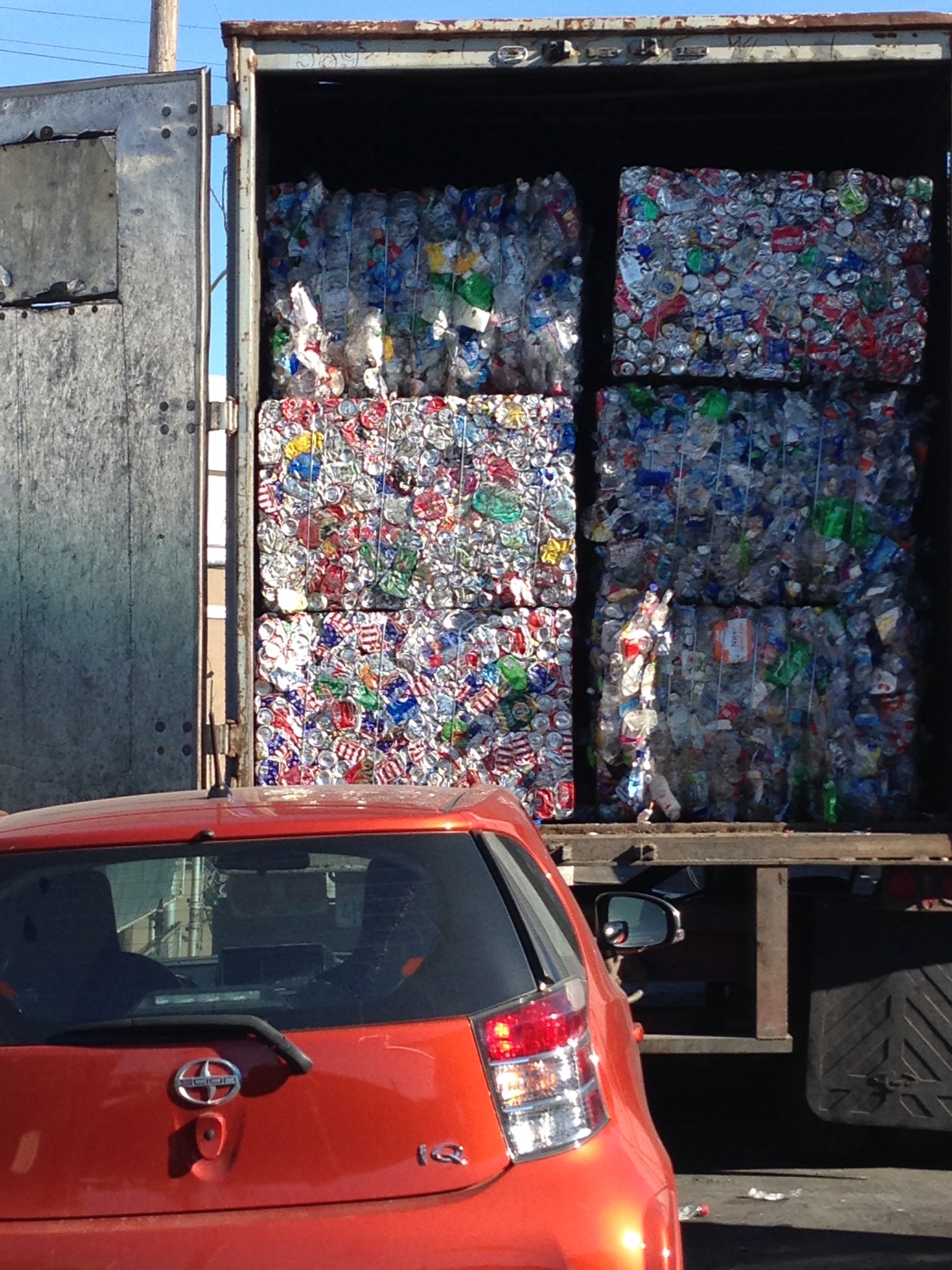
Our Planet Recycling, San Francisco. One bale of tin can weighs about 800 pounds.
Two headlines from November 7th came to my attention: “Tunica hosts Twinkie Eating Contest” and “90-year-old Florida man arrested for second time in a week after feeding the homeless again.” In the case of the first article (Associated Press; accessed online 11/8/2014), one learns that Joey Chestnut returns to “defend” his title in the 2014 World Twinkie-Eating Championship at Bally’s Casino. Noted is his former accomplishment of setting a world-record by downing 121 Twinkies in six minutes (“about one in every three seconds”). Steve Ettlinger cites the Hostess claim that it sells 500 million Twinkies a year (Twinkie, Deconstructed: My Journey to Discover How the Ingredients Found in Processed Foods Are Grown, Mined [Yes, Mined], and Manipulated into What America Eats [New York: Hudson Street Press, 2007]; page 8). With that many Twinkies in the world, we could all become Twinkie-eating contestants. In fact, Chestnut makes it look easy in accessible online videoclips. Be prepared to use your fingers by inserting most of them clumsily in your mouth. Ironically, Chestnut’s sportsmanship is about as exciting to watch as the repetitive arm motion of a Darts World Cup contestant. The elevation of bulimic eating to a sport can only be attributed to our fascination with the grotesque.
I can easily believe Chestnut’s feat as I remember eating Twinkies as an adolescent; it took about three seconds to eat a single Twinkie. That “so appealing” taste that Ettlinger refers to (8) may be true, given the individual nature of taste, but the appealing aspect that I would attribute to the Twinkie and like industrial products is the chemical input and reaction that the human body comes to crave as highly processed food becomes a staple of one’s diet. Do you ever remember singular moments in eating? I remember my friend John Engwerda serving a ginger souffle in his New York home. My god, what an experience! And it will never be repeated. Have you ever eaten the flower from the nasturtium, fresh from a garden? Why do moments like that bring the sensation of taste into pungent experience? But to call a Twinkie appealing as if eating one were an experience of enriching quality is laughable.
I began reading Twinkie, Deconstructed when I was involved in teaching a nutrition class for clients at the workplace. Many individuals from this community consume industrially processed food as the main staple of their diet. It is not uncommon for a client to consume three sodas on a daily basis. As a result, many are vulnerable to obesity, diabetes, and heart disease. (If you are curious about one label ingredient, sugar, measure out one teaspoon per gram to see what amount of sugar you may be consuming.) Ettlinger, who has involved himself with food at its source — gathering mussels in Maine, visiting the Beaujolais district of southeastern France to learn the origin and handling of wine grapes, eating wild raspberries from the yard — took on the project of investigating industrially processed food at its source(s) when his daughter asked what was in ice cream as he read the ingredients on a container. He did not have a way of explaining where polysorbate came from. Finding the iconic Twinkie ideal for investigating the “story of making convenience food, guided by science and commerce” (6), Ettlinger provides a comprehensive narrative of how each of the ingredients on a package list come to be processed, from the source.
You may feel as if you are an Ettlinger child reading his text. Structured as a travelogue, this is a narrative with a lot of explanation that rarely steps back to ponder. For instance, in writing about the vitamin thiamine mononitrate (B1), the author explains that the most common form is synthesized from petrochemicals “derived from that old trusted food source, coal tar”:
“. . . Thiamine chemicals are finished with about fifteen steps that may include, depending upon the company, such appetizing processes as oxidation with corrosive strength hydrogen peroxide and active carbon; reactions with ammonium nitrate, ammonium carbonate, and nitric acid (to form a salt); and washing with alcohol. It is edible at this point . . .” (37)
In this way, the journey is soothing where the information could be potentially jarring. Never mind that you may never have encountered an industrial food processing procedure before; it all works out in the end. On rare cccasion, the author includes brief word on the environmental costs of these industrial processes. For instance, in his chapter on phosphates, we learn that a Western Phosphate Field, within a hundred-mile radius of Soda Springs, Idaho, is the site for the mining of six million tons of phosphate per year. While Ettlinger visits a Monsanto phosphate plant to describe the industrial process of converting phosphate ore into liquid phosphoric acid, eventually to be incorporated into baking powder, the author notes several disturbing facts. Monsanto’s plant is the last of its kind in the United States. This is partly because of the “environmental concerns triggered by its toxic discharge” (157). One such plant, closed in 2001, became a Superfund site because of the level of arsenic and “other pollutants” found in the groundwater (157-8). We also learn that most of the phosphorus produced at this plant is used by Monsanto to produce the herbicide Roundup®. A newer “wet process” elsewhere in the world is superseding this older process.
Still, this examination of industrialized food processing is valuable in showing the awesome scale and science involved. Visiting the trona mine operated by FMC Corporation in the region of Green River, Wyoming, Ettlinger travels sixteen hundred feet below the earth’s surface by elevator to see where this ore is excavated. Trona is converted to soda ash, which then becomes sodium carbonate, then sodium bicarbonate, or, baking soda, one of the three components of baking powder (see pp. 141-52). The author follows it every step of the way. The book includes ample background information on the historical discovery and development of all the industrial food substances explored in the making of the Twinkie ingredient list.
Understanding that the Twinkie is a product of the “rural-industrial complex” with an “international nexus” is fundamental to viewing today’s industrial food processes (256). Given that, the author concludes his book by arguing that we, the consumer, should accept the chemical aspects of this web without reservation. First, history leads us here, such as “mass supply start[ing] to feed mass demand” here in the United States (259). Second, chemicals have always been in our food, as in the case of salt being composed of chlorine (“one of the world’s most lethal chemicals”) and sodium (“one of the most reactive”) (261). These are both false arguments: one must accept the author’s premise because they are presented to support it. Ettlinger’s unabashed enthusiasm overrides any and all concerns. While he states that “there is reason to be vigilant” about industrially processed food (260), we never learn exactly what vigilant concern should entail.
The Twinkie is an answer to putting food on the consumer shelf that is low-cost and readily available with a guaranteed shelf life. And so Ettlinger reminds us: “. . . Before getting on a high horse to decry the excessive pressures of capitalism that force food to be so overwhelmingly engineered, we need to remember this: no farmer would bring his or her crops to market without promise of a reward” (262). Enter Arnold Abbott, the 90-year-old Ft. Lauderdale criminal serving food plates to the homeless. At the time of his second citation, he faced 60 days in jail or a $500 fine (Marc Weinreich, New York Daily News; http:/www.nydailynews.com/. . . ; accessed 11/8/2014). The city ordinance he challenged restricts people from “camping, panhandling, food sharing [italics mine] and engaging in other ‘life sustaining activities’.” Pity food distribution systems that try to function independently from the excessive pressures of capitalism.










 dpduckworth