I am honored to host a short story by William Torphy. William and I first meet as I was organizing an exhibition for LaborFest at SOMArts Cultural Center, San Francisco, in 2009.
William Torphy’s poems, articles and critical reviews have appeared in publications such as Sebastian Quill, ArtWeek, Exposee, and High Performance. Ithuriel’s Spear Press of San Francisco has published Love Never Always (poetry collection), Snakebite (young adult fiction), and A Brush With History: Eda Kavin & The San Francisco Century (biography): www.ithuriel.com/ and www.edakavin.com/ek_book.php. He is a seasoned gallery dealer, exhibition curator and art consultant: www.torphyart.com/. William organized “Prophecy”, an exhibiton and series of events at SOMArts in 2007: prophecyhealing.org. This story is copyright 2013 by William Torphy. Illustrations are by David Duckworth.
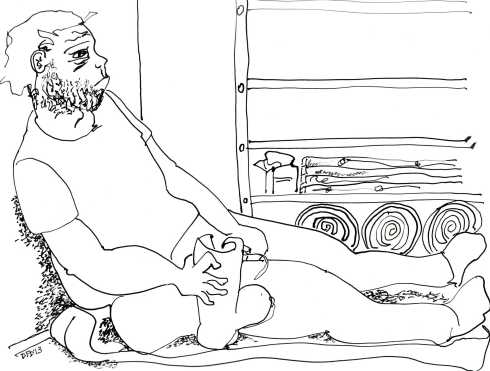
Let’s get one thing straight before we go any farther, okay? I’m homeless. I have no place, no room, no cave, no hovel, no aerie, no hut, and no tent. Nothing but a dirty sleeping bag I traded for a knife, and this waterlogged backpack with every lousy thing I own in it.
It’s been raining, coming down strong for many days now and there’s practically no escape from it for me. At first I hid under the trees in the park which helps in a light situation or when the rain’s just getting started. But it’s been pouring pretty steady off and on for weeks here. Some of the others gave in and line up for the shelters at night. I’ve stuck it out. I don’t like the shelters.
Right now, things are pretty good. Last night I broke into a shed on a construction site South of Market just half a block from my “office” at the freeway off ramp. Everything inside here smells like wet wood and oil but it’s pretty dry and safe. If I leave real soon no one will catch me. Maybe I can make the place look like I wasn’t here and come back tonight when things quiet down. Chances are somebody will see me coming or going, they’ll chase my ass out of here or call the cops, and it’ll be the end of a dry one-night stand for me. I might be taken into custody and hauled to a shelter where I might even be glad to sleep for a night or two with a warm bed and hot food. When I get sprung, showered and shaved, I won’t look so bad for my constituency.
My territory is 5th and Harrison. This is where commuters or out-oftowners come off the freeway and first land in town. It sometimes takes me most of the day but I usually raise enough money for a couple meals. Nearby there’s a convenience store run by Lebanese, a McDs and a Burger King and a KFC and even a bad-assed fish & chips. No surprise: just like at every other freeway exit in California. When I walk in I try to look halfway presentable which isn’t so easy when you’ve spent most of the day in the elements. The employees don’t exactly appreciate my business, but what can they do? I’ve got the money and they can’t legally hassle me even when I hang out hours with my paid-for coffee refill.
Man, I’ll tell you, the dudes who patronize those places eat a lot of bad-for-you food! People just don’t know what’s good for them. If I had real money, I wouldn’t be eating there, that’s for sure. I’d go to Chinese Buffet or even get myself a good steak somewhere. I knew a homeless guy once who claimed he was strictly vegetarian. He carried a sign in rainbow colors, except he didn’t use yellow which doesn’t show up on white too good: $$ FOR VEGGIES. We’re talking about the San Francisco Bay Area, so he had a sympathetic captive audience. Thing is, he never ate vegetables. He hated them. He always ordered a hamburger, nuggets or a fish sandwich. Sometimes he’d get vegetarian donations which he actually threw out. I told him he’d have bad karma for lying.

Me, I don’t fool the public. Sure, I can tell you plenty of personal hardluck stories but I know I’m mostly responsible for my situation. Nothing ever really ticked for me here. By “here,” I mean planet earth, this terra infirma. That’s a little joke. A woman once corrected me about my Latin. She said I was misquoting. I told her I meant what I said: “terra infirma,” because there’s nothing certain here except uncertainty.
She got my meaning and laughed. But I don’t get it. By this I mean, life in general. I used to think I understood something but not anymore. My brother Matt got it though. He saw the handwriting on the wall, finished high school and went off to college. He collected a couple degrees along the way. I didn’t follow his example, needless to say. I took off early from life, believing I was so smart racing down to Mexico where I could experience a foreign country and try some interesting drugs. But when I returned home, it seemed like the real foreign country to me. Matt told me to get smart fast and go back to school but it was too late. English looked like Spanish and everything moved too quick. The folks treated me like I was crazy. They kicked me out of the house after six months. I don’t blame them. I was a total freeloader, what’s called a slacker nowadays or at least it was last I checked.
I’m far behind the times. You’re not in on the game and you know you never will be. Most people now live on TV and smart phones and GPS. Hell, except for every once in a while in the shelter, which is too often for my taste, I don’t even watch television. Put my face up on a Facebook page anywhere and I guarantee you I wouldn’t gain a single friend. People would look the other way. It’s a funny concept people have about friendship these days, but I don’t have friends anyway. I keep to myself so what difference does friendship make?
My brother Matt never kept to himself. He was very popular. He collected friends like I collected insults. He invited kids over to the house. I had enemies mostly who didn’t give a shit where I lived. Matt was smart and even an athlete. I only ran fast when someone was going to beat me up. At Mom’s memorial, Matt’s speech choked up everyone. I was speechless but I cried with the rest of them. I didn’t go to Dad’s funeral because I learned about it a year too late.
Billy T, who’s the closest thing I have to a buddy, tells me I should get with the program. He calls my begging “demeaning.” He steals cell phones and shit like that, reselling them to other crooks on the streets. He’s the most high-end stocked homeless human being in the city. Bill breaks into cars and lifts backpacks and briefcases. People who leave them out in plain sight like that are really stupid and probably deserve what they get. Bill takes whatever he lifts to this guy with a garage in the Mission and gets enough cash to lay off his stealing for a couple days. Bill says it’s a good business. I tell him that I have no business sense and he’s wasting his breath.
I don’t believe in taking what people don’t give me of their own free will though I can’t say that’s always been 100% exactly true. But I have no grudges against the holdouts (who are definitely in the biggest majority) who sit in their warm cars listening to their stereos. I realize some of them are going to resent me or are afraid of me or don’t want to be reminded of my existence there just three or so feet away. They’re playing a game at my expense but in this I’m the one asking for some expense. They have their rights to ignore me. But what hurts though is when I’m completely invisible to them or they pretend I’m invisible which is worse. Like in that old movie, I’m “The Invisible Man.” If they don’t see me, then I don’t really exist in society, right? Or if they do notice me, my motley old presence makes them think of something frightening or disgusting like road kill under their tires.
I met up with my brother two weeks ago. At least I think it was him. He looked a lot older and his hair was grey, but let’s say for argument’s sake he definitely was Matt. It was no another rainy morning in paradise. His car, a beautiful green hybrid Highlander (I’m the world’s expert in automotive I.D.) was stopped at the red light right next to where I stood. So imagine my surprise when I bent down, waving a little like I always do so I don’t seem so threatening and holding out my sign: WILL WORK FOR FOOD. In this case, the sign is actually what does the work. Not that I’m lying about it because if someone rolled down his window and yelled: “Hop in! I’ve got a job for you to do,” I’d be willing to work for them. But that happenstance has never happened. I realize no one wants a man like me who stinks bad sometimes sitting in his car, even if I would work hard for peanuts.
Matt, or whoever he was because I have to give this the benefit of a doubt, was looking straight ahead waiting for the signal to change. He kept his eyes on that red light, staring straight ahead and preoccupied like most everyone else. I could tell he really didn’t see me. He wasn’t pretending. It’s strange how much effort people put into pretending. Sometimes they try so hard to look oblivious I believe they must put more emotional effort into that moment than yours truly, cold and wet and begging change for a hot cup of coffee. I’m not making this judgment to be superior or anything but just following experience.
Well, anyway, I’m standing there right next to my brother (or his twin or double or whatever) sitting high and dry in his green Highlander. My first reaction is panic and my second reaction is I feel ashamed. I want to avoid this particular embarrassing confrontation for sure. It’ll definitely give him a shock if he recognizes something of his long lost brother in this mangy homeless guy who’s asking for a handout, right? But the worst thing would be if he recognized me and drove off without comment.
I’m caught in this Catch-22 situation. So I reacted real quick and hustled in a hurry, making a beeline toward the next car behind his. But I figured if I keep on asking for change down the line Matt might spot me in the rear view mirror. I decided to sacrifice one red light to posterity and kept on moving. At a certain point in my trajectory, curiosity got the best of me. I glanced back and caught his face in the rearview mirror. His eyes flickered in my direction. There was some kind of a question happening but it lasted only a second. He stared forward again like maybe he’d been distracted by a piece of litter blowing around in the wind or something.
Then his eyes gravitated toward me again and held. Next thing I know, his door opens and I see long legs in expensive-looking pants touch the ground. He gets out of the car and turns to face me.
“Jimmy?” he yells.
I glance back at him, caught in my tracks.
“Jimmy? Is that you?”
I’m not generally in the habit of answering to my name. It sounds unfamiliar to me like I couldn’t be the person he’s calling to. I shake my head and take off. The ground is wet and muddy. I drop my sign which I trip over and fall down. I get up slowly. My knees are hurting bad but I gain a little traction and keep on running. I really feel ashamed now.
By this time a whole backup of drivers are honking their horns. I turn around again to see if Matt is following me. He’s standing there and just shrugs getting back into his Highlander. He takes off through the intersection. A couple cars manage to follow him before the light changes to red again.
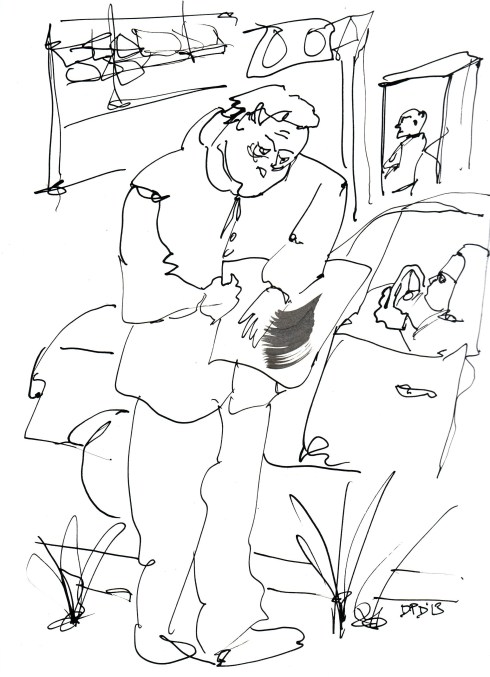
I pick up my sign and try to clean it off with the sleeve of my coat but I only make it worse. Now it looks like smeared shit. I know I should wait until the next light before I start up again. These drivers are pissed by the delay and won’t pay me any mind. A few of them are probably blaming me for their extra two-minute wait. But I hate to waste a whole light’s worth of customers so I hold up my shitty sign anyway. I have plenty of time to think about what just happened, all the time in the world.
When my brother sped off, I watched him leave my corner of the world, moving right along with all the other success stories in their fast-moving world. You gain a different perspective on things when you have no place to call home. You regard society from outside looking in when you make your living from handouts and cold sleep at night in a wet sleeping bag.
Meanwhile around you there’s all this movement. Go, go, go. The whole world’s going somewhere important and you’re just there standing still.
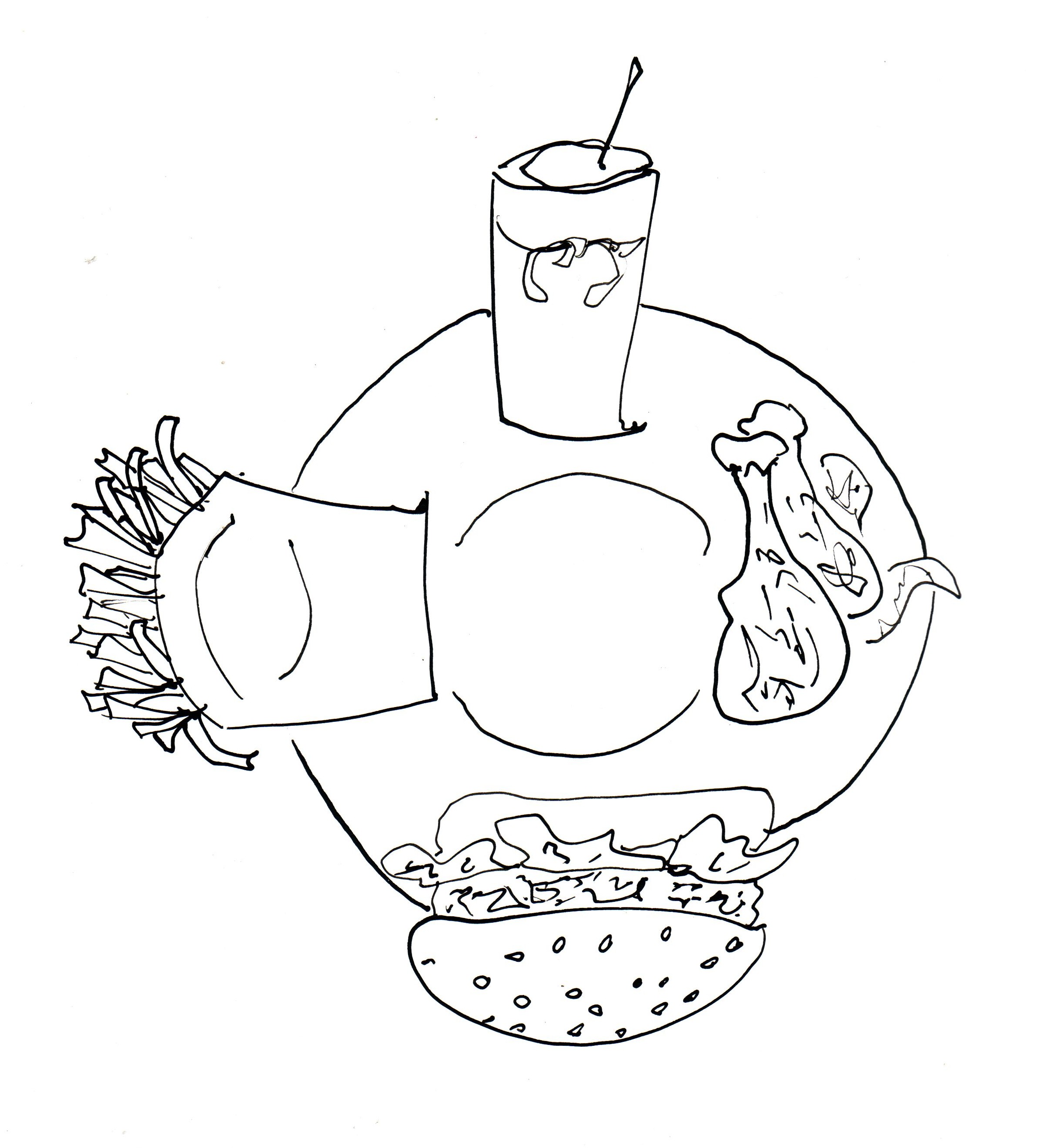
Later that day, over my fries and dollar burger, I wondered if my brother would’ve asked me into his nice car if I’d nodded and headed back toward him. Would he invite me to his home to meet his wife and kids or whatever he has? He didn’t look gay to me but you never know. That wouldn’t bother me. I’ve seen all kinds in my line of begging (ha-ha). Gay people help me out sometimes even though they make a really big deal about not touching me. Well, I wouldn’t touch me either, gay or not gay.
But I didn’t go for that brotherly embrace and Matt passed me by like everyone else. I’ll probably be holding out this sign forever hustling for rolled-down windows to get whatever comes my way. Begging is like waiting for the rain: unpredictable exactly when it’s going to happen and uncertain how much there’s going to be. But one thing is guaranteed for sure: it will happen eventually if I stand in the open long enough. I hope it holds off for a while. The rain, I mean. People aren’t willing to bother themselves so much with a handout when it’s pouring.
I need to leave this shed now before the hardhats come. I’ll squeeze through that hole in the fence. Maybe I can sleep here again tonight. I’ll think some more about my brother and his nice wife and good kids. I’ll dream about his guest room that smells like expensive soap and scented candles. Maybe I’ll meet Matt again. Maybe I won’t run next time.
Tags: david duckworth, eda kavin, ithuriel's spear, san francisco, william torphy
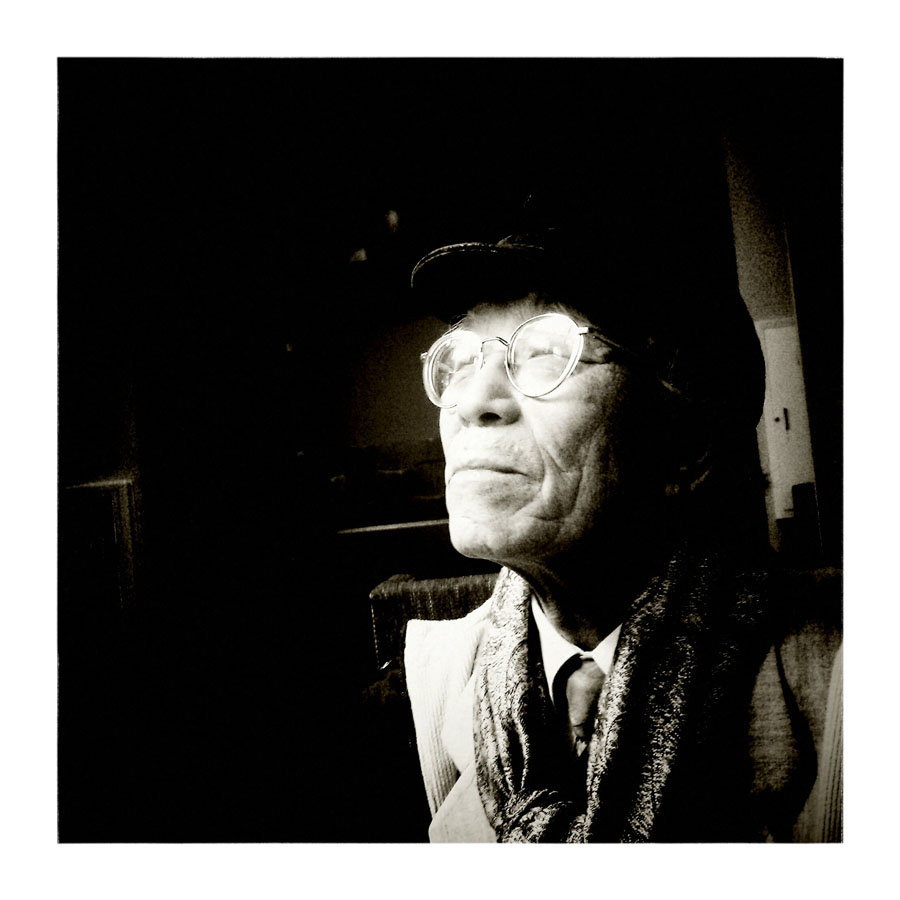 Takashi Tanemori, survivor of the 1945 nuclear attack on Hiroshima, Japan, and long-time peace activist, will be present during a reading of his memoir, Hiroshima: Bridge to Forgiveness. Losing both parents and two sisters to the atomic blast and its aftereffects, Tanemori became an Oyanashigo – a street urchin – who struggled to stay alive by searching waste sites and garbage cans for food in the ashes of postwar Japan. At the age of 18, he emigrated to the United States, becoming a laborer in the agricultural fields of Fresno. Currently a Berkeley resident, Takashi’s road to forgiveness spans decades of life experience, forging the bitterness of revenge into a devotion to peace and harmony. Founder of the Silkworm Peace Institute, a nonprofit organization dedicated to international peace, Takashi shares his life story through speaking engagements, conflict resolution seminars, workshops on The Seven Codes of the Samurai (“Peace through Forgiveness”), his writing and artwork.





 dpduckworth