Archive | Uncategorized RSS feed for this section

Parade of Pain

17 Jun

Untitled, from the series Short Tales from the American Landscape, 2008. Pen-and-ink on Bristol paper, 9 x 12 in.

“Parade of Pain” is a term journalist Thomas Ewing Dabney, the former Financial Editor for the New Orleans States, introduces in a chapter of the book, Revolution or Jobs: The Odenheimer Plan for Guaranteed Employment (New York: The Dial Press, 1933).  Three years into the Great Depression, Dabney wrote this piece of boosterism advancing a proposal of Sigmund Odenheimer to increase general employment.  The numbers of unemployed were staggering.  Four million were without jobs at the beginning of 1931 with that number doubling by the end of the year, representing a truer number of twenty-four million when factoring in the number of dependents (ftn. 2, pg. 27).  Efforts to address the problem had been ineffectual.  In 1930, with 2,429,000 unemployed, President Herbert Hoover appointed a Committee on Unemployment.  The presiding Colonel Arthur Woods, former committee chairperson under President Warren G. Harding’s Conference on Unemployment from 1921-22, created a proposal for “a billion dollar highway-reforestation-public works development” (96-7).  When the number of unemployed hit the ten million mark in 1931, Hoover put  Walter S. Gifford, President of American Telephone & Telegraph, at the head of a newly created Unemployment Committee, who served for one winter season.  Gifford favored private business expansion over any new public works projects (see quotation p. 98).  Curiously, projects earmarked from the $332,000,000 voted by Congress in fall 1932 for emergency measures included: 1) $1,500,000 improvement to Chanute Field, Illinois (later Chanute Air Force Base), 2) $55,000 improvement to Charleston navy yard, and, 3) $130,000 improvement to Boston navy yard.  None of these projects were deemed necessary by either the War Department or the Navy Department.  According to Dabney, all construction in 1932 dropped to half of the 1931 output (100).

By the time unemployment reached 11,420,000 in February 1932, Congress created the Reconstruction Finance Corporation (RFC).  The first action taken by the RFC was the “shovelling [of] money into the banks, and into Big Business, to pay off the banks and bolster bonds” (100).  Between February 2 and November 30, banks received $806,750,000, the greatest portion to a few large institutions — $90,000,000 was awarded to the Chicago Central Republic Bank and Trust Company (also known as City National Bank and Trust) a few days before bank board member, Charles Dawes, resigned as head of the RFC, while Amadeo Giannini’s San Francisco-based Bank of America received $64,000,000.  “Half a billion” went to railroads, and smaller amounts were doled out to crop-marketing organizations and farmers for crop production.  Of the $146,535,000 earmarked for construction projects, and thus, job creation, not a dollar was put into effect by the end of 1932 (for statistics, see pp. 101-3).

These large amounts of money, for their day, mean nothing without translating that legislated funding into actual benefit to the lives of ordinary people.  Dabney cites the case of Louisiana, the first state in the Union to receive unemployment-relief loans.  There the day’s pay was set at a maximum of $1.50, with four days the maximum number of days for the work week.  Total wage could not exceed $6.00, and that was limited to one person per family, no matter the size of the family.  Average employment was one and a half days a week.  The Mississippi bridge at New Orleans was the first such public works project under this funding.  The wage-rate on that job was 25 cents an hour, with a ceiling on hours worked at 30 per week.  Thus, the maximum a worker could receive was $7.50 per week (105-6).

Odenheimer was the president of Lane Cotton Mills in New Orleans.  He had been with the company for forty-six years.  During Odenheimer’s studies at University of Karlsruhe, in Germany, he came under the spell of socialism, perhaps suggesting, for Dabney at least, an unusual concern for the plight of the worker on the part of an employer.  He was a firm capitalist, though, during his rise in American commerce.  Early in his career, Odenheimer invented a cotton bagging made of cotton fiber at a time when the “jute trust” had doubled the price of its product.  By obtaining a patent and then offering the right to manufacture this product to others without royalty, he managed to defeat the jute trust.  He continued to innovate and engage the cotton industry in new methods of manufacture and distribution.  He was one of the few cotton manufacturers to weather the onslaught of the Great Depression.  Odenheimer first proposed his idea on unemployment at an Association of Commerce luncheon in November 1932.  Simply put, he sought an amendment that would authorize Congress to legislate on hours of labor.  With a congressional “Hours of Labor Commission,” any employer with, say, five or more employees would not be allowed to exceed a total number of hours per week, determined by the Commission on an economically dynamic scale (137).

While distributing worker hours to those unemployed by scaling down hours held by those employed seems simple enough, Dabney chose to stay clear of “the economic riddle”: “…foreign debts, business cycles, tariffs, debtor-and-creditor nations, budgets, the farm situation, the gold standard or armaments” (17).  Dabney cites the collapse of purchasing power as the cause for the crash of 1929, with too much invested in profits and new capital investment and too little in wages, or consuming power.  The author uses a frequently recurring equation that results in the phrase “purchasing-consuming-producing power” (70).

While it is true of this nation’s history that workers have always had to bear the brunt of recurring cycles of national depression since 1817, the idea, inherent in Dabney’s argument, that production and consumption are factors of unlimited quantity when unharnessed, does not accord with the concurrent history of corporate profit motivation.  Louis Adamic provides a set of questions of what profit motivation produces in the cycle of manufacturing and distribution in his book, Dynamite: A Century of Class Violence in America, 1830-1930 (London: Rebel Press, 1984; first published in 1931 and revised by the author in 1934).  In looking at racketeering and sabotage, two elements that rose hand-in-hand with industrialization in the nineteenth century and had been professionalized at the time of his writing, Adamic asks from the workers’ point of view:

“…have not [the capitalist class] laid waste the country’s national resources with utter lack of consideration for their human values — forests, mines, land and waterways?  Did they not dump cargoes of coffee and other goods into the sea, burn fields of cotton, wheat and corn, throw trainloads of potatoes to waste — all in the interest of higher incomes?  Did not millers and bakers mix talcum, chalk and other cheap and harmful ingredients with flour?  Did not candy manufacturers sell glucose and taffy made with vaseline, and honey made with starch and chestnut meal?  Wasn’t vinegar often made of sulphuric acid?  Didn’t farmers and distributors adulterate milk and butter?  Were not eggs and meat stored away, suffering deterioration all the while, in order to cause prices to rise?” (205)

Adamic relates the case of the Pacific Northwest Lumber Trust and the demand for lumber in 1917.  After the entry of the United States into World War I, the demand for lumber in various industries skyrocketed.  In consequence, lumber companies took advantage by boosting their prices: “…some increased them from $16 to $116 per thousand feet in a few days, and before the end of 1917 were selling spruce for government airplanes at $1200 a thousand.  And most of that spruce could not be used for airplanes.”  By comparison, workers’ wages increased only slightly where strikes were successful in coercing employers into raising wages (168).

The corporate landscape is the same today, witness oil spills destroying natural ecosystems, fracking for natural gas polluting natural water tables, or factories and mining polluting natural waterways.  The profit motive in manufacturing has not changed.  When pressed or when seeking to maximize profit, corporations have simply moved operations overseas where concerns for environmental degradation and worker health and safety do not exist.  I recommend viewing the film, Last Train Home (2009), directed by Lixin Fan, which documents the movement of 130 million Chinese workers during New Year to reunite with their families only several days out of the year.   It is heart rending with its focus on the cumulative effects upon the individual worker and the dissolution of family.  Or, come to see the screening of Dust: The Great Asbestos Trial (2011), directed by Niccolo Bruna and Andrea Prandstralle of Italy, in its San Francisco premiere on Friday, July 6th.  Besides exploring the “first great criminal trial” against asbestos manufacturers, which opened in Turin in 2009 and resulted in convictions in 2012, the film offers a look at the plight of asbestos-related work in India and Brazil.  For further information on this and other LaborFest events for the month of July, visit: http://www.laborfest.net.  A booklet for the complete programme is also available around the city, including The Green Arcade bookstore, 1680 Market Street at Gough.

Revolution or Jobs is still a useful guide to the economic landscape of the early years of the Great Depression.  Through this reading, one finds a palpable sense of the scope and detail of human misery from the time.  It was a time when people believed revolution could happen.  Adamic shows how the press only reported on unemployment and hunger when, starting in 1930, communists organized hunger demonstrations and parades, which often resulted in mounted police riding down upon demonstrators and clubbing them, causing much bloodshed.  It was the bloodshed which made headlines.  And it was those headlines that gradually forced Hoover to publicly acknowledge the seriousness of the unemployment problem.

A President’s Answer

16 May

President Bush Explains His Social Security Reform Proposal:

“WOMAN IN AUDIENCE: ‘I don’t really understand. How is it the new plan is going to fix the problem?’

PRESIDENT BUSH (Verbatim response): ‘Because the — all which is on the table begins to address the big cost drivers. For example, how benefits are calculated, for example, is on the table. Whether or not benefits rise based upon wage increases or price increases. There’s a series of parts of the formula that are being considered. And when you couple that, those different cost drivers, affecting those — changing those with personal accounts, the idea is to get what has been promised more likely to be — or closer delivered to that has been promised.
Does that make any sense to you?
It’s kind of muddled. Look, there’s a series of things that cause the –like, for example, benefits are calculated based upon the increase of wages, as opposed to the increase of prices. Some have suggested that we calculate — the benefits will rise based upon inflation, supposed to wage increases. There is a reform that would help solve the red if that were put into effect. In other words, how fast benefits grow, how fast the promised benefits grow, if those — if that growth is affected, it will help on the red.’ “

Circa July 24, 2005.

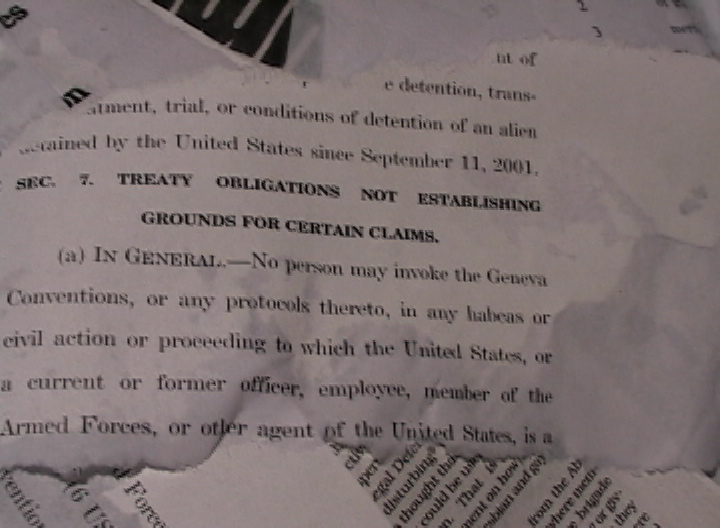
Documentation from collaborative performance by David Duckworth and John Landino, Waterboarding: Last Gasp for Habeas Corpus and the Geneva Conventions, Jonathan Shorr Gallery, New York, September 30, 2006. Involved wheat pasting by gallery visitors. Top photograph: Timothy Feresten. Middle and bottom photographs: author(s) unknown.

Heads 1/2 Off

15 May

Back Fill

11 May

David Duckworth, Soup Line.  Acrylic, 2012. Stencil executed by Philippe Barnoud on bridge near Paris University 8, Saint-Denis, for exhibition, Écritures en migration[s].

I made my second visit to City and County of San Francisco, Department of Human Services to apply for County Adult Assistance Programs / Personal Assisted Employment Services job placement.  The bookstore owner who employs me occasionally may be able to obtain a grant, in which case he can hire a part time employee who is registered with this City and County of San Francisco program.

Although my second appointment was not scheduled until Monday, the 14th of May, I appeared early this morning in the hope that I could be seen sooner.  I am scheduled to work one day only on Monday, the request to work coming only two days ago.  The doors open at 7:30 a.m.  For my purpose today, I am considered “back fill,” which resonates with sludge, sewage back-up, stagnant fluid, and a host of other terms.  If that suggests a condition in which bacteria or other organisms can lead to a festering predicament, the behavior of individuals at the lines inside the office fulfilled the imagination amply.  One gentleman ahead of me was greeted by an acquaintance who arrived behind all of us.  They switched places so that the first gentleman could retrieve a City and County form.  His return to the line was noticed by a security officer, who questioned his entering the line ahead of others.  Needless to say, an argument erupted.  In another instance, a woman who claimed to have been misdirected to one line, attempted to enter our line at the very front.  She was prevented from doing so by another security officer, but not without becoming loud and nasty.  She ended up behind me, where I listened to her tell someone, Wait until I catch that bitch outside and beat the shit out of her, with her geri curl head and Tammy Faye make-up.

These are not the meek supplicating for a bowl of soup.  I have been at this office enough times in the past to have formed the opinion that quite the opposite is true for a good number of program applicants, whether it is job-related or food-related (Food Stamps or EBT).  But we would all prefer anything else to this bureaucratic pavane.

Mount Tamalpais

10 May

Digital photograph, April 2011.

The Gifting Society

9 May

“The idea of a productive protest is happening and I believe it is the start of a new paradigm in collective action.  The urban gardening and guerrilla gardening movements are some more obvious examples of this new trend.  It seems difficult for many to see the political nature of gardening, but for the people involved in these approaches, it is a gesture to raise awareness of what a piece of industrial waste ground should be.  Choosing to plant life and feed people in a neglected area is a way of publicly and productively making an opinion heard in an attempt to influence public opinion or government policy.  It is also a community attempting to directly enact desired change themselves.  This is protest.” — Robyn Waxman, “Rethinking Protest: A Designer’s Role in the Next Generation of Collective Action,” FARM, 2011, page 30

On April 13th, a young woman held up a copy of this publication from The Future Action Reclamation Mob (F.A.R.M.) during an evening of song and spoken word at the reception for The Green Arcade bookstore’s art exhibition, A Night of Surreal Superstition.  She explained to the audience the project’s overall aims bringing together students of California College of the Arts San Francisco and the homeless of the vicinity.    Her call was an invitation for others to join in this act of revolution.  Not only does the farm aim to produce crops for anyone in need of food, but it does so by participating outside of a capitalist system of commodity and exchange.  Thus, gifting becomes the exchange medium wherein the individuals of the community involved carry equal status.

Certainly during earlier depressions, in an unending recurrence of depressions which constitute the life of capitalism, jobless and starving American citizens have sought the means to produce and consume outside the capitalist system.  The Hoovervilles of 1931, so-called because of President Herbert Hoover’s continued denials that an economic depression would last, involved people who had become homeless building structures from discarded materials.  The aggregate structures were shanty towns where homes tended to be built in rows and the pathways between took on the form of streets with given names.  The inhabitants were people who had become jobless.  A large self-help movement developed in California where, at various times, 500,000 families were affiliated.  By the end of 1932, thirty-seven states followed the example set by California.  In Seattle during the summer months of 1931, an organization called the Unemployed Citizens League (UCL) began organizing a self-help movement that centered around mutual aid.  Its membership rose to 80,000 in 1933 as it spread through the state of Washington.  The UCL negotiated with the fishermen’s union to lend boats for fishing.  Farmers were persuaded to allow UCL members to harvest fruit and potatoes that would not go to market, borrowing trucks to transport the food.  Bartering became widespread and highly organized.  By the winter of 1931, it was apparent that mutual aid would not be enough for the needs of the jobless  (Franklin Folsom, Impatient Armies of the Poor: The Story of Collective Action of the Unemployed, 1808-1942, pages 277-81).

Whether or not today’s economic crisis has initiated current experiments in collective action based on alternative economies, the fact that a growing number of people seek non-capitalist solutions for the exchange of goods and services is notable.  Bay Area Community Exchange (BACE) (http://timebank.sfbace.org/) offers a system of time exchange in which one member may “buy” an hour’s time from another member, receiving a particular service, giving the service provider an hour that can be used elsewhere.  This system values everyone’s hours equally, eliminates the use of paper and coin currency, and builds relationships between participating members.  “…This is a system for people who are undervalued in [the] traditional marketplace,” according to co-founder Mira Luna.  One off-shoot of the BACE model is the effort by People Organizing to Demand Environmental and Economic Rights (PODER) SF to serve residents of the Mission and the Excelsior with a similar program.  Where BACE has perfected digital and Web-based mechanisms to enhance operation, PODER prefers community gatherings where people meet face-to-face (see Yael Chanoff, “Bank Your Time,” San Francisco Bay Guardian, May 2-8, 2012, page 9).

Around the time I read Novella Carpenter’s Farm City: The Education of an Urban Farmer (2009), a humorous and endearing narrative of a guerrilla farmer cropping on a vacant lot in an economically depressed neighborhood of Oakland (Carpenter maintains a blog at http://ghosttownfarm.wordpress.com/), I became involved as a volunteer at Hayes Valley Farm.  Located on 2 1/4 acres where a set of freeway ramps once absorbed toxic waste from heavy traffic, the Farm was begun by a group of visionary permaculture enthusiasts who contracted from the City of San Francisco at no cost for 3 1/2 years.  I could no longer afford the cost of courses at City College of San Francisco’s Environmental Horticulture department, an excellent Associate of Arts degree program where graduates are guaranteed employment in the field.  Volunteering at the Farm, the roof garden of California Academy of Sciences (a native flora laboratory), and Bay Native Nursery, run by Geoffrey Coffey and Paul Furman, provided an excellent alternative education.  Hayes Valley Farm operates upon the principle of regenerative farming.  In this case, soil is built rather than shipped in; urban gardeners do not consider the fact that when they buy soil they are robbing another environment of its most precious commodity.  We started with recycled cardboard.  Upon that we dumped and mixed donated waste chipping from regional horticultural activity and donated horse manure from a San Francisco stable.  The next stage involved planting the nitrogen-fixing plants fava bean and clover.  Once the fava bean was harvested and its stems and leaves returned to the ground, other crops were planted.  Marigold was used as a natural pest repellant.

Life has not been as kind as I would like it to be, so I could not continue indefinitely with the Farm because of a changing employment situation.  But the time I did spend there was invaluable.  Anyone was welcome to join in the creation of the farm.  The food that was harvested was shared amongst volunteers and given to people in need.  Since that first year the Farm has built a greenhouse, compost pits, sheds, a stone and cob community meeting area, and conducted classes on permaculture and bee keeping in a straw bale seating area (http://www.hayesvalleyfarm.com/).

The land will revert to the city.  The city will then turn it over to commercial development.  There is sadness in endings, especially in a case like this, where an idyllic but achievable dream will be replaced by housing units for the more affluent.  I was speaking to an acquaintance named Kevin about the Farm recently.  Committed to the redistribution of wealth, his imagination of late has been fueled by theoretical acts of taking.  He condemned the organizers of the Farm for not resisting the impending commercial take over.  He also dismissed these same individuals for being from a social strata of the privileged (he had concluded this after working for one month only at the Farm).  We had a heated discussion about it; I could not agree and we are both passionate debaters.  I happened to tell Todd, a work colleague at a temporary job site, about the argument.  Todd is the conservative type.  He loves statements like, Name a Communist country that hasn’t failed!  (His father served as a public relations man, not a soldier, in Vietnam during the late 60s, so I can guess his indoctrination to authoritarian views began early in life.*)  Todd was impressed that I had a “conservative” side myself.  But I corrected him to an extent stating my belief that any conservatively minded person would simply laugh at a project like Hayes Valley Farm, where everyone is on equal footing and the fruits of this collective labor is equally shared.  After all, the conservatives of this country love the capitalist system for its sheer competitiveness and some-people-will-win-over-most-others rewards.

The Hooper Street garden siding California College of the Arts was also begun in 2009.  Like Hayes Valley Farm, the ground was toxic, in this case from what was once a Greyhound facility.  Waxman’s husband terms the project a “Slow Protest” (“Rethinking Protest,” 34) because FARM is remediating an environment that took decades to form.  Waxman set out to determine how the youngest generation, the so-called Millennial Generation, would respond to such a project as a form of protest; she observes the California College of Arts participants’ background as part of “a generation who has lived a fairly comfortable life…young, educated, upper/middle-class students, who perceive no obvious change in their civil rights” (ibid).  Looking at generational use of forms of protest is one of the  more interesting aspects of Waxman’s essay.  Like Mark Bauerlein, whom Waxman quotes — “…we’re about to turn our country over to a generation that doesn’t read much and doesn’t think much either” (“Rethinking Protest,” 12) — I have not put faith in this newest generation’s ability to challenge the world, because of my perception that they are additionally apathetic and self-absorbed with the consumption of social media and gadgetry.  Waxman finds positive attributes: a preference for group-oriented activities, participation as opposed to spectatorship, and a desire for experience as authentic.  Waxman believes that Millennials “could be strong participants in collective political action and social movements” (13).

It is the form of protest that must be addressed in terms of effectiveness.  With the Hooper Street project in focus: “[g]rowing a farm is a prolonged engagement through time, not a one-hour vigil at the trolly car turn-around on Market Street.  While both activities merit credit, building a farm is arguably more sustainable, more productive, and more engaging” (“Rethinking Protest,” 35).  Folsom cites historian Clark Kerr’s finding of California’s self-help organizations or “productive enterprises”  in 1932 (Folsom, 278).  And I do believe it will be the necessary enterprise of collective hard work and example that will lead us to a desired state of justice for the environment and the social world.  Capitalism is a dead-end in terms of the betterment of this world.

* Because I did not want to open discourse on nation states and political ideologies while at the job site, I did not engage Todd in clarifying how communist states had all failed.  But the implication is that anywhere communism is attempted it does fail.  Perhaps he meant that today’s communist states have integrated some form of capitalism into their structure.  If that were true, then I would have to say the reverse is equally true: all capitalist states have failed.  After all, our own country has integrated progressive forms of socialism in order to ensure health and well-being for some of its inhabitants.  And corporations are unable to profit, as obscene as those profits may be, without forms of governmental assistance and subsidy.  A pure state of economics exists only on paper.  The relationship between corporations and government over citizens and their government are as true today as they were at the opening of the Great Depression.  Observations about Hoover’s expulsion of the Bonus Marchers from Washington, D.C. in 1932 still resonate with meaning.  The approximately 20,000 World War I veterans had marched on the Capitol to demand payment for a promised and Congressionally legislated supplement to their $1-per-day service during the Great War.  Congressman C. Wright Patman reminisced about the expulsion to Studs Terkel: “Who were the so-called bonus marchers?  They were lobbyists for a cause.  Just like the ones in the Mayflower Hotel.  They didn’t try to evict them (italics in place).  Why the poor come to town, and they’re put in jail for stepping on the grass.  The Mayflower crowd, they don’t have any problem at all.  They’re on every floor of every building of the Capitol Hill all the time.”  Heywood Broun also wrote of the expulsion, contrasting the reception of business lobbyists and their success in garnering massive aid to banks and businesses by Hoover’s Reconstruction Finance Corporation and the use of tear gas against the veterans: “For the banks of America Mr. Hoover has prescribed oxygen.  For the unemployed, chlorine.” (Both quotations appear in Folsom, page 321.)

Red Hill Books

30 Apr

F.S. Rosa and David Duckworth at Red Hill Books, San Francisco, April 18, 2012. Photograph by Renshin Bunce.

It was an honor to share an evening with F.S. Rosa.  We presented on various aspects of labor history, Rosa reading from Elizabeth Gurley Flynn, “Big Bill” Haywood, and her own book, The Divine Comedy of Carlo Tresca, in a talk about the textile workers’ strike, known today as Bread and Roses, in Lawrence, Massachusetts of 1912.  Tresca was an Industrial Workers of the World labor organizer at the time of the strike.  I read from two posts here at the blog on labor history and the occupation of space.  Our audience was attentive and contributed greatly to the overall discussion, the best possible result for such an event.  I was not allowed, though, to occupy the bunny chair, normally reserved for small readers.

F.S. Rosa’s reading material at Red Hill Books. Photograph by Renshin Bunce.

Spring Art and Literature Gala, “Reclaiming Cinco de Mayo”

29 Apr

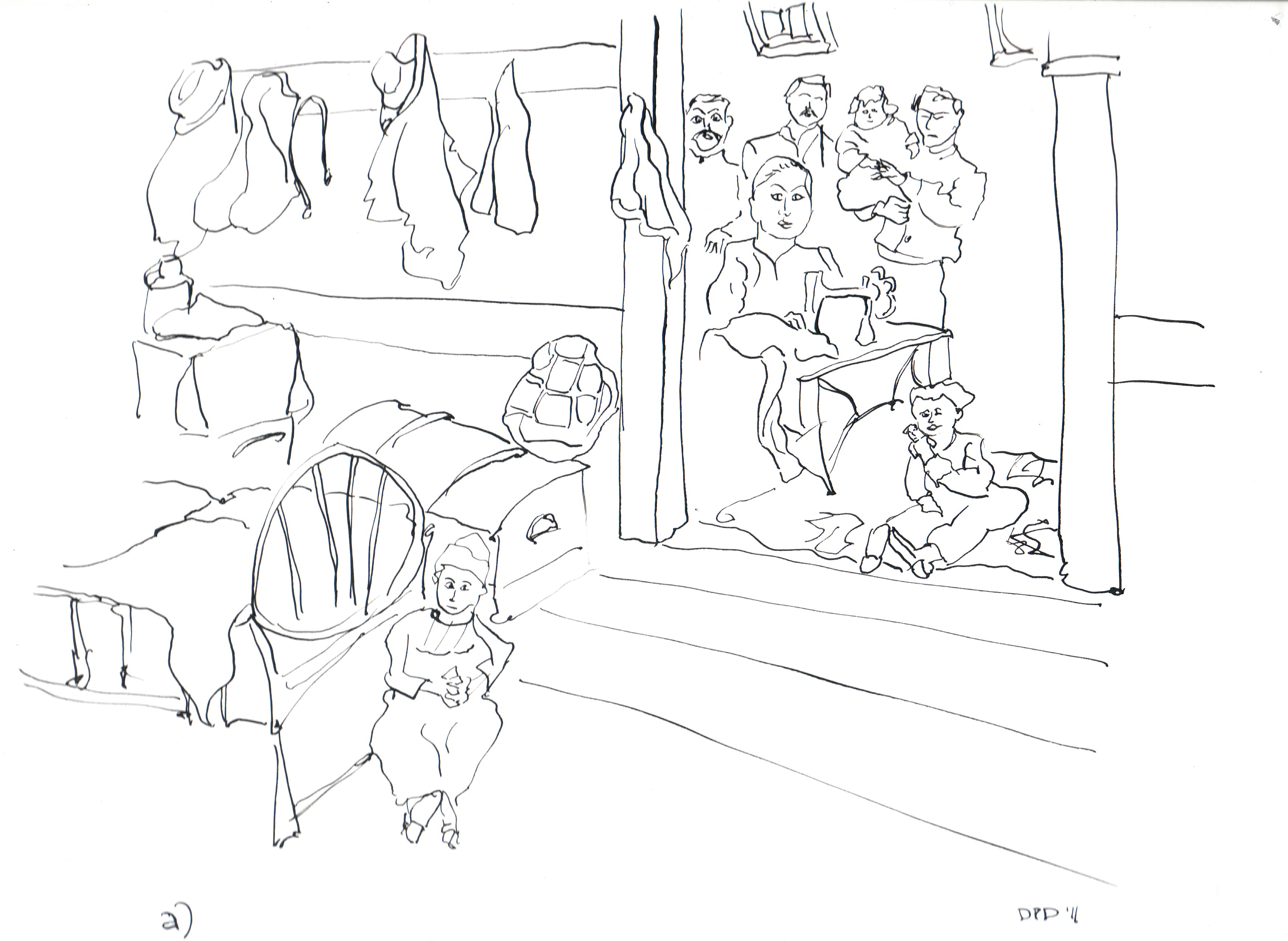
Seamstress, 2011. Pen-and-ink on Bristol paper, 9 x 12 in. After photograph: “While older children and adults work on various steps in the garment making process, they also care for younger children, prepare meals and consider their options.” Photographer: unknown, ca. 1900. Kheel Center 6153pb2f6-13

I invite you to attend a celebration being held on Saturday, May 5th, from 6 to 10 p.m., at the Eric Quezada Center for Culture and Politics, which will include a live and silent auction.  Three of my drawings, including the above, will be auctioned.  You can view a second drawing, “Stanyan and Haight,” at the November 21, 2011 posting.  “Seamstress” was exhibited at The Legacy of the Triangle / Protecting Workers Today exhibition, City College of San Francisco Mission Campus and ILWU Local 34 Hall, February 22—March 9 and March 25 and 26, 2011, respectively

The gala will be at 518 Valencia Street, with a $25 admission fee.  The event benefits the San Francisco Living Wage Coalition and Las Hormigas in Cuidad Juarez.  For more information, contact the San Francisco Living Wage Coalition at (415) 863-1225, sflivingwage@riseup.net, http://www.livingwage-sf.org.

Tents II

13 Apr

A Nightly Encampment, 2012. Pen-and-ink on Bristol paper, 9 x 12 in. Based on photograph.

“…He seems to be profoundly impressed with the sufferings of mankind and with a belief that there is a deep-laid plan of monopolists to crush the poor to the earth.” — a reporter on Jacob Sechler Coxey, as conveyed in the Pittsburgh Chronicle Telegraph of March 22, 1894

It appears pleasant enough: men sprawled across a grassy area as if at a picnic.  The arduous journey, though, that the many different groups traversed in order to converge on the Washington capitol  in 1894 was anything but a picnic.  Kelly’s Army, the largest of the “unemployed armies,” began their march from San Francisco, organized by Colonel William Baker and led by Charles T. Kelly, a thirty-two-year-old compositor in one of the city’s printing businesses.  Arriving in Council Bluffs, Iowa from Omaha, Nebraska on April 15, the men slept on damp ground.  Upon relocation to Chautauqua grounds three to four miles east of the city, the army slept in the mud and spent the next day standing in cold rain with flurries of snow.  That an otherwise unused amphitheater at Chautauqua Hill housed a militia company instead of Kelly’s men was no mistake: the militia officer in charge kept them out.  Eventually an indignant citizenry demanded the removal of the militia.  Kelly’s army had drawn an estimated 30,000 of the curious to Council Bluffs; the same curiosity followed the various unemployed armies wherever they passed.  Although their demands were lodged with the governor, the people held the railroads responsible for the calling out of the militia and the mistreatment of these men.  Not dissimilar to today’s social discontent over a government run by corporations, this was an intriguing tale of populist agitation to reform government, captured sympathetically in Donald L. McMurry’s 1929 book, Coxey’s Army: A Study of the Industrial Army Movement of 1894 (Little, Brown, and Company; see page 24 for the above quotation and pages 164-6 for the above account; unless otherwise noted, quotations that follow are from same, indicated by page number).

A financial panic in 1893 preceded the movement of these armies, for which the monopolists or “plutocrats” were blamed,  an upheaval in markets resulting in runs on the banks, business closures, and massive unemployment.  This was not the first time the nation’s workers suffered from widespread unemployment.  Franklin Folsom points out, in his book Impatient Armies of the Poor: The Story of Collective Action of the Unemployed, 1808-1942 (University Press of Colorado, 1991), that the first in a recurring cycle of “full-scale, national, modern depression[s]” occurred in 1819 (page 18).  Perhaps two million or more were unemployed in 1894 (see McMurry, page 9, for various estimates).  At the Populist Party’s first national convention in Omaha in July, 1892, a platform was adopted, reading, in part: “We meet…in the midst of a nation brought to the verge of moral, political, and material ruin.  Corruption dominates the ballot-box, the legislatures, the Congress, and touches even the ermine of the bench.  The people are demoralized…The newspapers are largely subsidized or muzzled; public opinion silenced; business prostrated; our homes covered with mortgages; labor impoverished; and the land concentrated in the hands of capitalists…The fruits of the toil of millions are boldly stolen to build up colossal fortunes for the few, unprecedented in the history of mankind; and the possessors of these, in turn, despise the republic and endanger liberty.  From the same prolific womb of governmental injustice are bred the two great classes of tramps and millionaires” (7).

We have come full circle since the cry for reform of 1894.  Today’s Occupiers are dismissed as individuals uninterested in finding jobs and their camps are cited as public health nuisances.  The branding of reform movements as communistic lost its political edge.  Certainly there were anarchists and socialists in 1894.  “Petition in boots” was the phrase applied by Coxey to his endeavor and was perhaps coined by Carl Browne, one of Coxey’s lieutenants, who had long dreamed of a march on Washington.*  The British editor W.T. Stead attributed the origin of the phrase to a Professor Hourwitch at the University of Chicago, who compared the march of Coxey’s army to the “petition in boots” of the Russian peasants, marching “in bodies to present their grievances” (33, ftn. 1).  A Senator Wolcott of Colorado railed against the armies arriving at the Capitol by urging his colleagues to “stand together against socialism and populism and paternalism run riot” (112), the last key word a reflection of a federal government forced to provide for its unemployed.  But the industrial armies’ detractors appeared to focus, for the most part, on labeling the individuals comprising these organized, determined, and highly disciplined bands as tramps, “hoboes,” the “shiftless,” or “vagrants” (apparently even “walking bums” were despised by their own class in regard to those who lacked the “skill and nerve” to hop fast-moving trains).  McMurry carefully describes the estimated forty to sixty thousand “professional hoboes” in the United States during the early 1890s in order to differentiate the “tramp liv[ing] by his wits at the expense of society” from  the unemployed workers comprising the industrial armies converging on Washington (see 12-14).

Coxey was a successful business man based in Massillon, Ohio.  The owner of a sandstone quarry and producer of sand for steel and glass works, Coxey also held extensive farming interests.  He envisioned a federal government that would relieve the unemployment crisis through his Good Roads Bill, which instructed the Secretary of the Treasury to issue 500 million dollars in legal-tender notes for the construction of roads throughout the nation.  The bill would both secure work and circulate money.  Coxey followed this proposal with his Non-interest-bearing Bond Bill, which would authorize any governmental entity to issue such bonds for financing public works projects, the bonds possibly deposited with the Secretary of the Treasury as security for a loan of legal-tender notes.  Coxey, like members of the Greenback Party or Greenbackers, opposed a monetary system based on the deposit of gold bullion because political power then followed the dictates of private banks and corporations, sole determinants of the value of production and labor.

Like the Occupy movement today, the “Coxeyites” or “Commonwealers,” as these various marching groups became known, received popular sympathy.  Their long journey was aided by stays in locales where the armies might receive provisions or shelter for the night.  At Canton, Ohio, a number of Coxey’s men were housed overnight in the jail; at Louisville, Ohio, a number of the men slept in the city hall.  This particular army did carry a circus tent wherein the men slept on straw.  The armies were sometimes greeted by populist sympathizers with brass bands, crowds of onlookers, and supportive speeches in halls.  Train hopping and train stealing were frequently aided by railroad workmen willing to turn an eye or state governors unwilling to call in militia when demanded by railroad corporations.

At times, political sentiment in the Capitol also ran in the industrial armies’ favor.  In an open letter to the press, Senator William S. Stewart, of Nevada, addressed this direct petitioning of Congress, as Coxey progressed through Ohio, by defending the ballot as the only legitimate means of “retain[ing] [the] right to life, liberty and the pursuit of happiness.”  But he did agree with the overall sentiments of the Coxeyites when looking back on the previous two decades, observing that: “…now a ‘soulless despot of alien origin’, whose name was Money, was ‘monarch of the commercial world’, and administrative and legislative bodies were his servants” (72-3).  While Brigadier General Ordway assembled militia in the Capitol to stop Coxey’s arrival, Populist Senator Peffer, of Kansas, who had introduced Coxey’s bills to Congress, prepared for an open reception of the petitioners, referring to the perception of his senatorial colleagues as an “‘American House of Lords’, out of touch with the people” (107).  In the House of Representatives, Haldor E. Boen, of Minnesota, introduced a resolution instructing the Secretary of War to “provide camping grounds and tents for all organized bodies of laborers that came into the district” (109).  All for naught as Coxey, Browne and Christopher Columbus Jones were arrested on the steps of the Capitol building without having had an opportunity to utter a word on their petition.  As a result, fifty or more people from a crowd gathered at these steps were beaten by police clubs for having cheered Coxey.  Coxey’s intended speech included the observation: “…Upon these steps where we stand has been spread a carpet for the royal feet of a foreign princess, the cost of whose entertainment was taken from the public treasury without the approval or consent of the people.  Up these steps the lobbyists of trusts and corporations have passed unchallenged on their way to the committee rooms, access to which we, the representatives of the toiling wealth producers, have been denied.  We stand here today in behalf of millions of toilers whose petitions  have been buried in committee rooms, whose prayers have been unresponded to, and whose opportunities for honest, remunerative, productive labor have been taken away from them by unjust legislation, which protects idlers, speculators, and gamblers” (119-20).

*Franklin Folsom reprints part of a speech made by Joseph R. Buchanan to a San Francisco labor group in 1886 in which Buchanan outlines a march on Washington for the unemployed (Impatient Armies of the Poor, 147).  Folsom also details Carl Browne’s involvement in Dennis Kearney’s rise to power in San Francisco.  Kearney, an Irish immigrant who formed the Workingmen’s Party of California (WPC), saw the advantage he would have advocating against Chinese American labor: in 1877, one month after witnessing participants of a Workingmen’s Party of the United States rally join an organized group of “hoodlums” to demolish more than twenty Chinese laundries on July 23, Kearney changed his former support for Chinese laborers, and their reputation for working hard, to cries of “The Chinese must go!” in his speeches.  Browne became one of three members of the WPC executive committee and a large stockholder in the corporation controlling it.  Browne’s weekly paper, the Open Letter, served the same party.  Eventually Browne became Kearney’s private secretary (ibid, 131-6).