

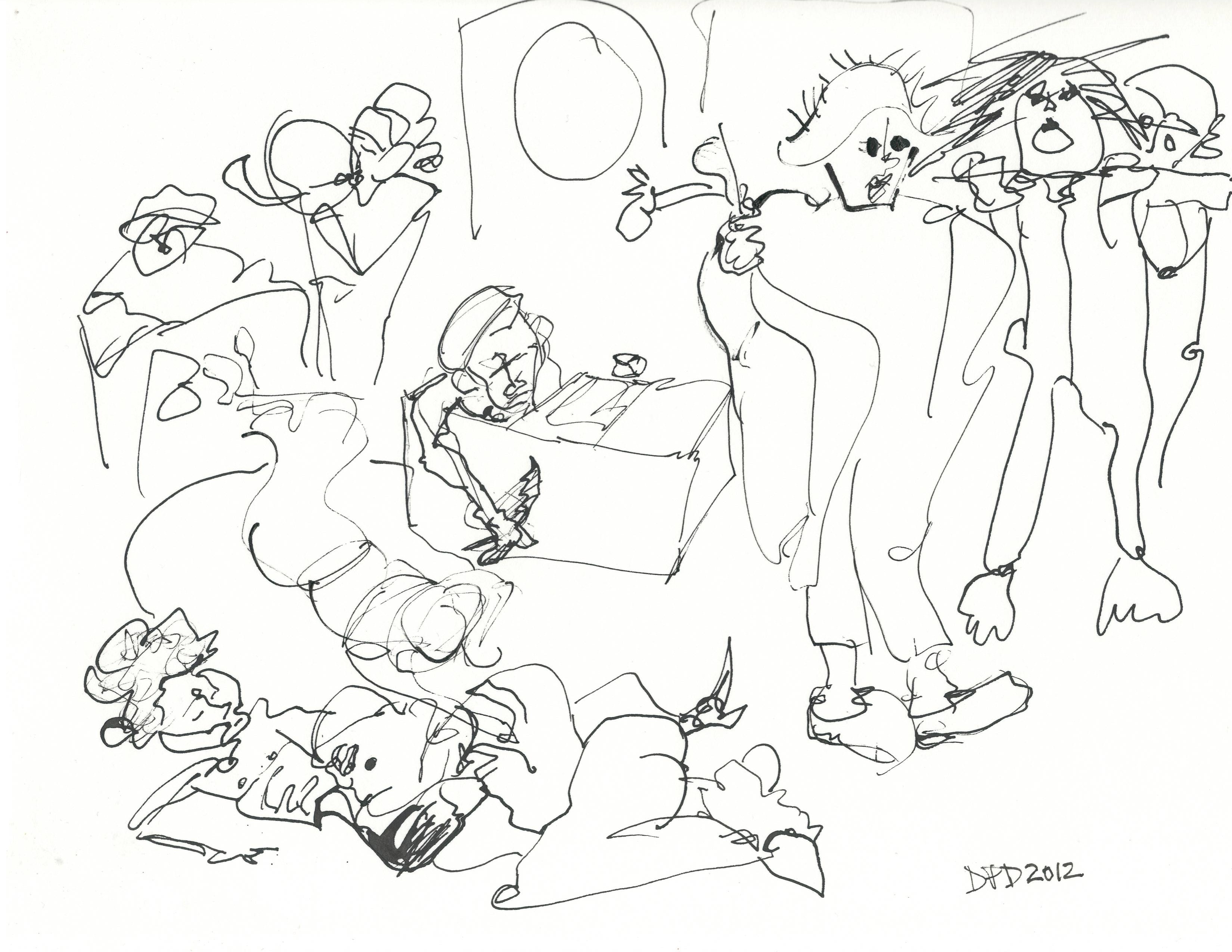
Marat / Sade, 2012. Pen-and-ink on Bristol paper, 9 x 12 in.
Rushing this to press, I write to encourage you to see Thrillpeddlers’s production of Marat / Sade at the Brava Theater on 24th Street in the Mission. It will run through July 29th. I was blessed with an invitation from a friend to watch the opening night performance.
As with their revival of Pearls over Shanghai in 2009, you will not be disappointed. Raucous and darkly humorous, with a strong ensemble cast, revolution is examined through “[t]he persecution and assassination of Jean-Paul Marat as performed by the inmates of the asylum of Charenton under the direction of the Marquis de Sade.”

El Coyote, 1986. Graphite on drawing paper, 12 x 18 in. Collection of Phyllis Aycock and Michael Schreiber.
Lately I have been promoting an idea whose time has possibly come. Drug use was a central feature of adolescence when I grew up in Los Angeles County. Pot, acid, bennies, and other sundry pursuits, besides Coors beer and Spanada wine, were the means to enhanced recreation for my peers. There was an incredible innocence to all of this. My friend Cindy never considered that the glue she sprayed into brown paper bags and huffed would corrode her brain. She had a big heart, but she wasn’t the smartest girl on the block. Bruce was the most obvious example of drugs gone wrong; he often talked about god and the word was that he once saw Jesus on acid.
I hope for enlightened attitudes about marijuana and peyote. Nature provided them and man has had a sacred, and sometimes profane, relationship with both for centuries. The fact that marijuana is illegal, and prescribed medicines that lead to addiction are not, is a certain sign of how ludicrous the laws are governing controlled substances. The Obama administration continues to raid medical marijuana dispensaries in the State of California even though the use and distribution of medical marijuana was legalized by the citizens of this state. Beyond that, we could really use hemp in this country from our own manufacturing base, rather than importing its products from Canada and countries of the European Union. Hemp is extremely versatile: paper, rope, textiles, food products. As for peyote, the above drawing was created the morning after an evening of peyote. How can one fault the blessings of such a natural substance?
My feelings, though, regarding drug use overall have changed. The innocence of my youth did not contemplate substances like methamphetamine. By the time crack was devastating communities during the 1980s, I knew the era of innocence was dead. When I found out later that the C.I.A. supported Nicaraguan Contra funneling of these drugs into these communities, drug trafficking and consumption took on the darkest overtones I could imagine. The level of violent crime directly connected to drug trafficking and use today is frightening. Over 55,000 Mexican nationals have been killed because we use drugs, including marijuana, that come over the border to satisfy our desires.
The proposal is simple: create housing for individuals who use a substance to the point where they begin to harm society. The housing would be equipped to provide all daily needs. The drug of choice would be available in this housing 24/7 in unlimited amount. The individual would, though, be cut off from society, no longer able to mingle with others. Monitoring would include surveillance of the premises, but no intervention would be used. If the drug user were to consume their drug of choice to the point of death, nothing would be done to prevent a terminal outcome.
Although I am not serious about this proposal, for various reasons, including the moral and ethical dimensions regarding compassionate intervention, I have mused on the notion purely for its novelty. As I have talked to others about the proposal, many interesting suggestions have been made that would augment the original. For instance, one friend suggested allowing people to watch a residence via the surveillance equipment, providing another mode of reality entertainment. Another friend suggested creating communities on Treasure Island, relegating individuals to communities based on a common drug. Some suggestions have been truly bizarre. I discussed the possibility, with a friend, of local government manufacturing the drug so as to weaken the hold that manufacturers of illegal drugs have on society. My friend proposed the arrest of dealers, which would lead to the arrest of manufacturers. The manufacturers would then be held in custody and forced to continue producing the drug for the housed users. And, as a ghoulish nod to Soylent Green, once the drug user expires, the body would be converted into food for surviving users, with the enhancement of drug traces in the recycled body product augmenting the supply of drug already circulating within the housing system.
As farfetched as the idea appears, popular culture has provided the model for decades now. In W. Somerset Maugham’s 1939 novel Christmas Holiday, the character Simon Fenimore gives voice to the belief that as long as people believe they are receiving what they want, they will be easily controlled: “…I should give the people the illusion of liberty by allowing them as much personal freedom as is compatible with the safety of the state…” The most frightening moment of George Orwell’s 1949 novel 1984 occurs at the Chestnut Tree Cafe as Winston Smith settles down to a glass of gin, “…his life, his death, and his resurrection,” perhaps the same Victory Gin we see him administering in his home at the beginning of the story, a potion that after an initial shock to the body begins to make the world look more cheerful. His vain attempt to wrest himself from the power of the State already brutally eclipsed, his re-education through torture and other devices in the Ministry of Love complete, Smith is ready to accept prescribed reality once again.

Another day at the races, as I used to hear as a child. Yesterday I attended an introductory group employment preparation (IGEP) event administered by the City and County of San Francisco. I truly believed I had crossed the threshold into the County Adult Assistance Programs (CAAP) Personal Assisted Employment Services (PAES) Program, which would then connect me to a Federally-funded JobsNow4 program. Having spent over two months trying to reach this point (see post dated May 11, 2012), I would become qualified as a potential part-time employee at the bookstore where I work on-call. The store owner applied for these funds to hire a worker through JobsNow3, but can only hire an individual engaged in PAES.
There were a number of us seated waiting for the presentation to begin. The session was already thirty minutes behind schedule when a six-foot-five transgender woman walked in, dressed in a skimpy, form-hugging blouse and spandex shorts, pink house slippers, and a wig that she paid constant attention to with a comb. A moment later another woman walked in, announcing to the security officer in English that the gentleman at her side was her interpreter. Using English, the transgender lady asked the woman where she was from. “Fresno, why?” “Oh, you said you use an interpreter. What language do you speak?” “I’m bilingual, I speak Spanish and Asian. Some Chinese and Laos.” From there the bilingual woman began a complaint about the room being full of hot air that persisted until she asked the security officer if she could sit outside while we waited. She clarified to the transgender lady that she wasn’t speaking about anybody’s personal funk, no, more that the room was stuffy. As she sat, she began to slightly asphyxiate, claiming loudly that she couldn’t breathe, wherein someone else suggested she was experiencing claustrophobia. I was relieved when she stood outside, but it did not stop the noise. I could hear her scolding her interpreter that he couldn’t blame her for the fact that he did not have a cell phone.
The slide presentation from an overhead projector was pleasant enough. The facilitator used a very soothing voice and appeared to be genuinely connected to the service he was providing us. I sat next to the transgender lady, who was fascinated by the shadows projected against the wall produced from her fluttering hands. Following the presentation, half of us were led to a second “classroom” to be processed out by signing a form. A scrawny, middle-aged woman, who looked as if she had spent ten years battling methamphetamine, sat across from each of us during the signing procedure. The City and County employee was noticeably perturbed by the transgender lady towering over her, either because the person was decidedly nonchalant and bored or because she was preoccupied with combing her hair the entire time.
Sadly, once I asked about JobsNow4, no one could answer questions about the program. But they did give me a telephone number to use to reach the offices for the same. This was the straw breaking the camel’s back. I already knew from the day’s presentation that we were expected to go through a training program, a half-Monday every two weeks, for three months, beginning September 17th. When I spoke to the JobsNow4 representative about qualifying, I was informed that qualification would begin after graduating from the three-month training. In other words, I would be eligible to become a potential employee for the bookstore sometime after January 1 of next year.
It is amusing now to think that one stop along the way involved sitting one-on-one with a City and County employee during an event referred to as Triage. The worker, completely separated from all of the other workers I have spoken to now over the last two months, asked me a series of pointed questions that no potential employer would ask. The questions roamed through matters of physical health, including diseases and medication, mental health, criminal history, and job experience. I had offered a copy of my resume, expecting discussion about my job skills, to which a refusal was made. But as I later answered her questions about experience, I overwhelmed her to the point where she requested the resume with great reluctance. Clearly, City and County forms are not designed for a life history like mine.
Rather than sit through six sessions designed to enable a person to enter the job world, I believe I will forgo the service, and thus the opportunity to work at a bookstore, and return to searching for employment as I know how. At least, when I sit with interviewers, I will not be forced to list the medications I use nor take in concerns about air or wig quality.

There is an array of felt dolls with charming personality on display in the lobby/shop window of the Museum of Craft and Folk Art. I do not yet know the name of the designer and wish I could provide better than what the cell phone captures. My favorite is the lantern fish.

 Untitled, from the series Short Tales from the American Landscape, 2008. Pen-and-ink on Bristol paper, 9 x 12 in.
“Parade of Pain” is a term journalist Thomas Ewing Dabney, the former Financial Editor for the New Orleans States, introduces in a chapter of the book, Revolution or Jobs: The Odenheimer Plan for Guaranteed Employment (New York: The Dial Press, 1933). Three years into the Great Depression, Dabney wrote this piece of boosterism advancing a proposal of Sigmund Odenheimer to increase general employment. The numbers of unemployed were staggering. Four million were without jobs at the beginning of 1931 with that number doubling by the end of the year, representing a truer number of twenty-four million when factoring in the number of dependents (ftn. 2, pg. 27). Efforts to address the problem had been ineffectual. In 1930, with 2,429,000 unemployed, President Herbert Hoover appointed a Committee on Unemployment. The presiding Colonel Arthur Woods, former committee chairperson under President Warren G. Harding’s Conference on Unemployment from 1921-22, created a proposal for “a billion dollar highway-reforestation-public works development” (96-7). When the number of unemployed hit the ten million mark in 1931, Hoover put Walter S. Gifford, President of American Telephone & Telegraph, at the head of a newly created Unemployment Committee, who served for one winter season. Gifford favored private business expansion over any new public works projects (see quotation p. 98). Curiously, projects earmarked from the $332,000,000 voted by Congress in fall 1932 for emergency measures included: 1) $1,500,000 improvement to Chanute Field, Illinois (later Chanute Air Force Base), 2) $55,000 improvement to Charleston navy yard, and, 3) $130,000 improvement to Boston navy yard. None of these projects were deemed necessary by either the War Department or the Navy Department. According to Dabney, all construction in 1932 dropped to half of the 1931 output (100).
By the time unemployment reached 11,420,000 in February 1932, Congress created the Reconstruction Finance Corporation (RFC). The first action taken by the RFC was the “shovelling [of] money into the banks, and into Big Business, to pay off the banks and bolster bonds” (100). Between February 2 and November 30, banks received $806,750,000, the greatest portion to a few large institutions — $90,000,000 was awarded to the Chicago Central Republic Bank and Trust Company (also known as City National Bank and Trust) a few days before bank board member, Charles Dawes, resigned as head of the RFC, while Amadeo Giannini’s San Francisco-based Bank of America received $64,000,000. “Half a billion” went to railroads, and smaller amounts were doled out to crop-marketing organizations and farmers for crop production. Of the $146,535,000 earmarked for construction projects, and thus, job creation, not a dollar was put into effect by the end of 1932 (for statistics, see pp. 101-3).
These large amounts of money, for their day, mean nothing without translating that legislated funding into actual benefit to the lives of ordinary people. Dabney cites the case of Louisiana, the first state in the Union to receive unemployment-relief loans. There the day’s pay was set at a maximum of $1.50, with four days the maximum number of days for the work week. Total wage could not exceed $6.00, and that was limited to one person per family, no matter the size of the family. Average employment was one and a half days a week. The Mississippi bridge at New Orleans was the first such public works project under this funding. The wage-rate on that job was 25 cents an hour, with a ceiling on hours worked at 30 per week. Thus, the maximum a worker could receive was $7.50 per week (105-6).
Odenheimer was the president of Lane Cotton Mills in New Orleans. He had been with the company for forty-six years. During Odenheimer’s studies at University of Karlsruhe, in Germany, he came under the spell of socialism, perhaps suggesting, for Dabney at least, an unusual concern for the plight of the worker on the part of an employer. He was a firm capitalist, though, during his rise in American commerce. Early in his career, Odenheimer invented a cotton bagging made of cotton fiber at a time when the “jute trust” had doubled the price of its product. By obtaining a patent and then offering the right to manufacture this product to others without royalty, he managed to defeat the jute trust. He continued to innovate and engage the cotton industry in new methods of manufacture and distribution. He was one of the few cotton manufacturers to weather the onslaught of the Great Depression. Odenheimer first proposed his idea on unemployment at an Association of Commerce luncheon in November 1932. Simply put, he sought an amendment that would authorize Congress to legislate on hours of labor. With a congressional “Hours of Labor Commission,” any employer with, say, five or more employees would not be allowed to exceed a total number of hours per week, determined by the Commission on an economically dynamic scale (137).
While distributing worker hours to those unemployed by scaling down hours held by those employed seems simple enough, Dabney chose to stay clear of “the economic riddle”: “…foreign debts, business cycles, tariffs, debtor-and-creditor nations, budgets, the farm situation, the gold standard or armaments” (17). Dabney cites the collapse of purchasing power as the cause for the crash of 1929, with too much invested in profits and new capital investment and too little in wages, or consuming power. The author uses a frequently recurring equation that results in the phrase “purchasing-consuming-producing power” (70).
While it is true of this nation’s history that workers have always had to bear the brunt of recurring cycles of national depression since 1817, the idea, inherent in Dabney’s argument, that production and consumption are factors of unlimited quantity when unharnessed, does not accord with the concurrent history of corporate profit motivation. Louis Adamic provides a set of questions of what profit motivation produces in the cycle of manufacturing and distribution in his book, Dynamite: A Century of Class Violence in America, 1830-1930 (London: Rebel Press, 1984; first published in 1931 and revised by the author in 1934). In looking at racketeering and sabotage, two elements that rose hand-in-hand with industrialization in the nineteenth century and had been professionalized at the time of his writing, Adamic asks from the workers’ point of view:
“…have not [the capitalist class] laid waste the country’s national resources with utter lack of consideration for their human values — forests, mines, land and waterways? Did they not dump cargoes of coffee and other goods into the sea, burn fields of cotton, wheat and corn, throw trainloads of potatoes to waste — all in the interest of higher incomes? Did not millers and bakers mix talcum, chalk and other cheap and harmful ingredients with flour? Did not candy manufacturers sell glucose and taffy made with vaseline, and honey made with starch and chestnut meal? Wasn’t vinegar often made of sulphuric acid? Didn’t farmers and distributors adulterate milk and butter? Were not eggs and meat stored away, suffering deterioration all the while, in order to cause prices to rise?” (205)
Adamic relates the case of the Pacific Northwest Lumber Trust and the demand for lumber in 1917. After the entry of the United States into World War I, the demand for lumber in various industries skyrocketed. In consequence, lumber companies took advantage by boosting their prices: “…some increased them from $16 to $116 per thousand feet in a few days, and before the end of 1917 were selling spruce for government airplanes at $1200 a thousand. And most of that spruce could not be used for airplanes.” By comparison, workers’ wages increased only slightly where strikes were successful in coercing employers into raising wages (168).
The corporate landscape is the same today, witness oil spills destroying natural ecosystems, fracking for natural gas polluting natural water tables, or factories and mining polluting natural waterways. The profit motive in manufacturing has not changed. When pressed or when seeking to maximize profit, corporations have simply moved operations overseas where concerns for environmental degradation and worker health and safety do not exist. I recommend viewing the film, Last Train Home (2009), directed by Lixin Fan, which documents the movement of 130 million Chinese workers during New Year to reunite with their families only several days out of the year. It is heart rending with its focus on the cumulative effects upon the individual worker and the dissolution of family. Or, come to see the screening of Dust: The Great Asbestos Trial (2011), directed by Niccolo Bruna and Andrea Prandstralle of Italy, in its San Francisco premiere on Friday, July 6th. Besides exploring the “first great criminal trial” against asbestos manufacturers, which opened in Turin in 2009 and resulted in convictions in 2012, the film offers a look at the plight of asbestos-related work in India and Brazil. For further information on this and other LaborFest events for the month of July, visit: http://www.laborfest.net. A booklet for the complete programme is also available around the city, including The Green Arcade bookstore, 1680 Market Street at Gough.
Revolution or Jobs is still a useful guide to the economic landscape of the early years of the Great Depression. Through this reading, one finds a palpable sense of the scope and detail of human misery from the time. It was a time when people believed revolution could happen. Adamic shows how the press only reported on unemployment and hunger when, starting in 1930, communists organized hunger demonstrations and parades, which often resulted in mounted police riding down upon demonstrators and clubbing them, causing much bloodshed. It was the bloodshed which made headlines. And it was those headlines that gradually forced Hoover to publicly acknowledge the seriousness of the unemployment problem.






 dpduckworth