Easter Greeting from a Friend

9 Apr

Michael Heyward, New York.

The culture of the hat is apparently still doing well in New York.  It is one of those small details of life that causes me to stop and reminisce about the city.  I have seen monumental constructions adorning the head during the morning Easter Parade and Easter Bonnet Festival along Fifth Avenue.  Halloween in New York is equally festive.  But, perhaps, the most extraordinary event for crowning one’s ensemble was the annual Wigstock, begun in Tompkins Square Park, then relocated several times over the years, before retiring in 2005.  Yesterday we donned hats at Richard and Earl’s.  Richard, a retiree who is now a trader in what I jokingly call “could be Deco” (still, using a fine discriminatory eye for what he finds around the city), invited everyone to choose from a small mountain of hats atop the piano.  I chose the beaded flapper’s hat that I had first seen at Earl and Richard’s shop, Lotta’s Bakery.  Earl, the baker, by the way, provides scrumptious desserts.  Having a slice of blackstrap molasses gingerbread with an herbal tea is a heavenly treat.  1720 Polk Street is the place.

Visit Me in Paris

8 Apr

While I will not be able to travel there, perhaps you will.  At any rate, go and see my art in a group exhibition, “Écritures en migration(s): Histoires d’écrits, histoires d’exils,” at Paris University 8 à Saint-Denis, on May 11 and 12th.  The exhibition is to be part of an academic program.  I will exhibit one pen-and-ink drawing and four stencil designs, executed by my friend Philippe Barnoud.  You can visit the colloquium website at: https://sites.google.com/site/ecrituresenmigrations/

Bread and Roses Exhibition on View at LaborFest Website

29 Mar

The January exhibition of art at International Longshore and Warehouse Union, Local 34 Hall, celebrating the one-hundredth year commemoration of the Bread and Roses strike of Lawrence, Massachusetts, has moved to a virtual location: laborfest.net.  If you did not have a chance to visit the art in January, you can see it now.

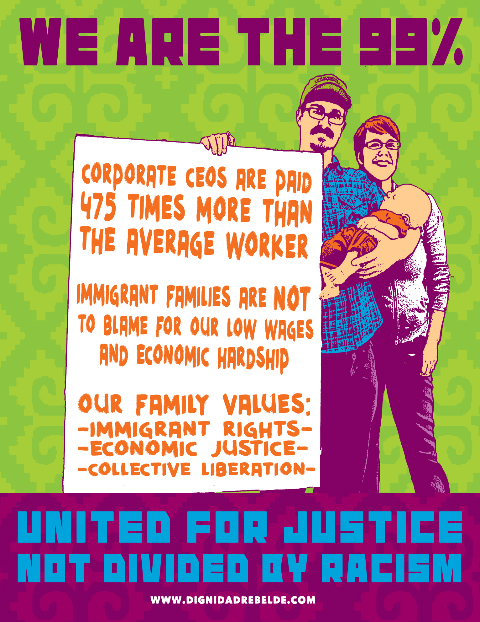
Melanie Cervantes, San Leandro, and Chris Crass. United For Justice, Not Divided By Racism. Print. Courtesy of Melanie Cervantes. DignidadRebelde.com. 

Bubbling Up

18 Mar

The Red Door Cafe window, Post.

A window along Polk.

Graffiti on a laundromat sign, Post and Franklin.

Streets

26 Feb

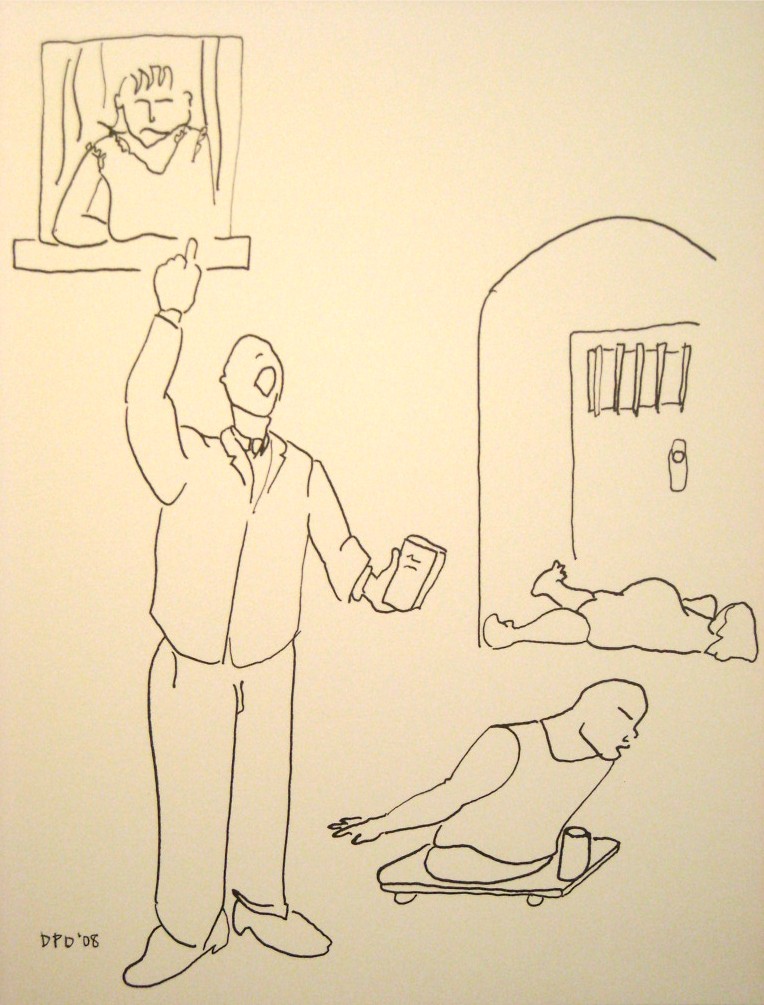
Untitled, from the series Short Tales from the American Landscape, 2008. Pen-and-ink on Bristol paper, 9 x 12 in. Collection of Patrick Marks.

Bodies litter sidewalks, asleep under blankets.  Bodies move in slow procession along the streets of the city, with belongings attached in back packs or  valises or shopping carts.  Bodies congregate at the 16th and Mission plazas, like pigeons en masse.  Yesterday morning I discovered a young man was asleep in the shower room of the hotel with the door locked.

It’s time to move.  The 21-day limit at the hotel arrived today.  The managers avoid the city’s residency requirements by keeping people moving.  Move.  Keep moving.

An American Love for Automated War

22 Feb

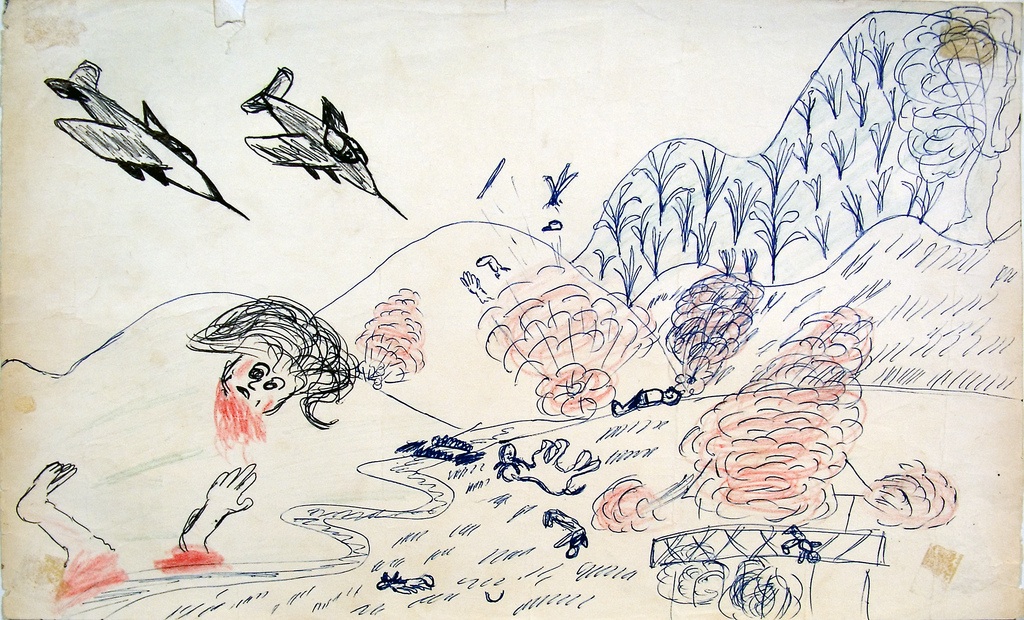
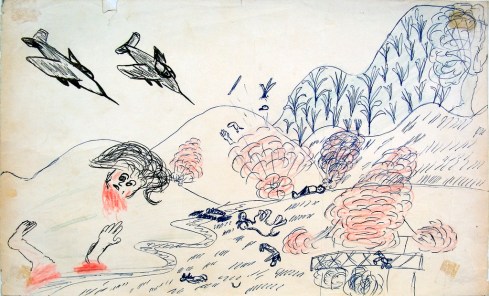
Drawing created by a displaced 27-year-old Laotian farmer in 1972. Courtesy of Fred Branfman.

What sadness!  Formerly, the fragrance of ripening rice

would fill the ricefields

I would see flowers opening their blossoms everywhere

in the forests

How beautiful it was for us!

— by a 20-year-old Laotian man, a traditional singer

It was a fertile land, a land of temperate weather and lush landscapes, rich in forests, jungles and mountain scapes.  Rice was the main crop of the region.  Water buffalo, cows, pigs, horses, ducks and chickens were staple livestock.  People lived in small villages where a pagoda might serve as a focal point.  Needs were simple enough that marketing was limited to occasional trips to purchase textiles and clothing.  Then the American bombers came.

From 1964 to 1969, the American government conducted a secret air war against the Laotian people occupying the Plain of Jars, the people there known locally as the Lao Phouen.  The Plain of Jars, so named because of receptacles found in the region believed to be from an ancient Mon-Khmer race, was located in the central Xieng Khouang province.  Editor Fred Branfman’s book, Voices from the Plain of Jars: Life under an Air War (Harper Colophon Books, Harper & Row, New York, 1972) documents the complete disappearance of a civilization through the testimony of survivors from this American-waged Guernica, survivors who were eventually herded into encampments outside the southern Laotian city of Ventiane.

It was the political victory of the Pathet Lao (“nation of Laos”) in May, 1964 that prompted the American government to act.  The United States had earlier attempted to control the Plain: from 1955 to 1963, funding Ventiane regime and far-right coups at a cost of $480.7 million; expanding a right-wing Lao army from a few thousand in 1954 to over thirty thousand by 1960; organizing a separate army of Meos, Laotian hill tribesmen originally from China, under the leadership of the C.I.A.; and establishing Air America bases owned by the C.I.A. (see Branfman, pages 12-13).  Following Western loss of control of most of the Plain, United States influence shrank to an area southwest of the Plain, where the C.I.A. directed the military base Long Tieng (Branfman 13-14).  Strategically, the United States had used northern Laos for Meo and American special forces teams entering North Vietnam on espionage, sabotage and assassination raids, from the 1950’s on; radar sites aiding American bombers attacking North Vietnam in the mid-1960’s; and, also, as a base for carrying out espionage missions into China (Branfman 16 fn. 14).

According to a U.S. Senate Staff Report, quoted by Branfman, the air war was meant “to destroy the social and economic infrastructure of Pathet Lao held areas,” with clarification from Branfman that “it was meant to hurt them by depriving them of local food supplies, disrupting transport and communications, killing off potential recruits and rice porters, demoralizing the civilian population, and eventually causing a refugee flow away from the Plain” (17-18).  Indeed, every aspect of civilian living became targeted under this “automated battlefield.”  Villages were bombed to smoldering ruins.  Rice paddies were destroyed.  As civilians fled to forests and jungles, these refugee sites were destroyed.  Even attempts to live in holes dug in the ground and farm at night were without avail; reconnaissance and electronic aircraft filmed and tracked the people below everyday for five and a half years (Branfman 18).

I found a copy of this book two months ago quite by accident.  Although a teenager in 1972, I was completely unaware of this remarkable testimony from the survivors of an American automated air war.  The words of these people, many who could not understand why the United States was bombing, saddens me greatly.  The drawings that are included are harrowing visions of the destruction we wrought against a people we held absolutely no compassion for.  What are we ignorant of today as our government acts secretly elsewhere in the world?

Branfman continues to educate people about the morality of automated war and the targeting of civilian populations.  You can learn about his life-long peace and justice work, and greater detail about the bombing of the Plain of Jars, at his blog: http://fredbranfman.wordpress.com.  His website, Truly Alive: Facing Death in the Prime of Life, at www.trulyalive.org, addresses psychological and spiritual principles with concern for societal and biospheric well-being.

Note: the above poem appears on page 37 of Voices from the Plain of Jars.

It’s 4:45 in the Morning

7 Feb

Thus the day began with the neighbor in number 21 turning on his radio as if a concert had been demanded by the whole building.  I do not know this person.  This was my first morning waking up at the Westman Hotel on Mission Street between 16th and 17th Streets.

As all good things come to an end, my stay in the Sunset district house in probate ended on Saturday morning.  The estate had been settled and work men were already preparing the walls for painting.  I spent the weekend looking for a hotel where I could pay for the coming week.  The No Vacancy signs were out in full force.  Before my final resting stop, I visited a variety of hotel lobbies that typically were cluttered and run down.  At a hotel on 16th Street between Valencia and Mission Streets, two garbage cans heaping with refuse greeted me as I was helped through the street-level door by a resident, a young woman who looked as if she had not eaten in a long time.  The hunger in her eyes, though, spoke of drugs or sex.  At the top of the stairs a clerk quoted a price of $200 for the week.

The Westman is protected by two iron gates, one street level and the next second-floor level across from the manager’s unit.  The building is run by a South Asian couple.  The husband first stared at me as if I were not to be trusted.  They let me inspect the room, but not without resistance.  Once paid, they became cordial.  As I waited to finish the business transaction, a couple leaving paid their good-byes to the manager’s wife.  The woman leaving noticed the cash in my hand and advised me not to display money in the hotel, a clear warning that I take seriously.

I went to find number 20 one flight up.  As I reached the top of the landing I witnessed a young woman in number 18 bent over strewn clothing on the floor, her door fully open, muttering some dissatisfaction.  She noticed me and complained that one would think they could clean the place for the fifty dollars she had paid them.  She moved towards me as if she had picked up a new scent.  She looked like a drug user, so I moved away for fear of becoming the money conduit for further recreation.  She continued to say hello to me, though, whenever I passed by.  When she hears steps outside her room, she opens her door with a Lennie shout-out: “Lennie, is that you?” “Lennie, are you there?” “Lennie, come here.”  Lennie must either have the money or the drugs.

Number 20 is a quiet affair: one chair, one stool, one dresser, one closet, one wash stand with mirror, and a bed.  On the dresser is a television.  The hotel advertises cable TV.  A towel, roll of toilet paper, and bar of Del Webb’s TownHouse soap are issued upon payment.  There are bathrooms on each floor, but the only shower I have found is one floor down.  The walls and other surfaces of unit 20 look as though every army in modern history has camped here.  There are small peepholes through walls between units, peeling paint, and cockroach stains.  Small, personal graffiti is everywhere, my favorite inscription written above a chair next to the door of the room.

I planned to wake at 5:30 so that I could prepare for travel to a temporary job site in Sierra Point, on the bay in South San Francisco.  I am part of a contracting crew doing document control for a pharmaceutical company.  Because of this morning’s blaring noise I left early.  A free shuttle from Balboa Park BART station takes me to the job.  The ride is short but picturesque.  It is a time when I can meditate.

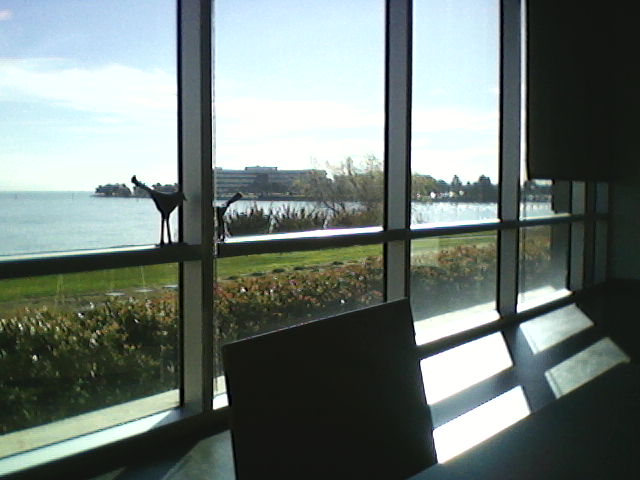
The work place itself offers space for lovely day dreaming as the glass pane windows along the back facade face the bay directly.  The employee cafeteria is spacious.  The company provides ample free food daily, including three kinds of fresh fruit, organic energy bars, organic yogurt, organic juices, and various healthy snacks and bottled drinks.  Free Peet’s coffee is brewed early in the morning.

I have never experienced this kind of serenity on the job.  It is not something I would even look for otherwise.  But I seek it out in the morning before the work day begins and thereafter during breaks.

In the dingy reality of a hotel room and its environs I believe there must also be beauty.  It will be found with love, courage, and the aid of balance.

Minorities and the Critical Decade: World War II and After

30 Jan

Minorities and the Critical Decade: World War II and After

Join me for a ten-session course beginning Wednesday, February 1st.  This is offered through International Free University, and, yes, it is free.  You will find me in Room 215 of the Science Building at the Ocean Campus of City College of San Francisco, from 6:00 to 8:30 p.m.

This course looks at the rise of consciousness in American society towards minorities and minority rights through the lens of popular culture and social discourse during and following World War II.  American participation in World War II pressed American society to live by the ideals of the democratic society it espoused as it battled fascist states overseas.  This not only resulted in the reevaluation of laws denying Chinese, Indian and Philippine Americans citizenship, but also challenged Jim Crow laws segregating the Black and White races.  By the end of the 1940s, challenges to anti-semitism were prevalent and homosexuals were being viewed by some as an emerging minority.  On the other hand, the incarceration of Japanese Americans struck an unspoken blow to citizenship and civil rights in the United States.

Through the lens of popular culture, including short stories, novels, cartoons, plays and film, and the fine arts, narratives focusing on minority representation are examined and contextualized both within the realm of popular cultural production and discourses from the social sciences.

Squimmy

24 Jan

The Wages of Sin

22 Jan

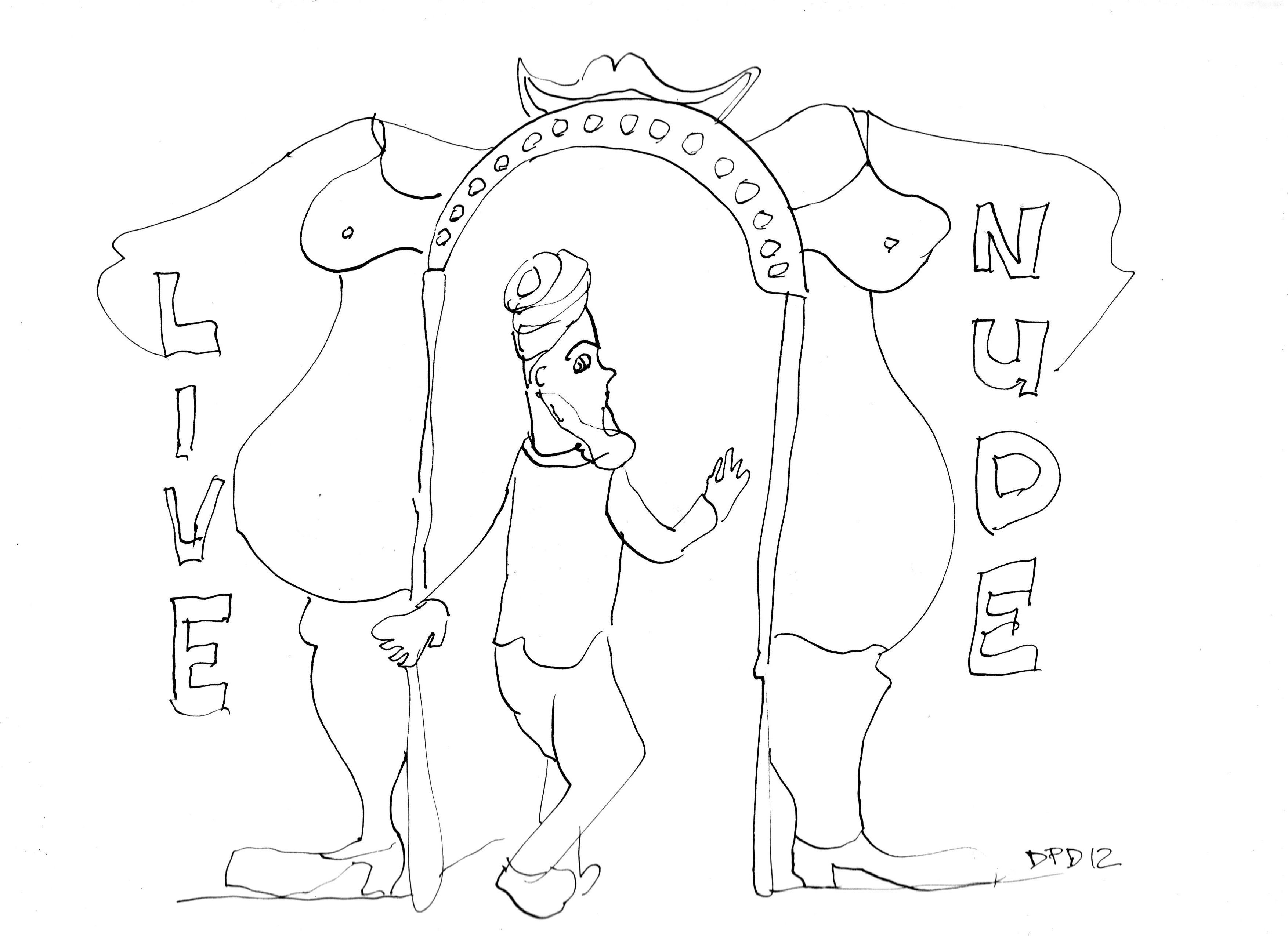
My thanks to Patrick Marks for describing to me a cartoon he had always imagined being created, involving a conversation between a barker at a peep show and a would-be patron.  But this is not that cartoon.  It is partly based on the traffic I witnessed going into a triple xxx venue on 8th Avenue at 31st Street in New York.  Three 9 x 12-in. pen-and-ink on Bristol paper drawings.