Tag Archives: san francisco

Tents II

13 Apr

A Nightly Encampment, 2012. Pen-and-ink on Bristol paper, 9 x 12 in. Based on photograph.

“…He seems to be profoundly impressed with the sufferings of mankind and with a belief that there is a deep-laid plan of monopolists to crush the poor to the earth.” — a reporter on Jacob Sechler Coxey, as conveyed in the Pittsburgh Chronicle Telegraph of March 22, 1894

It appears pleasant enough: men sprawled across a grassy area as if at a picnic.  The arduous journey, though, that the many different groups traversed in order to converge on the Washington capitol  in 1894 was anything but a picnic.  Kelly’s Army, the largest of the “unemployed armies,” began their march from San Francisco, organized by Colonel William Baker and led by Charles T. Kelly, a thirty-two-year-old compositor in one of the city’s printing businesses.  Arriving in Council Bluffs, Iowa from Omaha, Nebraska on April 15, the men slept on damp ground.  Upon relocation to Chautauqua grounds three to four miles east of the city, the army slept in the mud and spent the next day standing in cold rain with flurries of snow.  That an otherwise unused amphitheater at Chautauqua Hill housed a militia company instead of Kelly’s men was no mistake: the militia officer in charge kept them out.  Eventually an indignant citizenry demanded the removal of the militia.  Kelly’s army had drawn an estimated 30,000 of the curious to Council Bluffs; the same curiosity followed the various unemployed armies wherever they passed.  Although their demands were lodged with the governor, the people held the railroads responsible for the calling out of the militia and the mistreatment of these men.  Not dissimilar to today’s social discontent over a government run by corporations, this was an intriguing tale of populist agitation to reform government, captured sympathetically in Donald L. McMurry’s 1929 book, Coxey’s Army: A Study of the Industrial Army Movement of 1894 (Little, Brown, and Company; see page 24 for the above quotation and pages 164-6 for the above account; unless otherwise noted, quotations that follow are from same, indicated by page number).

A financial panic in 1893 preceded the movement of these armies, for which the monopolists or “plutocrats” were blamed,  an upheaval in markets resulting in runs on the banks, business closures, and massive unemployment.  This was not the first time the nation’s workers suffered from widespread unemployment.  Franklin Folsom points out, in his book Impatient Armies of the Poor: The Story of Collective Action of the Unemployed, 1808-1942 (University Press of Colorado, 1991), that the first in a recurring cycle of “full-scale, national, modern depression[s]” occurred in 1819 (page 18).  Perhaps two million or more were unemployed in 1894 (see McMurry, page 9, for various estimates).  At the Populist Party’s first national convention in Omaha in July, 1892, a platform was adopted, reading, in part: “We meet…in the midst of a nation brought to the verge of moral, political, and material ruin.  Corruption dominates the ballot-box, the legislatures, the Congress, and touches even the ermine of the bench.  The people are demoralized…The newspapers are largely subsidized or muzzled; public opinion silenced; business prostrated; our homes covered with mortgages; labor impoverished; and the land concentrated in the hands of capitalists…The fruits of the toil of millions are boldly stolen to build up colossal fortunes for the few, unprecedented in the history of mankind; and the possessors of these, in turn, despise the republic and endanger liberty.  From the same prolific womb of governmental injustice are bred the two great classes of tramps and millionaires” (7).

We have come full circle since the cry for reform of 1894.  Today’s Occupiers are dismissed as individuals uninterested in finding jobs and their camps are cited as public health nuisances.  The branding of reform movements as communistic lost its political edge.  Certainly there were anarchists and socialists in 1894.  “Petition in boots” was the phrase applied by Coxey to his endeavor and was perhaps coined by Carl Browne, one of Coxey’s lieutenants, who had long dreamed of a march on Washington.*  The British editor W.T. Stead attributed the origin of the phrase to a Professor Hourwitch at the University of Chicago, who compared the march of Coxey’s army to the “petition in boots” of the Russian peasants, marching “in bodies to present their grievances” (33, ftn. 1).  A Senator Wolcott of Colorado railed against the armies arriving at the Capitol by urging his colleagues to “stand together against socialism and populism and paternalism run riot” (112), the last key word a reflection of a federal government forced to provide for its unemployed.  But the industrial armies’ detractors appeared to focus, for the most part, on labeling the individuals comprising these organized, determined, and highly disciplined bands as tramps, “hoboes,” the “shiftless,” or “vagrants” (apparently even “walking bums” were despised by their own class in regard to those who lacked the “skill and nerve” to hop fast-moving trains).  McMurry carefully describes the estimated forty to sixty thousand “professional hoboes” in the United States during the early 1890s in order to differentiate the “tramp liv[ing] by his wits at the expense of society” from  the unemployed workers comprising the industrial armies converging on Washington (see 12-14).

Coxey was a successful business man based in Massillon, Ohio.  The owner of a sandstone quarry and producer of sand for steel and glass works, Coxey also held extensive farming interests.  He envisioned a federal government that would relieve the unemployment crisis through his Good Roads Bill, which instructed the Secretary of the Treasury to issue 500 million dollars in legal-tender notes for the construction of roads throughout the nation.  The bill would both secure work and circulate money.  Coxey followed this proposal with his Non-interest-bearing Bond Bill, which would authorize any governmental entity to issue such bonds for financing public works projects, the bonds possibly deposited with the Secretary of the Treasury as security for a loan of legal-tender notes.  Coxey, like members of the Greenback Party or Greenbackers, opposed a monetary system based on the deposit of gold bullion because political power then followed the dictates of private banks and corporations, sole determinants of the value of production and labor.

Like the Occupy movement today, the “Coxeyites” or “Commonwealers,” as these various marching groups became known, received popular sympathy.  Their long journey was aided by stays in locales where the armies might receive provisions or shelter for the night.  At Canton, Ohio, a number of Coxey’s men were housed overnight in the jail; at Louisville, Ohio, a number of the men slept in the city hall.  This particular army did carry a circus tent wherein the men slept on straw.  The armies were sometimes greeted by populist sympathizers with brass bands, crowds of onlookers, and supportive speeches in halls.  Train hopping and train stealing were frequently aided by railroad workmen willing to turn an eye or state governors unwilling to call in militia when demanded by railroad corporations.

At times, political sentiment in the Capitol also ran in the industrial armies’ favor.  In an open letter to the press, Senator William S. Stewart, of Nevada, addressed this direct petitioning of Congress, as Coxey progressed through Ohio, by defending the ballot as the only legitimate means of “retain[ing] [the] right to life, liberty and the pursuit of happiness.”  But he did agree with the overall sentiments of the Coxeyites when looking back on the previous two decades, observing that: “…now a ‘soulless despot of alien origin’, whose name was Money, was ‘monarch of the commercial world’, and administrative and legislative bodies were his servants” (72-3).  While Brigadier General Ordway assembled militia in the Capitol to stop Coxey’s arrival, Populist Senator Peffer, of Kansas, who had introduced Coxey’s bills to Congress, prepared for an open reception of the petitioners, referring to the perception of his senatorial colleagues as an “‘American House of Lords’, out of touch with the people” (107).  In the House of Representatives, Haldor E. Boen, of Minnesota, introduced a resolution instructing the Secretary of War to “provide camping grounds and tents for all organized bodies of laborers that came into the district” (109).  All for naught as Coxey, Browne and Christopher Columbus Jones were arrested on the steps of the Capitol building without having had an opportunity to utter a word on their petition.  As a result, fifty or more people from a crowd gathered at these steps were beaten by police clubs for having cheered Coxey.  Coxey’s intended speech included the observation: “…Upon these steps where we stand has been spread a carpet for the royal feet of a foreign princess, the cost of whose entertainment was taken from the public treasury without the approval or consent of the people.  Up these steps the lobbyists of trusts and corporations have passed unchallenged on their way to the committee rooms, access to which we, the representatives of the toiling wealth producers, have been denied.  We stand here today in behalf of millions of toilers whose petitions  have been buried in committee rooms, whose prayers have been unresponded to, and whose opportunities for honest, remunerative, productive labor have been taken away from them by unjust legislation, which protects idlers, speculators, and gamblers” (119-20).

*Franklin Folsom reprints part of a speech made by Joseph R. Buchanan to a San Francisco labor group in 1886 in which Buchanan outlines a march on Washington for the unemployed (Impatient Armies of the Poor, 147).  Folsom also details Carl Browne’s involvement in Dennis Kearney’s rise to power in San Francisco.  Kearney, an Irish immigrant who formed the Workingmen’s Party of California (WPC), saw the advantage he would have advocating against Chinese American labor: in 1877, one month after witnessing participants of a Workingmen’s Party of the United States rally join an organized group of “hoodlums” to demolish more than twenty Chinese laundries on July 23, Kearney changed his former support for Chinese laborers, and their reputation for working hard, to cries of “The Chinese must go!” in his speeches.  Browne became one of three members of the WPC executive committee and a large stockholder in the corporation controlling it.  Browne’s weekly paper, the Open Letter, served the same party.  Eventually Browne became Kearney’s private secretary (ibid, 131-6).

Easter Greeting from a Friend

9 Apr

Michael Heyward, New York.

The culture of the hat is apparently still doing well in New York.  It is one of those small details of life that causes me to stop and reminisce about the city.  I have seen monumental constructions adorning the head during the morning Easter Parade and Easter Bonnet Festival along Fifth Avenue.  Halloween in New York is equally festive.  But, perhaps, the most extraordinary event for crowning one’s ensemble was the annual Wigstock, begun in Tompkins Square Park, then relocated several times over the years, before retiring in 2005.  Yesterday we donned hats at Richard and Earl’s.  Richard, a retiree who is now a trader in what I jokingly call “could be Deco” (still, using a fine discriminatory eye for what he finds around the city), invited everyone to choose from a small mountain of hats atop the piano.  I chose the beaded flapper’s hat that I had first seen at Earl and Richard’s shop, Lotta’s Bakery.  Earl, the baker, by the way, provides scrumptious desserts.  Having a slice of blackstrap molasses gingerbread with an herbal tea is a heavenly treat.  1720 Polk Street is the place.

Bubbling Up

18 Mar

The Red Door Cafe window, Post.

A window along Polk.

Graffiti on a laundromat sign, Post and Franklin.

Streets

26 Feb

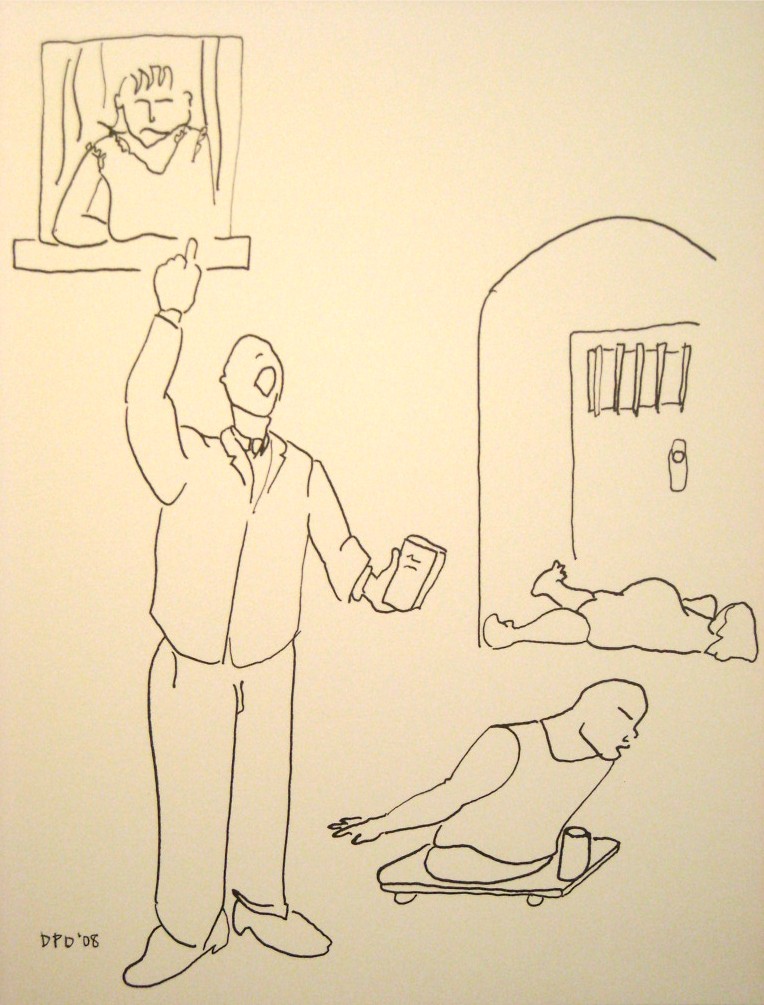
Untitled, from the series Short Tales from the American Landscape, 2008. Pen-and-ink on Bristol paper, 9 x 12 in. Collection of Patrick Marks.

Bodies litter sidewalks, asleep under blankets.  Bodies move in slow procession along the streets of the city, with belongings attached in back packs or  valises or shopping carts.  Bodies congregate at the 16th and Mission plazas, like pigeons en masse.  Yesterday morning I discovered a young man was asleep in the shower room of the hotel with the door locked.

It’s time to move.  The 21-day limit at the hotel arrived today.  The managers avoid the city’s residency requirements by keeping people moving.  Move.  Keep moving.

It’s 4:45 in the Morning

7 Feb

Thus the day began with the neighbor in number 21 turning on his radio as if a concert had been demanded by the whole building.  I do not know this person.  This was my first morning waking up at the Westman Hotel on Mission Street between 16th and 17th Streets.

As all good things come to an end, my stay in the Sunset district house in probate ended on Saturday morning.  The estate had been settled and work men were already preparing the walls for painting.  I spent the weekend looking for a hotel where I could pay for the coming week.  The No Vacancy signs were out in full force.  Before my final resting stop, I visited a variety of hotel lobbies that typically were cluttered and run down.  At a hotel on 16th Street between Valencia and Mission Streets, two garbage cans heaping with refuse greeted me as I was helped through the street-level door by a resident, a young woman who looked as if she had not eaten in a long time.  The hunger in her eyes, though, spoke of drugs or sex.  At the top of the stairs a clerk quoted a price of $200 for the week.

The Westman is protected by two iron gates, one street level and the next second-floor level across from the manager’s unit.  The building is run by a South Asian couple.  The husband first stared at me as if I were not to be trusted.  They let me inspect the room, but not without resistance.  Once paid, they became cordial.  As I waited to finish the business transaction, a couple leaving paid their good-byes to the manager’s wife.  The woman leaving noticed the cash in my hand and advised me not to display money in the hotel, a clear warning that I take seriously.

I went to find number 20 one flight up.  As I reached the top of the landing I witnessed a young woman in number 18 bent over strewn clothing on the floor, her door fully open, muttering some dissatisfaction.  She noticed me and complained that one would think they could clean the place for the fifty dollars she had paid them.  She moved towards me as if she had picked up a new scent.  She looked like a drug user, so I moved away for fear of becoming the money conduit for further recreation.  She continued to say hello to me, though, whenever I passed by.  When she hears steps outside her room, she opens her door with a Lennie shout-out: “Lennie, is that you?” “Lennie, are you there?” “Lennie, come here.”  Lennie must either have the money or the drugs.

Number 20 is a quiet affair: one chair, one stool, one dresser, one closet, one wash stand with mirror, and a bed.  On the dresser is a television.  The hotel advertises cable TV.  A towel, roll of toilet paper, and bar of Del Webb’s TownHouse soap are issued upon payment.  There are bathrooms on each floor, but the only shower I have found is one floor down.  The walls and other surfaces of unit 20 look as though every army in modern history has camped here.  There are small peepholes through walls between units, peeling paint, and cockroach stains.  Small, personal graffiti is everywhere, my favorite inscription written above a chair next to the door of the room.

I planned to wake at 5:30 so that I could prepare for travel to a temporary job site in Sierra Point, on the bay in South San Francisco.  I am part of a contracting crew doing document control for a pharmaceutical company.  Because of this morning’s blaring noise I left early.  A free shuttle from Balboa Park BART station takes me to the job.  The ride is short but picturesque.  It is a time when I can meditate.

The work place itself offers space for lovely day dreaming as the glass pane windows along the back facade face the bay directly.  The employee cafeteria is spacious.  The company provides ample free food daily, including three kinds of fresh fruit, organic energy bars, organic yogurt, organic juices, and various healthy snacks and bottled drinks.  Free Peet’s coffee is brewed early in the morning.

I have never experienced this kind of serenity on the job.  It is not something I would even look for otherwise.  But I seek it out in the morning before the work day begins and thereafter during breaks.

In the dingy reality of a hotel room and its environs I believe there must also be beauty.  It will be found with love, courage, and the aid of balance.

Squimmy

24 Jan

The Wages of Sin

22 Jan

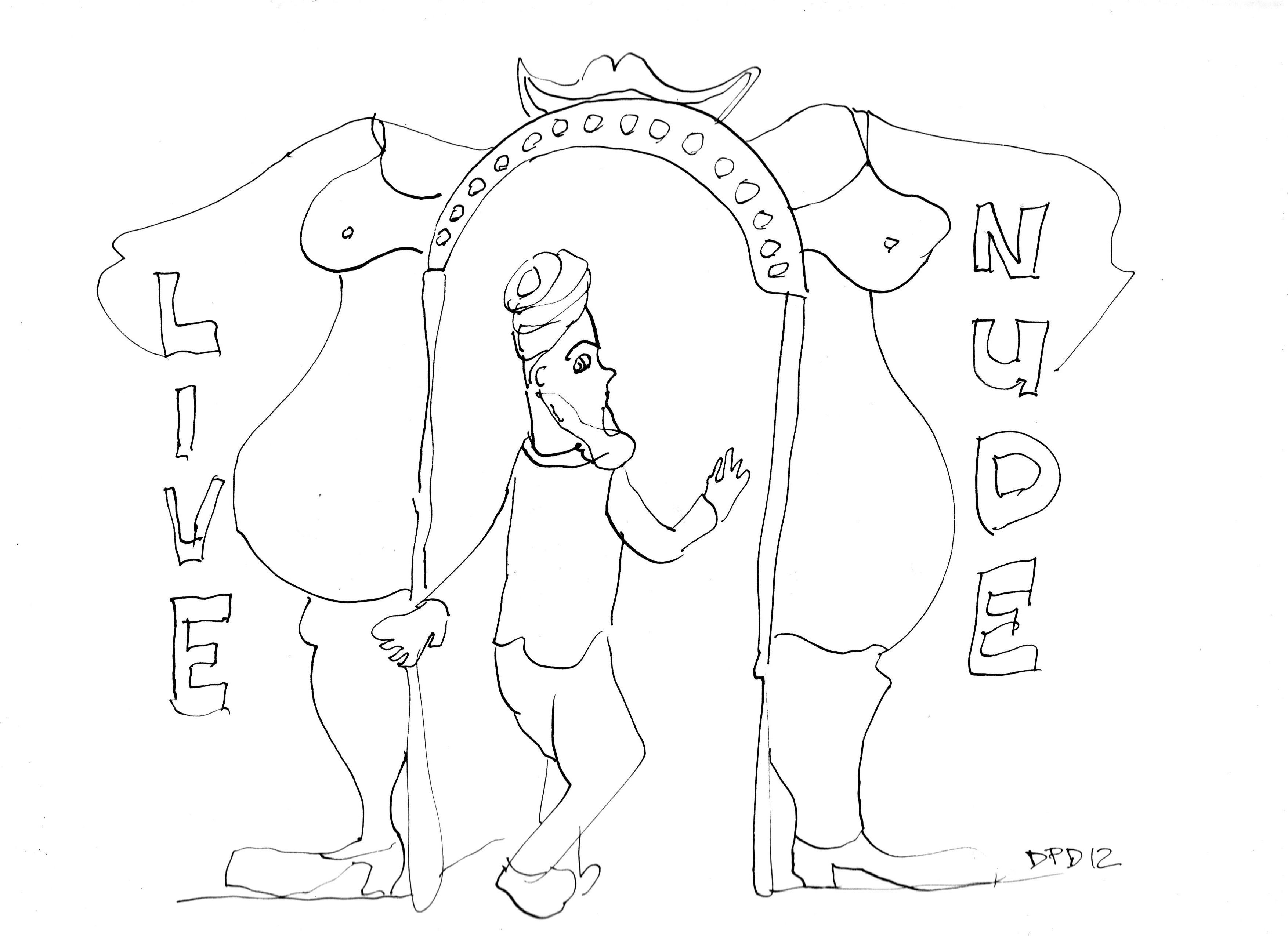
My thanks to Patrick Marks for describing to me a cartoon he had always imagined being created, involving a conversation between a barker at a peep show and a would-be patron.  But this is not that cartoon.  It is partly based on the traffic I witnessed going into a triple xxx venue on 8th Avenue at 31st Street in New York.  Three 9 x 12-in. pen-and-ink on Bristol paper drawings.

An Evening of Music at ILWU Local 34

16 Jan

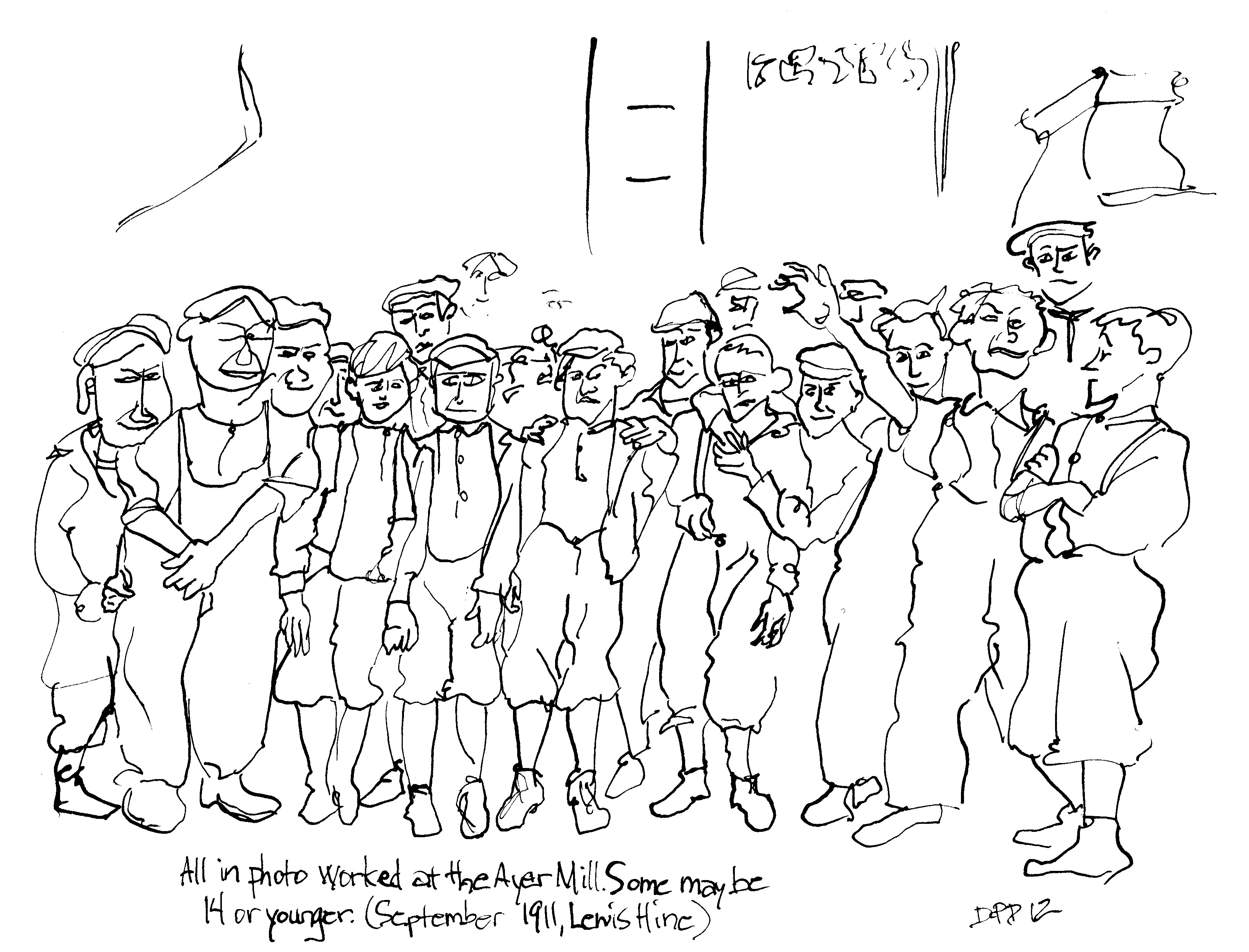
Child Labor III, 2012. Pen-and-ink on Bristol paper, 9 x 12 in. After Lewis Hine. Collection of Steve Zeltzer and Kazmi Torii.

In commemoration of the 100th year anniversary of the Bread and Roses textile workers’ strike in Lawrence, Massachusetts, the International Longshore and Warehouse Union (ILWU) Local 34 hall was host to a lively evening of music and poetry.  Carol Denney presented several of her songs on American class and culture with a vibrant voice.  Denney shared with us her song “Have Yourself a Slice of Occupy,” which the artist has combined with collaged images from Occupy Berkeley and Oakland sites in a voice recording video clip that can be viewed and heard at YouTube: http://youtu.be/_WlSOkadPaw.  The lyrics to the song appear below.

Have Yourself a Slice of Occupy, a ragtime salute by Carol Denney 11-8-2011

we are having quite a slice of occupy
hot, fresh, wild, delicious occupy
stir it up a nice hot cup of occupy
share it with your friends and neighbors
taste the fruit of all your labors
be the first one on your block to occupy
wind it up and set your clock to occupy
tell the cops and tell the mayor
you’ve become an occuplayer
have yourself a slice of occupy

grab your tent and screw the rent come occupy
join the slackers and the hackers occupy
meet the folks who lost their homes
meet the folks who never owned one
meet the folks down to the bone you’ll
find you’ll never be alone
grab a sign and join the line at occupy
admit you’re the 99 and occupy
if your tent don’t get reception
change your channel of perception
have yourself a slice of occupy

don’t you love the great outdoors
there’s no bureaucracy
but your meeting might be endless
it’s democracy – you gotta love it

don’t be late no need to wait just occupy
have yourself a heaping plate of occupy
hop on your bike and be the mike at occupy
the rich are going to miss the fun
but afterwards we’ll all be one
lose your frown and dance around at occupy
boot the blues and make the news at occupy
this ain’t no occupy in the sky
and there’s more to occupy than meets the eye
come have yourself a slice of occupy
(we really mean it)
have yourself a slice of occupy

You can also catch online her performance of another song she shared on Wednesday, “Song of the Wealthy Man,” which was presented as part of a Revolutionary Poets Brigade performance at Mythos Gallery in Berkeley on July 22, 2011: http://youtu.be/5yO4qgqx0aE .  This is a good time to consider Denney’s commentary on what the Wealthy Man thinks of the common man, especially since the Republican presidential candidacy is a complete chorus line of wealthy individuals.  Should one wonder, then, that current Republican attempts to relax child labor laws are happening a century after the Progressive Movement brought the ills of child labor to the attention of America?  Or that Newt Gingrich, one of the chorus line, advocates relaxation?  I suppose, if “vulture capitalist” had been sincerely lobbied by this chorus at No. 1 contender Mitt Romney.  At Harvard University, Wealthy Man Gingrich proposed doing away with laws that would prevent children in poor neighborhoods from being put to work, and on December 10th, 2011, the same puffy professor proposed putting New York City high school students to work as janitors.  In Maine, the state Restaurant Association lobbied for a law, sponsored by Republicans Debra Plowman and David Burns, that would allow an increase of total weekly hours for teenagers from 20 to 32.  The legislation as passed increased the number of hours to 24.  But please note that teenagers are allowed by law to be paid as little as $5.25 per hour, $2.25 less than the state’s minimum wage.  In Wisconsin, another legislative act of grace conferred upon teenagers the ability to work more than 24 hours per week during school session and more than 50 hours per week during summer break, this thoughtful enactment inserted into an amendment to the state’s budget bill in late June by Republicans Robin Vos and Alberta Darling.  A state Grocers Association spokesperson is quoted by Holly Rosenkrantz as saying: “It wasn’t like [our members] were trying to overwork these kids or create a sweatshop…”  Of course not.  But we can guess that the initiative is to drive down wages, just as the Maine legislation enables employers to do (see Rosenkrantz, “Taking Aim at Child Labor Laws,” Bloomberg Businessweek [January 11, 2012; http://www.readersupportednews.org/news-section2/320-80/9381-taking-aim-at-child-labor-laws; accessed 1/14/12]).

We were also energized on Wednesday evening by singer/songwriter Hali Hammer, social justice singer/songwriter David Rovics, both with driving voices and uplifting messages, the magnificent Rocking Solidarity Chorus, labor poet Alice Rogoff and a song from poet Mary Rudge.

Note on drawing: Working as an investigative reporter, Lewis Wickes Hine (1874-1940) documented working children at employment sites and home between 1908 and 1924.  More than 5,100 photographic prints and 355 glass negatives, along with records of the National Child Labor Committee, a non-profit organization that advocated for child labor reform, were given to the Library of Congress in 1954.  The following caption for the photograph upon which the above drawing is based appears at a website for Hine’s photographs, http://www.lewishinephotographs.com/: “All in photos worked (even smallest girl and boys) and they went to work at (noon) 12:45. Some of the following boys and girls mey [sic] be 14, many are not. John Gopen, 189 Elm St. Joseph Stonge, 73 King St. Billie Welch, 178 Union St. Tim Carroll, 310 Salem St. Michael Devine, 64 South Broadway. Jacob Black, 15 Bradford Bl. Binnie Greenfield, 281 Park St. Andrew Pomeroy, 76 South Broadway. Louis Gross, 39 Myrtle St. Arthur Davois, 244 Salem St. Joseph Latham?, 165 Willow St. Salvatore Quatirtto, 48 Union St. Sam Gangi, 82 Pleasant Valley St. These two boys were about the youngest of the boys, others nearly as young. Location: Lawrence, Massachusetts. Date Created/Published: 1911 September. LOC original medium: 1 photographic print. Picture of child labor by Lewis Wickes Hine.”  Ayer Mill may be a misattribution on my part.  If anyone has better information, please notify me so that a correction can be published.

My thanks to Summer Brenner for notifying me of the Rosenkrantz article.

Beached Thumb, Land’s End

10 Jan

City State

5 Jan