Fred Branfman, June 26, 2013

Executive Branch leaders have killed, wounded and made homeless well over 20 million human beings in the last 50 years, mostly civilians.
Editor’s Note: The following is the latest in a series on the Executive Branch of the United States.
Introduction: America’s Secret Shame
America has a secret. It is not discussed in polite company or at the dinner tables of the powerful, rich and famous.
Parents do not teach it to their children. Best-selling authors do not write about it. Politicians and government officials ignore it. Intellectuals avoid it. High school and college textbooks do not refer to it. TV pundits do not comment on it. Teachers do not teach it. Journalists from the nation’s most highly regarded TV news shows, newspapers and magazines, do not report it. Columnists do not opine about it. Editorial writers do not editorialize about it. Religious leaders do not sermonize about it. Think tanks and professors do not study it. Lawyers do not litigate it and judges do not rule on it.
The few who do not keep this secret, who try to break through to their fellow citizens about it, are marginalized and ignored by society at large.
To begin to understand the magnitude of this secret, imagine that you get into your car in New York City, and set out for a drive south, staying overnight in Washington DC, a four-hour drive. As you leave, you look out your window to the left and see a row of bodies, laid end to end, running alongside you all the way to DC.
You spend the night there, and set out early the next morning for Charleston, South Carolina, an 11-hour drive. Again, looking out your window, you see the line of bodies continues, hour after hour. You are struck that most are middle-aged or older men and women, younger women, or children. You arrive in Charleston, check into your hotel, have a good meal, and get up early the next morning to drive to Miami, another 12-hour drive. And once again, hour after hour, the line of bodies continues, all the way to your destination.
If you can imagine such a drive, or these bodies piled one on top of each other reaching 120 miles into the sky, you can begin to get a feeling for former Defense Secretary Robert McNamara’s mid-range estimate of 1.2 million civilians killed by U.S. firepower in Vietnam. (1) (The U.S. Senate Refugee Committee estimated 430,000 civilian dead at the end of the war. (2) Later estimates as more information has become available, e.g. by Nick Turse, author of Kill Anything That Moves, put the number as high as 2 million.)
And the secret that is never discussed is far larger. To the 430,000 to 2 million civilians killed in Vietnam must be added those killed in Laos, Cambodia, Afghanistan, Iraq and many other nations (see below), all those wounded and maimed for life, and the many millions more forced to leave villages in which their families had lived for centuries to become penniless refugees. All told, U.S. Executive Branch leaders – Democrats and Republicans, conservatives and liberals – have killed wounded and made homeless well over 20 million human beings in the last 50 years, mostly civilians.
U.S. leaders have never acknowledged their responsibility for ruining so many lives, let alone apologized or made proper amends to the survivors. Those responsible have not been punished, but rewarded. The memory of it has been erased from national consciousness, as U.S. leaders endlessly declare their nation’s, and their own, goodness. Millions of civilian lives swept under the rug, forgotten, as if this mass murder and maiming, the destruction of countless homes and villages, this epic violation of basic human decency—and laws protecting civilians in time of war which U.S. leaders have promised to observe—never happened.
Over a million innocent human lives in Vietnam alone. Grandparents, parents and children. Decent, hard-working people, each with a name, a face, and loved ones; people with dreams and hopes, and as much of a right to life as you or I. Forgotten. Over one million civilians dead, over 10 million wounded and made homeless in Vietnam alone, forgotten. And particularly remarkable is how this has happened. Totalitarian regimes go to great lengths—strict censorship, prison for those violating it—to cover up their leaders’ crimes. But in America, the information is available. All that is needed to keep America’s secret is to simply ignore it.
Americans keep this secret because facing it openly would upend our most basic understandings about our nation and its leaders. A serious public discussion of it would reveal, for example, that we cannot trust Executive Branch leaders’ human decency, words, or judgment no matter who is President. And more troubling, acknowledging it would mean admitting to ourselves that we have been misleading our own children, that our silence has robbed them of the truth of their history and made it more likely that future leaders will continue to commit acts that stain the very soul of America.
It is a matter of indisputable fact that the U.S. Executive Branch has over the past 50 years been responsible for bombing, shooting, burning alive with napalm, blowing up with cluster bombs, burying alive with 500 pound bombs, torturing, assassinating, and incarcerating without evidence, and destroying the homes and villages of, more innocent civilians in more nations over a longer period of time than any other government on earth today.
It is also undeniable that it has committed countless acts, as no less an authority than U.S. Secretary of State John Kerry noted in regard to Vietnam, which have been:
“contrary to the laws of the Geneva Convention, and… ordered as established policies from the top down,” and that “the men who ordered this are war criminals.”
And its crimes against humanity have continued since Vietnam. Thirty years later, a Nuremberg prosecutor speaking of the U.S. invasion of Iraq stated that a
“prima facie case can be made that the United States is guilty of the supreme crime against humanity, that being an illegal war of aggression against a sovereign nation.”
And as you read these words the U.S. Executive Branch is adding to its crimes, as it conducts secret drone and Joint Special Operations Command (JSOC) ground assassinations of individuals without due process.
The rationalizations by which even decent human beings allow themselves to ignore their leaders’ mass murder, e.g. that “these things always happen in war,” or “it’s the other side’s fault,” are just that: rationalizations that allow us to avoid our secret shame. Human civilization, through its body of international law, has defined which acts are both immoral and illegal even in times of war. And a citizen’s first responsibility is to oppose his or her own government’s crimes, not those of others.
Although America’s media, intellectual, political and economic elites ‘turn their heads pretending they just don’t see’ U.S. leaders’ responsibility for mass murder, dozens of dedicated and honorable scholars and activists led by Noam Chomsky have spent years of their lives meticulously documenting it.
Readers wishing to flesh out the overview below are directed to five important recent books: Kill Anything That Moves, by Nick Turse, about Vietnam; Dirty Wars (and a film), by Jeremy Scahill, about Iraq, Afghanistan and Somalia; The Deaths of Others, by John Tirman, covering Korea, Vietnam, Iraq and Afghanistan; The Untold History of the U.S. by Oliver Stone and Peter Kuznick (and a 10-part Showtime documentary) discussing U.S. policy from World War II to the present; and Drone Warfare by Medea Benjamin. FLYBOYS, by James Bradley, also offers invaluable information on U.S. aerial mass murder of civilians in World War II, as does The Korean War: A History by Bruce Cumings on U.S. Executive massacres of civilians in Korea. Such careful work has been supplemented by numerous reports from such organizations as Amnesty International and Human Rights Watch.
Until now, the issue of U.S. Executive Branch leaders’ disregard for innocent human life has mainly concerned their treatment of “non-people” abroad. But as the sinews of a surveillance state and police-state infrastructure have been steadily strengthened at home since 9/11, an Executive Branch mentality that has been so indifferent to innocent human life abroad will threaten increasing numbers of Americans in coming years.
No honest human being can deny what the facts below reveal about the U.S. Executive’s institutional evil and lawlessness. The only serious question is what we are willing to do about it.
Can Americans Trust the U.S. Executive Branch?
Columnist George Will recently summarized the fundamental issue underlying not only Edward Snowden’s recent whistleblowing, but all controversies about U.S. Executive Branch behavior:
“The problem is we’re using technologies of information-gathering that didn’t exist 20 years ago… and they require reposing extraordinary trust in the Executive Branch of government.”
Former Bush aide Matthew Dowd chimed in on the same talk show, saying “what they’re saying is trust us, trust us.” Trust is indeed the only basis for supporting a U.S. Executive which hides its activities from its own citizens.
But can we trust the Executive’s Branch’s commitment to truth, law and democracy, or even basic human decency? Judging its actions, not words, over the past 50 years is the key to deciding this issue. And we might begin with some basic questions:
How would you regard the leaders of a foreign power who sent machines of war that suddenly appeared over your home, dropped bombs which killed dozens of your neighbors and your infant daughter, wounded your teenage son, destroyed your home, and then forced you into a refugee camp where your older daughter had to prostitute herself to those foreigners in order to support you, your wife and legless son? (U.S. Executive Branch officials created over 10 million refugees in South Vietnam.)
What would you think of foreign leaders who occupied your country, disbanded the military and police, and you found yourself at the mercy of marauding gangs who one day kidnapped your uncle and cousin, tortured them with drills, and then left their mangled bodies in a garbage dump? (U.S. Executive Branch officials occupied Iraq, disbanded the police, and failed to provide law and order as legally required of Occupying Powers.)
How would you view a foreign power which bombed you for five and a half years, forced you and your family to live in caves and holes like animals, burned and buried alive countless of your neighbors, and then one day blinded you in a bombing raid that leveled your ancestral village, where you had honored your ancestors and had hoped after your death to be remembered by your offspring? (U.S. Executive Branch leaders massively bombed civilian targets in Laos for nine years, Cambodia for four years.)
What would you think of foreign assassins who, as Jeremy Scahill reports in Dirty Wars, broke into your house at 3:30 am as a dance was coming to an end, shot your brother and his 15-year old son, then shot another of your brothers and three women relatives (the mothers of 16 children) denied medical help to your brother and 18-year-old daughter so that they slowly bled to death before your eyes, then dug the bullets out of the women’s bodies to cover up their crimes, hauled you off to prison, and for months thereafter claimed they were acting in self-defense? And how would you feel toward the leaders of the nation that had fielded not only these JSOC assassins but thousands more, who were conducting similar secret and lawless assassinations of unarmed suspects while covering up their crimes in many other countries around the world? (3)
How would you view the foreign leaders responsible right now for drone attacks against you if you lived in northwest Pakistan where, a Stanford/NYU study reported after a visit there:
“hovering drones have traumatized millions living in these areas. Drones hover twenty-four hours a day over communities in northwest Pakistan, striking homes, vehicles and public spaces without warning. Their presence terrorizes men, women and children, giving rise to anxiety and psychological trauma among civilian communities. Those living under drones have to face the constant worry that a deadly strike may be fired at any moment, and the knowledge that they are powerless to protect themselves.”
These are not rhetorical questions. Every one of these acts, and countless more, have been committed by the U.S. Executive Branch over the past 50 years, and will continue indefinitely until it is transformed. If we judge them by their actions, not words, we must face the following facts:
— The U.S. Executive Branch killed in Vietnam from a U.S. Senate Refugee Subcommittee-estimated 430,000 civilians to the 1.2 million civilians later estimated by Robert McNamara, to the two million civilians estimated by Nick Turse. And it wounded at least 1,050,000 civilians and refugeed at least 11,368,000, according to the Refugee subcommittee (3); assassinated through its Phoenix Program an officially estimated 26,000 civilians, and imprisoned and tortured 34,000 more, on unproven grounds that they were “Vietcong cadre”; created an estimated 800,000-1.3 million war orphans and 1 million war widows; and after the war ended left behind Agent Orange poisons, unexploded cluster bombs, and landmines, creating an estimated 150,000 deformed Vietnamese children; and killing and maiming 42,000 peacetime victims.
— The U.S. Executive has, in Laos, conducted nine years of bombing which has been estimated by Laos’ National Regulatory Authority to have killed and wounded a minimum of 30,000 civilians by bombing from 1964-’73, and another 20,000 since then from the unexploded cluster bombs it left behind. It also created over 50,000 refugees after it had leveled the 700-year-old civilization on the Plain of Jars.
— The U.S. Executive has, in Cambodia, killed and wounded tens of thousands of civilians by carpet-bombing villages from 1969-’75. All told, after Richard Nixon and Henry Kissinger secretly bombed and invaded Cambodia, waging a war that made the U.S. Executive responsible for casualties on all sides, the U.S. Senate Refugee Subcommittee estimated that 450,000 persons had been killed and wounded, and 3,990,000 made refugees. (4) Historian Michael Clodfelter has estimated that, all told, 600,000 Cambodian civilians died. (5)
— The U.S. Executive under Bill Clinton in Iraq, John Tirman reports in The Deaths of Others, imposed an embargo so severe that “UNICEF estimated that 500,000 children under five years of age had died as a result of the war and sanctions from malnutrition, diseases for which cures were available but medicine in Iraq was not, and poor health at birth due to prenatal effects on mothers.” (6)
Dennis Halliday, Assistant UN Secretary General, declared that:
“I had been instructed to implement a (sanctions) policy that has effectively killed over a million individuals.”
— And after invading Iraq in 2003, the Executive under George W. Bush, as the Occupying Power, was legally responsible for maintaining law and order. Its war was also an aggressive war as outlawed at Nuremberg. It thus bears both the moral and legal responsibility for the deaths of more than 130,000 Iraqis (Iraq Body Count) to 654,965 (Lancet Scientific Journal) to 1,220,580 (Opinion Research Business), hundreds of thousands more wounded, and more than officially estimated 5 million refugees. (Please also see footnote 15)
— The Executive has, in Afghanistan, conducted thousands of night raids familiar to viewers of World War II Gestapo movies – killing over 1500 civilians in 6282 raids in 10 months from 2010 to early 2011 alone, as revealed by investigative reporter Gareth Porter. They have also conducted numerous bombing strikes and supported a corrupt regime which has stolen billions of dollars while their fellow citizens died for lack of healthcare and food.
–The Executive has, in Pakistan and Yemen, killed an estimated 2,800-4,000 persons from drone strikes, only 73 of whom it has named. Most were killed in “signature strikes” in which the victims’ names were unknown, and who in no way threatened the United States.
— Also, over the past 50 years, the U.S. Executive Branch bears a major responsibility for massive death and torture throughout Central and Latin America, Africa and Asia. Church, human rights and others estimate that U.S.-installed, trained, equipped and advised death squads in El Salvador and Contras in Nicaragua killed well over 35,000 and 30,000 persons respectively. The U.S.-supported Rios Montt regime in Guatemala killed an estimated 200,000. The U.S.-supported coup in Chile brought to power a regime that killed an estimated 3,200-15,000 political opponents and tortured another 30,000. U.S. support for Indonesian government genocide in East Timor helped kill over 200,000 persons. U.S. support for terrorists led by Jonas Savimbi in Angola helped kill an estimated 1.2 million persons and displaced another 1.5 million. (7)
And how much can you trust the decency of a US. Executive that treats these millions of human beings as mere nameless, faceless “collateral damage” at best, direct targets at worst, as human garbage barely worthy of mention, as “non-people” as Noam Chomsky has observed?
We almost never ask such questions in this country, never try to put ourselves in the shoes of the tens of millions of victims of our leaders’ war-making, because doing so confronts us with a grave dilemma. On the one hand, if we would say these acts are evil if done to ourselves they are obviously also evil when done to others. But admitting that would require most of us to challenge our most basic beliefs about this nation and its leadership. And if we are members of our political, intellectual, media, government and private sector elites, it would threaten our jobs and livelihoods.
We are divided. The honest part of ourselves knows there is only one word that can adequately describe the U.S. Executive Branch’s indifference to non-American life. It is not a word to be used lightly, for overuse robs it of its power. But when appropriate, failing to use it is an act of moral cowardice that assures its continuation. That word is “evil”.
If we would regard such acts as evil if done to us, they are equally evil if done to others. This is what we teach our children when we teach them the Golden Rule or that America is a nation of laws not men. It means, simply, that if needlessly ruining the lives of the innocent is evil, the U.S. Executive Branch is the most evil and lawless institution on the face of the Earth today, cannot be trusted, and poses a clear and present danger to countless innocents abroad and democracy at home.
We speak of “institutional evil” here because the greatest evils of our time are conducted by often personally decent, even idealistic, men and women. It is not necessary to be hate-filled or personally violent for an American to commit evil today. One need only be part of, or support the police, intelligence and military activities of the U.S. Executive Branch.
But the practical part of ourselves, the part that needs to make a living and maintain emotional equilibrium, leads us to ignore the mass evil our leaders engage in. It is so much easier. For accepting this truth means accepting that our leaders are not good and decent people; that JSOC commandos are not “heroes” but rather lawless assassins whose very existence shames us all; that we are not being protected, but endangered by leaders who are turning hundreds of millions of Muslims against us; that we must assume that Executive officials are right now secretly engaging in a wide variety of illegal and immoral activities that would shock and disgust us if they were revealed; and that we cannot believe a word they say when these abuses are revealed as they so regularly engage in secrecy and stonewalling, lying when discovered, covering up when the lie is revealed, and claiming it was an aberration and/or blaming it on a subordinate when the cover up fails. (8)
The issue of trust is key since it is the only basis upon which U.S. citizens can support secret Executive actions about which they are not informed. And the issue of trust is ultimately a moral, not legal judgment. We acknowledge that the citizen actually has a moral obligation to resist an unjust law promulgated by an immoral government, whether in the Soviet Union, South Africa, or, as we acknowledge when we celebrate Martin Luther King Jr.’s birthday, in America.
Even when the law is used by the likes of David Ignatius, David Brooks, Tom Brokaw, and Nancy Pelosi to attack an Edward Snowden, their key unstated assumption is that they trust the U.S. Executive since they know little more about its secret activities than anyone else. The moral dividing line is clear. Those indifferent to innocent human life and democracy are less angry at Executive mass murder and threats to democracy than at those who reveal this wrongdoing.
Although the principal responsibility for the millions of lives U.S. leaders have ruined lies with the Executive, most of America’s other organs of power have also participated in keeping the screams of America’s victims from reaching the public. Republicans and conservatives have not only shown no concern for America’s innocent victims, but cheered on its leaders’ torment of the innocent.
Bush U.N. Ambassador John Bolton, when asked by a New York Times writer about U.S. responsibility to aid the millions of refugees its invasion of Iraq had created, responded that the refugees had:
“nothing to do with our overthrow of Saddam. Our obligation was to give them new institutions and provide security. We have fulfilled that obligation. I don’t think we have an obligation to compensate for the hardships of war. Helping the refugees flies in the face of received logic. You don’t want to encourage the refugees to stay.”
But particularly striking has been the behavior of centrists and liberals who know full well the horrors U.S. Executive Branch leaders have inflicted upon the innocent, espouse humanitarian values, but simply look the other way. The Times, for example, quite appropriately ran photos and small bios humanizing each of the nearly 3,000 Americans killed on 9/11. But its editors have made a conscious decision not to humanize virtually any of the millions of non-Americans for whose deaths U.S. leaders are responsible, as has the rest of the U.S. mass media.
David Petraeus became Afghanistan commander on July 4, 2010, and proceeded to loosen General McChrystal’s rules of engagement, triple bombing and night raids and invade southern Afghanistan, leading to a huge increase in U.S. and Taliban violence against civilians. Within months, the Red Cross said conditions for civilians were the worst they’d been for 30 years.
A Pakistan newspaper reported that things were so bad at the Kandahar Mirwais hospital that civilian casualties “overwhelm the limited bed space. On some days, the floor is red with blood” and that “the overflow at Kandahar’s Mirwais hospital has forced hundreds of sick and injured Afghans to cross the border into Pakistan every day to seek medical treatment.” It also noted that “many Afghans are unable to get to basic healthcare” because, despite hundreds of billions in U.S. spending on war, “thirty years of conflict have left the country’s health care system struggling to cope.”
The Special Representative to Afghanistan of close ally Great Britain said:
“David Petraeus should be ashamed of himself … He has increased the violence, trebled the number of special forces raids and there has been a lot more rather regrettable boasting from the military about the body count … Petraeus has ignored his own principles of counter-insurgency which speaks of politics being the predominant factor in dealing with an insurgency.”
But none of this reached the American public. No stories of visits to Kandahar Hospital, no interviews with Britain’s Special Representative appeared in the U.S. mass media. Instead, dozens of U.S. journalists visiting Afghanistan praised General Petraeus, and presented his sanitized version of a war in which only “militants” are killed. Petraeus’ greatest accomplishment, Time magazine columnist Joe Klein informed his readers after a Petraeus-managed trip to Afghanistan, was to turn the U. S. army into a “learning institution.”
And Democratic Party politicians, while at least voicing concern for those in need in this nation and acting honorably for a few brief moments at the end of the Indochina war, have funded the Executive’s killing abroad and limited their own concerns to the wellbeing of America’s soldiers. (9)
In 1967, Chomsky wrote a landmark essay entitled “The Responsibility of Intellectuals,” arguing that public intellectuals – who had the time, opportunity and freedom to study the pain its leaders inflicted upon the innocent, and to convey it to the larger public – had a special responsibility to do so.
But his argument, by and large, has fallen upon deaf ears, particularly since Vietnam. Thousands of intellectuals, members of Congress, pundits, academics and journalists have turned a blind eye to U.S. mass murder. And many even turned into “liberal hawks”, supporting war against Iraq. The likes of the Washington Post’s Richard Cohen, the N.Y. Times’ Thomas Friedman, Slate’s Christopher Hitchens, The NewRepublic’s Leon Wieseltier, CNN’s Fareed Zakaria, and many others not only urged a war that brought a living hell to Iraq, but being liberals, justified it on the grounds that it would help the Iraqi people. (See “Bush’s Useful Idiots,” by Tony Judt.)
They even denigrated the millions of decent and honorable Americans who marched to try and head off the Iraq war. It is so easy when making a good living and having access to “official sources” to see oneself as smarter and better-informed than “naïve” students and grandmothers in tennis shoes. Hitchens, for example, called war opponents “moral imbeciles,” “noisy morons,” “overbred and gutless,” “naive” and “foolish.”
And after the war began most of these “liberal war hawks” then turned a blind eye to the civilian carnage resulting from the war they had supported in the name of the Iraqi people, as the body count steadily rose by tens of thousands until over 5 million Iraqis were killed, wounded or made homeless. Nor did they apologize to the millions of their fellow Americans opposing the war whom they had so arrogantly maligned, and who had turned out to be so much wiser and more moral than were they.
Executive Evil in Microcosm: A Personal Report
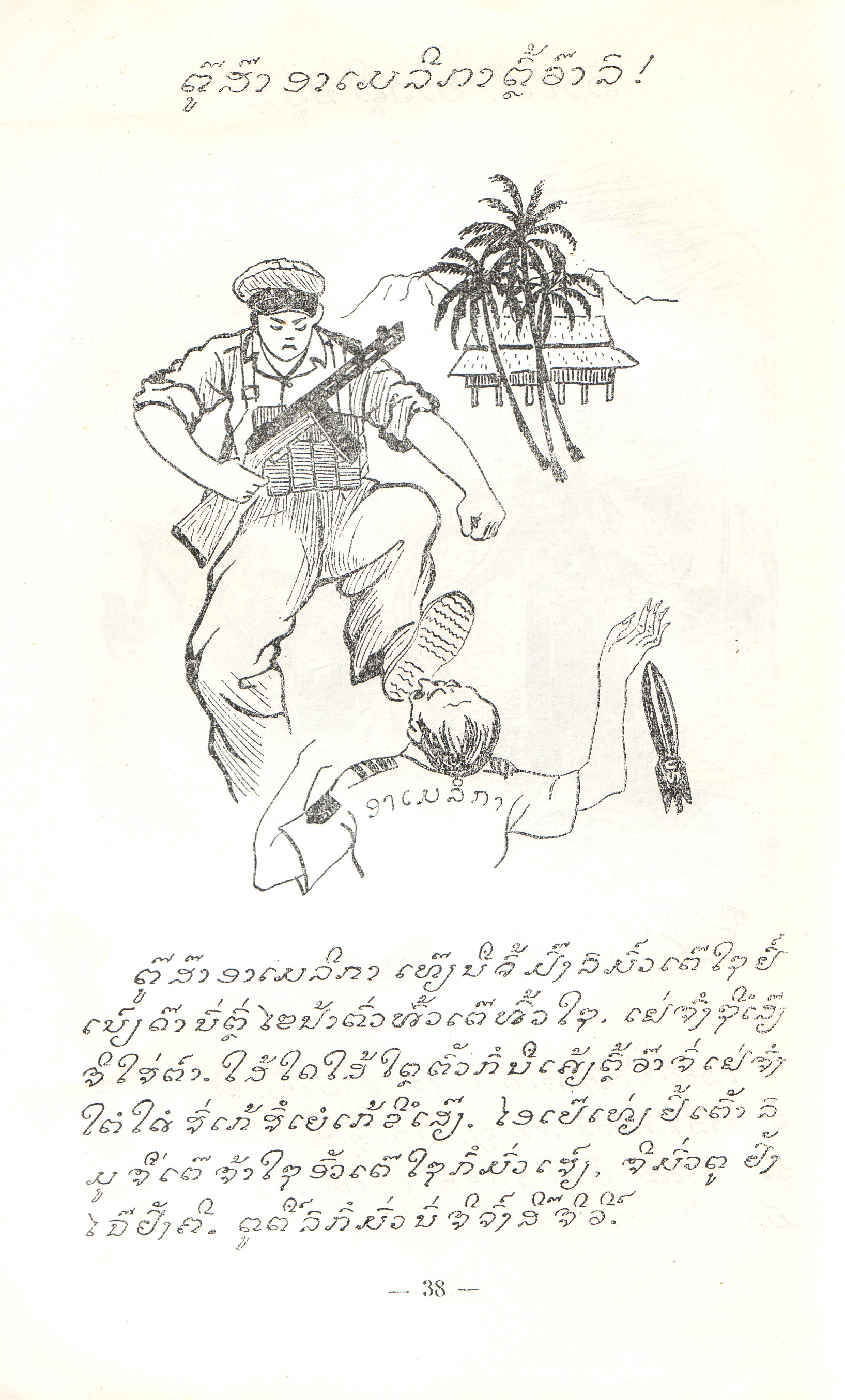
I first encountered U.S. Executive evil and lawlessness in September 1969, when I interviewed the first Lao rice farmers to come out of communist zones in northern Laos into American zones around the capital city of Vientiane. I was horrified as these gentle Lao, who did not even know where America was, described living under U.S. bombing for five and a half years. I interviewed people who had been blinded and lost limbs and yet were the lucky ones because they had survived. As I learned of grandmothers burned alive, pregnant mothers buried alive, children blown to bits by antipersonnel bombs, and realized that millions of Lao and Vietnamese farmers were still being bombed, I felt as if I had discovered Auschwitz while the killing was still continuing.
As I began to research the bombing, visiting U.S. airbases in Thailand and South Vietnam, talking with U.S. Embassy officials, interviewing a former U.S. Air Force captain over a period of months, I learned it was but a handful of top U.S. Executive Branch leaders, Republicans and Democrats alike, who were solely responsible for the bombing. Neither Congress nor the American people had even been informed, let alone offered their consent. The U.S. Executive, I learned, was a power unto its own that could not legitimately claim to represent the American people.
From May 1964 until March 1970, U.S. Executive officials constantly denied they were even bombing in Laos. When the evidence became so great that even Richard Nixon had to admit the bombing, Executive Branch officials continued to lie by denying they had bombed any civilian targets at all—even as I was interviewing over 1,000 refugees on dozens of occasions and hearing from each that their villages had been destroyed and that they had witnessed countless civilian casualties.
One day I was shocked to feel pellets still in the body of an old grandmother and see a 3-year old girl with napalm wounds on her breast, stomach and vagina. That night I read that U.S. Air Attaché Colonel William Tyrrell had testified to the U.S. Senate that:
“I recall talking to refugees from (the Plain of Jars) and they told me they knew of no civilian casualties during the operation. Villages, even in a free drop zone, would be restricted from bombing.” (10)
I couldn’t believe it! How could a U.S. official look a U.S. senator directly in the eye and tell so big a lie?
I also read how the Senate had not been told of this mass bombing, how Executive officials had lied to senators even in a closed 1968 hearing. Senator William Fulbright stated at the fall of 1969 hearing that:
“I think the surprise that is evidenced by the chairman of the subcommittee and others, that they did not know the extent of this involvement until these hearings, is pretty clear evidence that we were not aware of these activities, although we had had some hearings on it.” (11)
Realizing that a handful of U.S. Executive Branch leaders had the power, all by themselves, to level the Plain of Jars shook me to my core. Every belief I had about America was upended. If a handful of Executive leaders could unilaterally and secretly destroy the 700-year-old civilization on the Plain of Jars, it meant that America was not a democracy, that the U.S. was a government of men, not laws. And it meant that these men were not good and decent human beings, but rather cold-blooded killers who showed neither pity nor mercy to those whose lives they so carelessly destroyed.
On a deeper level, it meant that even core beliefs I took for granted were untrue. Might did make right. Crime did pay. Suffering is not redemptive. Life looks very different in a Lao refugee camp looking up than in Washington, D.C. looking down. In those camps I realized that U.S. Executive Branch leaders lacked even a shred of simple human decency toward the people of the Plain.
I remember once laying in my bed late at night after returning from an interview with Thao Vong, a 38-year old Lao farmer who had been blinded in a U.S. bombing raid. Vong was a gentle soul, displayed no anger to those who had turned him from a provider of four into a helpless dependent.
I contrasted him and the other Lao farmers who had been burned and buried alive by bombers dispatched by LBJ, McNamara, Nixon and Kissinger. The latter were ruthless, often angry and violent men, indifferent to non-American life—precisely the qualities threatening all life on earth. Thao Vong was gentle, kind and loving, and he and his fellow Lao wanted nothing more than to be left alone to raise their families, enjoy nature and practice Buddhism — precisely the qualities needed for humanity to survive.
I also thought of sweet-faced Sao Doumma, whose wedding photo had so struck me, and who was killed in a bombing raid executed by Henry Kissinger seven years later. (12)
And I found myself wondering: by what right does a Henry Kissinger live and a Sao Doumma die? Who gave Richard Nixon and he the right to murder her? Who gave Lyndon Johnson the right to blind Thao Vong? I found myself asking, what just law or morality can justify these “killers in high places” who burned and buried alive countless Lao rice farmers who posed no threat whatsoever to their nation, solely because they could?
I was also troubled by another thought: if even a Thao Vong and his fellow subsistence-level farmers were not safe from this kind of brutal savagery, who was? If I believed that a society is judged by how it treats the weakest among us, what did this say about my nation?
And I found myself particularly reflecting on the question I found most troubling of all: beyond the issue of lawless and heartless American leaders, what does it say about my species as a whole that the most powerful could so torment the weakest for so long with virtually no one else knowing or caring? I was anguished not only about this extreme form of mass murder, but what it implied about humanity.
I shuddered in 1969 as I reflected on what I was seeing with my own eyes. I shudder today as I write these words.
One particular fact puzzled me during my investigations of the air war. All the refugees said the worst bombing occurred from the end of 1968 until the summer of 1969. They were bombed daily, every village was leveled, thousands were murdered and maimed. But I knew from U.S. Embassy friends that there were no more than a few thousand North Vietnamese troops in Laos at the time, and that there was no military reason for the sudden and brutal increase in U.S. bombing. Why, then, had this aerial holocaust occurred?
And then, to my everlasting horror, I found out. At Senator Fulbright’s hearing, he asked Deputy Chief of Mission Monteagle Stearns why the bombing of northern Laos had so intensified after Lyndon Johnson’s bombing halt over North Vietnam. Stearns answered simply:
“Well, we had all those planes sitting around and couldn’t just let them stay there with nothing to do.” (13)
Yes, there it was, in black and white. U.S. officials had exterminated thousands of people of the Plain of Jars, destroying their entire civilization, because the U.S. Executive just couldn’t let its planes sit around with nothing to do. The fact that innocent human beings were living there was irrelevant. No one hated the Lao. For Executive policy-makers in Washington, they just didn’t exist, had no more importance than cockroaches or mosquitoes.
And that wasn’t all. Once the planes became available, they did in fact discover a purpose for them, as the U.S. Senate Subcommittee on Refugees reported in September 1970:
“The United States has undertaken a large-scale air war over Laos to destroy the physical and social infrastructure in Pathet Lao held areas. Throughout all this there has been a policy of secrecy. The bombing has taken and is taking a heavy toll among civilians.” (14)
Once the planes became available, the people of the Plain of Jars were not “collateral damage” to military targets. They were the target.
Chomsky, who interviewed the refugees in 1970 and is the world’s expert on U.S. war crimes abroad, has called the bombing of northern Laos “one of the most malevolent acts of modern history,” and N.Y. Times columnist Anthony Lewis termed it “the most appalling episode of lawless cruelty in American history.” Chomsky has also stated that though U.S. leaders did not achieve their primary goal of winning militarily in Indochina, they did destroy a possible independent economic alternative to the U.S. model for developing countries.
“Malevolence.” “Lawless.” “Cruel.” These are not words we normally apply to the Executive Branch as an institution, or the individuals who head its powerful agencies. But if we are to decide whether we can trust the Executive Branch with our own lives we must face the truth of its evil lawlessness.
Executive Lawlessness: Might Makes Right
In the movie The Fog of War, McNamara stated that after World War II, General Curtis Lemay, who had firebombed Tokyo killing 100,000 civilians and dropped the atomic bomb, said:
“`if we’d lost the war, we’d all have been prosecuted as war criminals.’ And I think he’s right. He, and I’d say I, were behaving as war criminals. LeMay recognized that what he was doing would be thought immoral if his side had lost. But what makes it immoral if you lose and not immoral if you win?”
Good question. U.S. leaders dropped 6.7 million ton of bombs and fired an equal amount of ground artillery in Indochina, killed 1.2 million Vietnamese civilians, wounded over a million more, leveled towns and villages, created 10 million refugees, and poisoned Vietnam’s forests and soil. This was precisely “the indiscriminate destruction of cities, towns, and villages,” and “other inhumane acts committed against civilian populations”, as so painstakingly documented in Kill Anything That Moves, for which the U.S. executed Nazi leaders at Nuremberg. Had the same judgment been rendered on Lyndon Johnson and Richard Nixon, and other top officials in their administration like Henry Kissinger and Robert McNamara, they too would have been executed – as McNamara acknowledged.
But the truth is that we live in a world, and an America, in which the rule of law does not prevail and might makes right. Our leaders endlessly inform us that America is a “nation of laws not men,” even though they only escape punishment for their massive violations of basic human decency and the law, as McNamara suggested, because they are too powerful to be punished.
Even if one believes the U.S. had a right to intervene in Indochina or Iraq, no decent human being can possibly excuse its disregard for civilian life after doing so. You do not need to be a lawyer to know this was wrong. You just need a conscience.
In addition to one’s own sense of right and wrong, however, there is another basis for deciding whether Americans can “trust” the Executive Branch: its willingness to observe the rule of international law. Laboriously, over more than a century, humanity has slowly evolved a body of international law that spells out what “geopolitical evil” consists of.
This body of international law is what determines whether a given nation is or is not acting lawfully. Any nation – from North Korea to Russia to the United States – can pass its own domestic laws legalizing its war-making, e.g. North Korea giving itself the right to attack South Korea, or George Bush using the “Authorization for the Use of Military Force,” authorizing him only to respond appropriately to 9/11, to justify his illegal invasion of Iraq, failure to meet the legal responsibilities of an Occupying Power, and subsequent mass murder.
But domestic laws cannot be said to truly constitute the “rule of law” unless they also conform to international standards. The second of the Nuremberg Principles specifically states that
“the fact that internal law does not impose a penalty for an act which constitutes a crime under international law does not relieve the person who committed the act from responsibility under international law.”
And the third and fourth principles specifically state that the fact that one is a head of state, government official, or was acting under orders “does not relieve him from responsibility under international law.”
No nation on earth has refused to ratify so many laws seeking to protect civilians in times of war, and so violated even those it has signed, than the U.S. The U.S. did ratify the “Fourth Geneva Convention Relative To The Protection Of Civilian Persons In Time Of War, 1949,” but has massively violated it ever since.
Those laws seeking to protect civilians in times of war that the U.S. has refused to ratify include (1) Protocol II to the Geneva Convention, passed in 1977, “relating to the Protection of Victims of Non-International Armed Conflicts”; (2) the Biological and Toxin Weapons Convention (BWC); (3) the Rome Statute Of The International Criminal Court; (4) the Convention for the Protection of All Persons from Enforced Disappearance, which prohibits the abduction and secret detention of the state; (5) the Optional Protocol To The Convention Against Torture; (6) the Mine Ban Treaty; (7) the Cluster Bomb Treaty. And though the U.S. ratified (8) the Chemical Weapons Convention, it has gutted it by demanding exceptions for itself.
The responsibility for the U.S. failure to ratify treaties protecting innocent people is shared between the Executive Branch and U.S. Senate conservatives. But there is little doubt that if a president and giant Executive Branch agencies, especially the Pentagon, lobbied for them they would probably be ratified. In almost every case, however, it is Pentagon lobbying and presidential indifference which has prevented ratification. Former Vietnam Veterans Foundation chief Bobby Muller personally lobbied then-President Bill Clinton to sign the land mine treaty, for example. Clinton responded that it was up to Muller to “get the military on board” but showed no interest himself in trying to do so.
The Fourth Geneva Convention explicitly defines “grave breaches” which are to be considered “war crimes.” Those that U.S. leaders have committed on a massive scale include:
“launching an indiscriminate attack affecting the civilian population or civilian objects in the knowledge that such attack will cause excessive loss of life, injury to civilians or damage to civilian objects.” (Protocol 1, Article 85).
U.S. Executive Branch leaders have tried to escape their legal responsibilities in their current war-making by claiming they do not apply to today’s “War on Terror” against “non-state” actors. But this is, of course, as valid as North Korea giving itself the right to attack South Korea. As U.N. Rapporteurs on Torture and Drone strikes have stated, there is no serious doubt that U.S. leaders have massively violated both the spirit and letter of international law seeking to protect civilians in wartime.
Among the most obvious and important violations of international law to which U.S. leaders are a signatory include:
(1) Failing to meet their responsibilities for “Protection Of Civilian Persons In Time Of War,”including Article 25 of the 1907 Hague Convention which states that “attack or bombardment of towns, villages, habitations or buildings which are not defended, is prohibited.”
In Vietnam alone U.S. leaders dropped 6.7 million tons of bombs and used an equal amount of ground artillery. As Oliver Stone and Peter Kuznick report,
“Unexploded ordnance blanketed the countryside. Nineteen million gallons of herbicide poisoned the environment. In the South, the U.S. had destroyed 9,000 of 15,000 hamlets. In the north it rained destruction on all six industrial cities leveling 28 of 30 provincial towns and 96 of 116 district towns … Nearly 4 million of their citizens had been killed. The landscape had been shattered. The beautiful triple-canopy forests are largely gone. In 2009 land mines and unexploded bombs still contaminated over a third of the land in six central Vietnamese provinces. Over 16 million acres remained to be cleared. Beyond the terrible toll of the war itself, 42,000 more Vietnamese were killed by leftover explosives.” (15)
(2) Failing to meet their responsibilities as an Occupying Power in Iraq as required by the Hague Convention Article 43 which states that
“the authority of the legitimate power having in fact passed into the hands of the occupant, the latter shall take all the measures in his power to ensure … public order and safety.”
As discussed, U.S. Executive leaders failed to provide public order and safety; the U.S. military was revealed in the Wikileaks cables to be turning over captives to be tortured by the Iraqi police; and, of course, the U.S. was itself murdering, maiming, torturing and incarcerating the innocent. (16)
(3) Engaging in the “Crimes Against Peace” defined at Nuremberg to include “planning, preparation, initiation or waging of a war of aggression or a war in violation of international treaties, agreements or assurances,” and defined by U.S. Chief Supreme Court Justice Robert Jackson as
“the supreme international crime differing only from other war crimes in that it contains within itself the accumulated evil of the whole.”
There is no doubt that the U.S. invasion of Iraq was such a “crime against the peace.” U.N. Secretary General Kofi Annan unambiguously stated, as reported in a BBC article entitled “Iraq War Illegal, Says Annan”:
“I have indicated it was not in conformity with the UN charter from our point of view, from the charter point of view, it was illegal.”
Benjamin Ferencz, a U.S. Nuremberg prosecutor who convicted 22 Nazis, has stated that a:
“prima facie case can be made that the United States is guilty of the supreme crime against humanity, that being an illegal war of aggression against a sovereign nation.”
He also noted that the British deputy legal adviser to the Foreign Ministry had stated that:
“I regret that I cannot agree that it is lawful to use force against Iraq without a second Security Council resolution … [A]n unlawful use of force on such a scale amounts to the crime of aggression; nor can I agree with such action in circumstances that are so detrimental to the international order and the rule of law.”
Only in America could leaders convince their citizens they are not launching an aggressive war when they unilaterally attack foreign nations thousands of miles away which pose no serious threat to them.
Footnotes
(1) Robert McNamara, “The Post-Cold War World; Implications for Military Expenditures In Developing Countries,” in Proceedings of the World Bank Annual Conference on Development Economics, 1991 (Washington D.C.: International Bank of Reconstruction and Development, 1991)
(2) See “Dollars and Deaths,” Congressional Record, May 14, 1975, p. 14262
(3) Kindle loc., 7078ff.
(4) “The Study Mission Report for the Subcommittee to Investigate Problems Connected With Refugees and Escapees,” January 27, 1975, p. 31
(5) Vietnam in Military Statistics, p. 278
(6) The Deaths of Others, Kindle loc. 3653
(7) The Deaths of Others, Kindle loc. 3311
(8) The Deaths of Others, kindle loc. 5988
(9) The two times Congress has limited Executive war-making were its vote to halt bombing over Cambodia in August 1973, and when it cut military aid to Thieu from $1.2 billion to $700 million in the fall of 1974.
(10) “United States Security Agreements and Commitments Abroad, Kingdom of Laos,”Hearings Before the Subcommittee on United States Security Agreements and Commitments Abroad of the Committee on Foreign Relations, United States Senate, Ninety-First Congress, First Session, Part 2, October 20, 21, 22, and 28, 1969, p. 514
(11) “United States Security Agreements and Commitments Abroad, Kingdom of Laos,” ibid.p. 547
(12) Sao Doumma’s wedding photo appears on the cover of Voices From the Plain of Jars, recently republished, which is the only book of the Indochina war written by the peasants who suffered most and were heard from least.
(13) ”United States Security Agreements and Commitments Abroad, Kingdom of Laos,” ibid., p. 484
(14) “Refugee and Civilian War Casualty Problems in Indochina”. Staff report of the Subcommittee on Refugees and Escapees, Senate Judiciary Committee, September 28, 1970






 dpduckworth